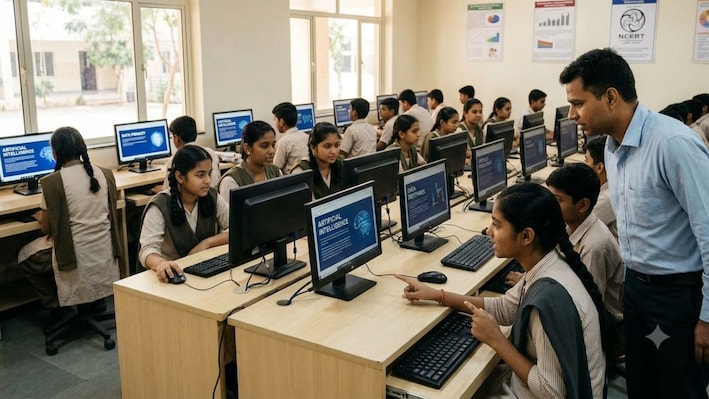
The National Council of Educational Research and Training (NCERT) has launched a 20-hour introductory course on computational thinking and artificial intelligence for students in Classes 9 to 12.
It is meant to teach students how AI actually works, how to spot misleading content, and how to use technology sensibly.
The course was prepared with input from faculty at IIT Madras, IIT Jodhpur and NCERT, and follows the National Education Policy (NEP) 2020. Students need no background in AI to follow it. The emphasis is on hands-on activities, not on memorising technical terms.
It also deals with some of the problems students already run into online: deepfakes, AI-generated misinformation, privacy risks, and the habit of trusting an AI answer without checking it.
The 20 hours are split into five units.
- AI in daily life: Students look at where AI already shows up around them, such as phone keyboards, music recommendations and other everyday apps.
- How machines learn: This unit explains how AI systems pick up patterns from training data, and why poor data leads to poor results.
- When AI gets it wrong: Students study deepfakes, misinformation and AI "hallucinations", and learn why an answer that sounds confident can still be wrong.
- Data privacy and responsible use: Topics include consent, fairness, online safety and keeping personal information protected.
- Working with AI tools: Students practise writing clear prompts, judging the responses they get, and fixing incorrect information.
A large part of the course is about the risks of AI-generated content. Students will learn what deepfakes are, meaning images, videos or audio that have been created or altered using AI, and will be encouraged to check information before they believe it or forward it.
The privacy lessons are practical. Students are warned against typing sensitive details into AI tools, including Aadhaar and PAN numbers, passwords, one-time passwords (OTPs) and personal documents.
The course is built around discussions, exercises, experiments and reflection. Schools can run the activities in three ways:
- On digital devices, used by individual students or in pairs
- Through teacher demonstrations on a shared screen
- Offline, with paper-based tasks and classroom discussion
The offline route means schools with few computers or poor internet can still cover the core activities. Students will also keep a "Curious Notebook" to note down what they observe, how they reasoned and what they thought about each lesson.
The aim is for students to use AI without relying on it blindly. Besides learning what AI can do, they are expected to catch errors, weigh the information they receive and think critically about what digital tools tell them.
Stay informed on all the latest news, real-time breaking news updates, and follow all the important headlines in india news and world news on Zee News.