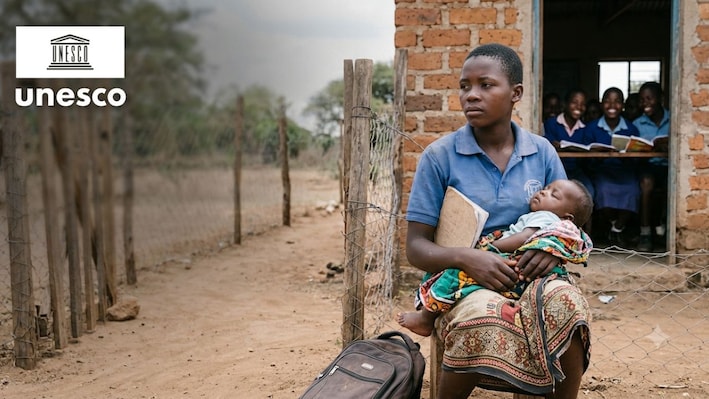
More girls are in school today than before, but early marriage and teenage pregnancy are still stopping many of them from finishing their education, according to UNESCO's 2026 Global Education Monitoring (GEM) Gender Report.
The report says social pressure, money problems and a lack of support for young mothers can cut short a girl's schooling, even in countries where education policies recognise gender equality.
Gap between cities and villages
The report finds a sharp urban-rural divide in India. Cities have reached gender parity, but in rural areas only 59 girls complete upper secondary education for every 100 boys.
The numbers show that getting girls into classrooms is only half the task. Keeping them there until they finish matters just as much.
Child marriage is falling, but unevenly
Globally, the share of girls married before 18 dropped from 25% in 2000 to 18% in 2025. The decline has not been the same everywhere. The figure is 25% in Central and Southern Asia and 31% in sub-Saharan Africa.
Marriage is the primary reason that forces girls to leave school, and pregnancy or motherhood makes it harder to return, especially when families and schools cannot offer help.
In sub-Saharan Africa, an estimated six million pregnant girls and young mothers aged 10 to 19 were out of school in 2024. Fewer than 5% of pregnant and parenting girls went back to education.
Few countries protect young mothers' right to study
Legal protection for girls has improved in many places, but the report finds a gap when it comes to pregnant students and young mothers. In 2026, 58% of countries guaranteed the right to education without discrimination on the basis of sex or gender.
Only 35% explicitly protected the right of pregnant and parenting girls to education.
Sierra Leone, Togo, Cameroon, Tanzania, the Central African Republic and São Tomé and Príncipe have lifted restrictions that kept married, pregnant and parenting girls and women out of school.
Such changes help, but scrapping a rule does not by itself bring young mothers back to class.
What keeps young mothers away
The obstacles go beyond marriage or pregnancy. The report lists several:
- Money: Transport and other school-related costs can make attendance difficult.
- Childcare: Many young mothers have no one to look after their child during school hours.
- Stigma: Negative attitudes towards pregnant students and young mothers discourage them from returning.
- Safety: An unsafe route to school can be a barrier.
- Sanitation: Schools without proper water and toilet facilities do not meet girls' needs.
The report shows Burkina Faso, where building girl-friendly schools raised enrolment by 19 percentage points overall, with bigger gains among girls.
It suggests that making schools more accessible and supportive works best alongside laws that protect girls' right to learn.
The report says girls' right to education should be protected at every stage, including during pregnancy and after they become mothers. Work against child marriage and early pregnancy needs to run alongside measures that let girls keep learning: stronger legal protection, financial aid, suitable school facilities and practical help for young mothers.
Stay informed on all the latest news, real-time breaking news updates, and follow all the important headlines in india news and world news on Zee News.