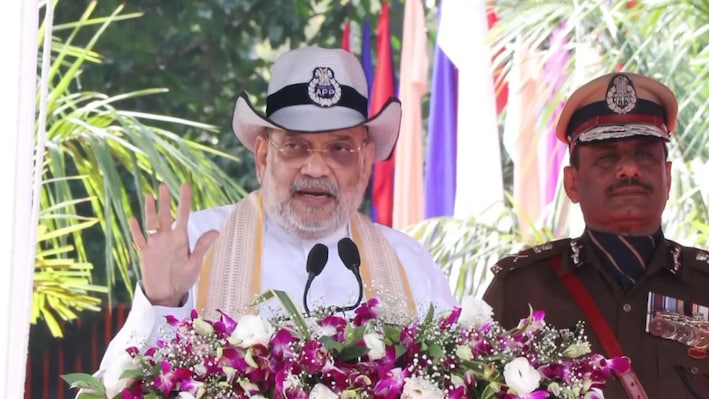
Union Home Minister Amit Shah on Saturday assured residents of Arunachal Pradesh's Siang region that concerns over proposed hydropower project would be addressed through dialogue and that they would be taken into confidence. His remarks in Itanagar came amid protests against the 11,200-MW project, with local organisations demanding an immediate halt to the preliminary surveys and greater public consultation.
Amit Shah assures Siang residents of constructive discussions
Addressing a gathering in the state capital, Home Minister Shah said he had learnt about people's concerns through media reports and other representations. Chief Minister Pema Khandu had also briefed him on the issue a day earlier, he said.
Home Minister Shah described the proposal as a national project with implications for Arunachal Pradesh's development, government revenue, India's energy needs and strategic interests.
"We will take you into confidence, and a way forward will be found through dialogue alone," he said, promising positive and constructive discussions with residents of the Siang region.
What is the Siang Upper Multipurpose Project?
The proposed Siang Upper Multipurpose Project (SUMP) envisages an 11,200-MW hydropower facility on the Siang River.
The Siang enters Arunachal Pradesh from Tibet, where it is known as the Yarlung Tsangpo, before joining other rivers to form the Brahmaputra in Assam. The Centre and the state government have said the Indian project could help generate electricity and manage variations in river flows, particularly in view of China's large hydropower project upstream.
However, residents and indigenous organisations fear that a major dam could submerge villages, affect ancestral land and farmland, and force families to relocate. They have also raised concerns about environmental damage and the safety of the proposed structure.
Siang dam protests and demands of local organisations
The opposition intensified after survey-related activities began in parts of the Siang Valley. Protests turned violent in October, with clashes between police and demonstrators and damage to a police station and an NHPC office in Pasighat. Security personnel were deployed in greater numbers, and several protesters were arrested.
Pema Khandu says Siang project needs consent of affected families
Arunachal Pradesh Chief Minister Pema Khandu had earlier said the project would not proceed without the consent of affected families. Speaking on November 16, he maintained that the proposal was still at an initial stage and that the government would consider feasibility assessments before deciding whether to go ahead.
In September, the state cabinet also formed a high-level committee to coordinate preliminary surveys and consultations with villagers in Siang and Upper Siang districts. CM Khandu has said any subsequent steps would involve further environmental assessments and arrangements for rehabilitation if the project is found feasible.
Stay informed on all the latest news, real-time breaking news updates, and follow all the important headlines in india news and world news on Zee News English.