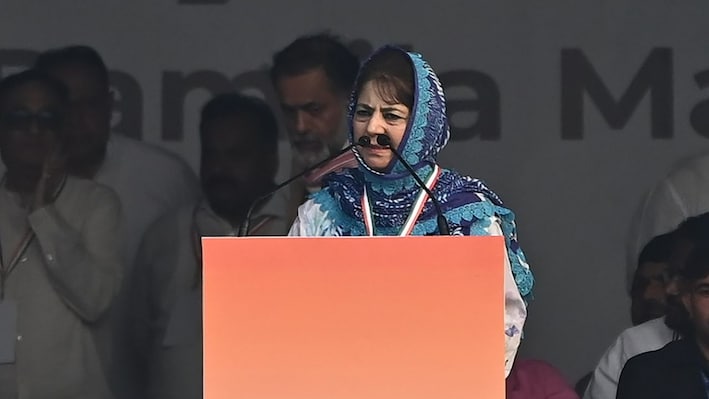
Peoples Democratic Party (PDP) president Mehbooba Mufti on Monday launched a fierce attack on the National Conference (NC) and its president Farooq Abdullah, accusing the party of double standards over its position on Pakistan and alleging that its political choices had helped create a deep trust deficit between Kashmiris and the rest of the country.
Addressing a workers’ convention at Sher-e-Kashmir Park in Srinagar to mark the PDP’s Foundation Day, Mufti took aim at Abdullah’s recent remarks suggesting that Pakistan was protecting Kashmiris by keeping the Kashmir issue alive on international platforms.
She accused the NC of sending contradictory messages by criticising Pakistan at one point and portraying it as a protector at another. Such statements, she argued, reinforced the perception that ordinary Kashmiris sympathised with Pakistan.
“Today they (NC) say Pakistan is our protector, which means an ordinary Kashmiri has sympathy for Pakistan, while just the other day they spoke against it. This is their dual standard, and because of this trust deficit ordinary Kashmiris are suffering,” Mufti said.
She held the NC leadership responsible for creating an atmosphere of suspicion around Kashmiris, tracing what she described as the roots of the problem back to 1947.
In a particularly sharp attack, Mufti described the NC as the “biggest traitor”, claiming that Jammu and Kashmir would see no improvement as long as the party continued to function in its present form.
She accused the party of repeatedly raising the issues of Pakistan, plebiscite and, later, autonomy, without delivering on those promises despite holding power and commanding around 60 MLAs at certain points.
Mufti also blamed the NC’s politics for contributing to the difficult years of militancy and accused it of using Ikhwan forces.
Recalling Sheikh Mohammad Abdullah’s role in Jammu and Kashmir’s accession to India, she said he had chosen India despite the region being Muslim-majority, placing his faith in leaders such as Jawaharlal Nehru and Mahatma Gandhi and in the country’s democratic and secular character.
She questioned how the political position shifted within a relatively short period towards Pakistan, plebiscite and separatism. In her view, this change helped turn Kashmiris into suspects in the eyes of people elsewhere in the country and provided ammunition to Hindutva forces.
Even after Sheikh Abdullah returned to mainstream politics through the 1975 accord and abandoned those slogans, she said, ordinary Kashmiris continued to bear the consequences.
Mufti contrasts her father’s approach with NC politics
Mufti contrasted the NC’s political approach with that of her father, Mufti Mohammad Sayeed, highlighting his efforts to build bridges with Delhi.
She recalled his initiatives to bring former Prime Minister Atal Bihari Vajpayee to the region, construct the Mughal Road and expand educational opportunities. His approach, she said, focused on healing rather than confrontation.
The PDP, Mufti maintained, was founded to restore the dignity and identity of Jammu and Kashmir and had never pursued a “double agenda”.
‘Why does Hindustan have so much suspicion about us?’
A recurring theme in Mufti’s address was the mistrust she said Kashmiris continued to face, even over routine expressions and gestures.
“If Mehbooba Mufti stands and says ‘Jai Hind’, they will call it Pakistan. If she says ‘Assalamu Alaikum’, they will call it Pakistan. If she says ‘Kashmir Inshallah’, they will call it Pakistan,” she said.
She questioned why Kashmiri youngsters were allegedly being harassed, officers removed from service, passports affected and land occupied. She also raised concerns over the treatment of tribal communities, including Gujjars and Bakarwals, alleging that they faced eviction and a reduction in their land rights.
Mufti specifically referred to reports of Kashmiris being targeted in Haryana and spoke of the wider sense of insecurity in a region that remains heavily militarised.
“Why does Hindustan have so much suspicion about us? Our youngsters are being beaten, Kashmiri officers are being removed from service and tribals are being evicted. This needs to be thought about,” she said.
Arguing that force and restrictions could not guarantee lasting peace, Mufti urged the Government of India to initiate meaningful dialogue with the people of Jammu and Kashmir rather than rely on coercive measures.
She pointed to public anger expressed at recent events in Delhi, including those in October, as a warning that accumulated frustration could not be contained indefinitely.
Describing the people of Jammu and Kashmir as “the crown of Hindustan”, she warned against attempts to undermine their place in the country.
“J&K ke log Hindustan ka taaj hain; unhein taaj se utarne ki koshish karoge toh khud mit jaoge,” she said, adding that Kashmiris had already made their choice and stood with India.
At Delhi rally, Mufti warns against repeating Kashmir’s experience
A day before her Srinagar address, Mufti had delivered a broader warning at the INDIA bloc’s “Vote Bachao, Desh Bachao” rally at Ramlila Maidan in Delhi.
She said Jammu and Kashmir’s experience following the 2019 constitutional changes and its conversion into a Union Territory should serve as a warning to the rest of the country.
“We, the people of Jammu and Kashmir, have been destroyed. They hollowed out the Constitution in 2019. But you should ensure they don’t make the whole country Jammu and Kashmir. We are with you,” she told the gathering.
Mufti also alleged that the Centre was transferring assets to corporate interests while neglecting the poor and unemployed. She stressed the need to safeguard the constitutional right of people to elect and change their governments.
She ended her address by invoking the patriotic song “Sare jahan se achha Hindustan hamara”.
PDP calls for unity and restoration of Institutions
Reiterating the PDP’s stated political objectives, Mufti said the party did not practise double-faced politics and sought to understand the sentiments of the people of Kashmir.
She called for efforts to repair damaged institutions, restore freedom of expression and ensure that people regained their rightful place. Urging party workers to remain courageous and united, she called for a continued struggle to form a government capable of addressing Jammu and Kashmir’s pressing problems.
Mufti maintained that peace imposed through force had its limits, warning that the “lava” of accumulated public grievances would eventually surface.
Stay informed on all the latest news, real-time breaking news updates, and follow all the important headlines in india news and world news on Zee News.