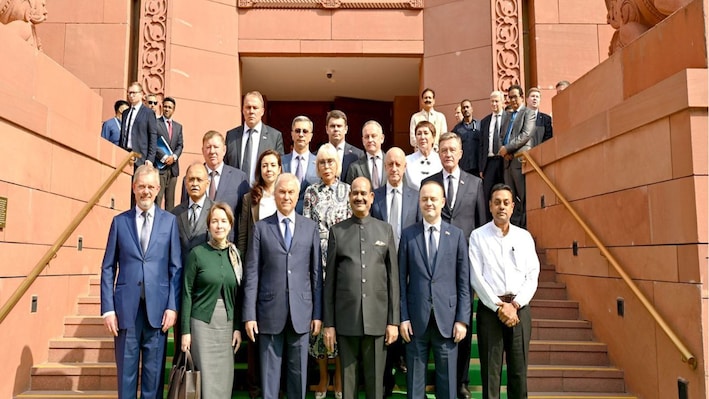
New Delhi: Parliamentary delegations from 21 countries have arrived in the Indian capital for the 12th BRICS Parliamentary Forum, where Prime Minister Narendra Modi is scheduled to meet speakers and heads of delegations on Monday (October 26). Hosted by the Parliament of India, the two-day meeting will discuss how legislatures can strengthen democratic institutions, use artificial intelligence (AI) responsibly and promote people-centric development.
The forum brings together representatives from 11 BRICS member countries and 10 partner nations. Lok Sabha Speaker Om Birla will deliver the inaugural address at the Parliament complex. The conference will conclude on October 27 with the adoption of a joint statement and the handover of the forum's chairmanship to China.
What’s BRICS Parliamentary Forum?
The BRICS Parliamentary Forum is a platform for legislators from BRICS member and partner countries to exchange views, share legislative practices and discuss issues that require cooperation between countries. It provides an opportunity for parliamentary leaders to exchange views on international challenges and ways to strengthen their institutions through dialogue and cooperation.
BRICS began as a grouping of Brazil, Russia, India and China. South Africa joined it in 2011, and it has since welcomed additional members. The bloc works to strengthen political, economic and social cooperation and increase the representation of countries from the Global South in international decision-making.
The parliamentary forum is distinct from the BRICS leaders' summit. The summit brings together national leaders and government representatives to deliberate on the grouping's overall priorities, while the parliamentary forum allows legislators to exchange views on the role of parliaments in addressing those priorities.
Why is India hosting the forum?
India is hosting the 12th edition under its BRICS chairship in 2026. The meeting gives Indian parliamentary leaders an opportunity to engage directly with their counterparts from member and partner countries on democratic institutions, international cooperation and development.
The official theme is ‘Strengthening Parliaments for People-Centric Development’. The forum will explore how legislatures can make governance more responsive to citizens, improve institutional capacity and support inclusive and sustainable development.
It also provides space for bilateral meetings along with the main sessions. These discussions allow participating countries to raise issues of mutual interest and explore opportunities for cooperation through parliamentary channels.
What will be discussed at the forum?
The conference will feature four high-level sessions on resilience, innovation, cooperation and sustainability.
The resilience session will examine the role of parliaments in strengthening institutions. The innovation session will discuss human-centred uses of AI and digital technologies, including the role of lawmakers in overseeing their development and use.
The cooperation session will address the need for a more representative system of international governance. The forum will explore ways to strengthen coordination among legislatures and make international institutions more responsive to the changing needs of countries.
The sustainability session will examine how parliaments can support inclusive development and sustainable futures.
A separate meeting of the chairpersons of parliamentary committees on international affairs will discuss parliamentary diplomacy, capacity building and the exchange of legislative best practices. The forum will also facilitate bilateral meetings and exchanges through parliamentary friendship groups.
PM Modi's meeting with delegations and India-Russia talks
The prime minister is scheduled to meet visiting speakers and heads of delegations on Monday. His meetings will provide an opportunity to exchange views with parliamentary leaders from BRICS member and partner countries.
Ahead of the forum, Lok Sabha Speaker Birla met a Russian parliamentary delegation led by Vyacheslav Volodin, chairman of Russia's State Duma, on October 25. According to the Lok Sabha Secretariat, the two sides exchanged views on parliamentary cooperation, joint efforts against terrorism and coordination at international forums.
He also called for regular exchanges between the Lok Sabha and the State Duma, including through the India-Russia Inter-Parliamentary Commission. He reiterated India's call for reform of the United Nations Security Council (UNSC) and thanked Russia for supporting New Delhi’s bid for permanent membership.
The two sides also examined areas of cooperation in nuclear energy, industry, trade, agriculture and cultural exchanges. Volodin emphasised the need to encourage joint business ventures and address obstacles to bilateral trade and investment.
Birla also met parliamentary delegations from Cuba, Egypt and Belarus.
Stay informed on all the latest news, real-time breaking news updates, and follow all the important headlines in india news and world news on Zee News.