• हिन्दीEnglishमराठीবাংলাதமிழ்മലയാളംગુજરાતીతెలుగుಕನ್ನಡଓଡ଼ିଶାZ BharatPHHBusinessWION
  • facebookyoutubetwitterwhatsapp
Zee News Hindi
  • news
  • Live Blog
  • photos
Add Zee Business As A Preferred Source
App
  • Live TV
  • Latest News
  • India
  • World
  • Entertainment
  • Sports
  • Business
  • Lifestyle
  • Astrology
  • Auto
  • Education
  • Technology
  • News
  • /India News
  • /CISF shifts to sector-specific command structure to strengthen security of critical infrastructure

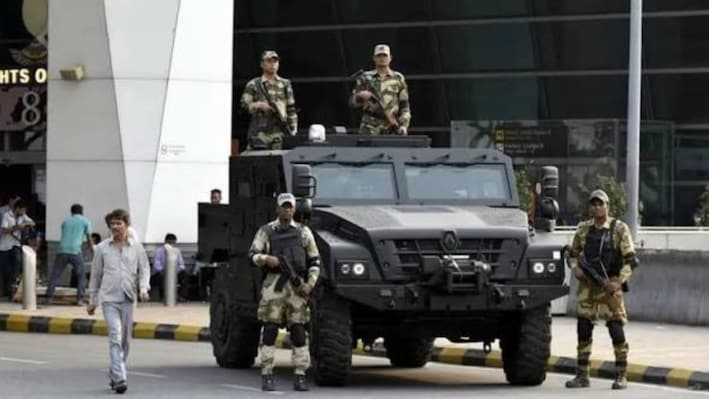
CISF shifts to sector-specific command structure to strengthen security of critical infrastructure

The restructuring, implemented with the concurrence of the Ministry of Home Affairs (MHA), came into effect on November 1. It aims to bring greater specialisation, improve coordination with different industries and make security arrangements more responsive to emerging threats.

Written ByZee Media Bureau
Published: Nov 01, 2026, 08:54 PM IST|Updated: Nov 01, 2026, 08:58 PM IST
joinshare
CISF shifts to sector-specific command structure to strengthen security of critical infrastructure

About the Author

    Zee Media Bureau

    Zee Media Bureau

    Zee Media Bureau is the editorial news desk of Zee Media Corporation, one of India’s leading news networks.The bureau represents a collective of experienced journalists, editors, and correspondents who work across television, digital, and social platforms to deliver timely, accurate, and wide-ranging news coverage. Zee Media Bureau's coverage spans politics, business, economy, technology, health, entertainment, and global affairs. The bureau follows a collaborative newsroom model, where stories are researched, verified, and published by a team. This ensures speed, editorial consistency, and adherence to journalistic standards, particularly for breaking news and developing stories.
    Read More

    Trending

    • News
    • Photos
    US midterm elections: Can Trump survive growing public anger? Why results matter for India and world

    US midterm elections: Can Trump survive growing public anger? Why results matter for India and world

    2

    India thrash Korea 8-0 to finish unbeaten in league stage, set up semi-final rematch in Asian Champions Trophy 2026

    3

    Fire breaks out at Visakhapatnam refinery after explosion sounds; no casualties reported

    4

    'Whenever a team comes out, I have expectations’: Sarfaraz Khan on missing India A tour of New Zealand

    5

    Kashmir IGP orders strengthening of security grid ahead of harsh winter

    logo
    • contact us
    • privacy policy
    • legal
    • investor info
    • advertise with us
    © 1998-2026 Indiadotcom Digital Private Limited, All Rights Reserved.

    The Central Industrial Security Force (CISF) on Sunday introduced a sector-specific functional command structure, replacing its existing territorial model to strengthen the security of India's critical infrastructure and improve operational efficiency.

    The restructuring, implemented with the concurrence of the Ministry of Home Affairs (MHA), came into effect on November 1. It aims to bring greater specialisation, improve coordination with different industries and make security arrangements more responsive to emerging threats.

    Under the earlier territorial system, a single Sector Headquarters was responsible for supervising more than 50 units across diverse sectors, including coal mines, power plants and ports. The new arrangement will organise supervision according to the type of installation, allowing commanders to develop a better understanding of sector-specific security requirements.

    New functional sectors

    Under the revamped structure, the CISF has established the following functional commands:

    • Power-I Sector in New Delhi and Power-II Sector in Kolkata
    • Coal Sector in Ranchi
    • Steel Sector in Bhilai
    • Petroleum and Natural Gas Sector in Guwahati
    • West Coast Port Sector in Mumbai and East Coast Port Sector in Chennai
    • Government Buildings, Museums and Monuments and Mass Rapid Transit System (GBMM & MRTS) Sector in New Delhi

    These sectors will join the Aviation Sectors, which have operated under the functional model since 2001, and the Department of Atomic Energy and Department of Space (DAE & DoS) Sector, which adopted the arrangement in 2018.

    With this change, the CISF will bring its supervisory structure under a unified functional model.

    Focus on emerging security threats

    The force said the restructuring was necessary to address the changing nature of threats to critical infrastructure, including drone attacks, precision weapons, cyber-attacks, sabotage and coordinated disruptions.

    It noted that even a temporary disruption to electricity generation, petroleum supplies or port operations could have far-reaching consequences for the country.

    While facilities such as refineries, coal yards and seaports require perimeter security, their operational processes and vulnerabilities differ significantly. The new structure will allow the CISF to develop security arrangements based on the specific functions of an installation and the potential impact of any disruption.

    Greater focus on technology and coordination

    The restructuring is also expected to move the force towards an intelligence-led and risk-based approach to infrastructure protection, rather than relying primarily on conventional guarding arrangements.

    Dedicated Sector Commanders will serve as points of contact for client organisations, helping improve coordination and decision-making. The sector headquarters will also focus on integrating physical security with cyber-risk management, particularly for Operational Technology and Industrial Control Systems (OT/ICS).

    Other priorities include the deployment of specialised counter-drone technologies and the development of sector-specific contingency plans to ensure the speedy restoration of operations following a security incident.

    Explaining the organisational benefits of the restructuring, CISF Director General said the new arrangement would improve coordination between multiple agencies and the managements of installations through dedicated points of contact.

    "Firstly, in a multi-stakeholder environment of our units, it will promote better inter-agency coordination and communication, especially with the respective managements, as a single point of contact from either side," the DG said.

    He added that dedicated heads for functional sectors would help reduce operational bottlenecks, leading to faster and better-informed decisions on tactical and strategic matters, as well as more effective crisis management.

    "Such a revamped structural set-up will establish a protocol of efficiency, professionalism and accountability, which are the defining benchmarks for any organisation," he said.

    The CISF said the new command structure would strengthen its ability to protect India's interconnected industrial infrastructure through specialised sectoral expertise, improved coordination and technology-driven security measures.

    Stay informed on all the latest news, real-time breaking news updates, and follow all the important headlines in india news and world news on Zee News.

    Add Zee News as a Preferred Source