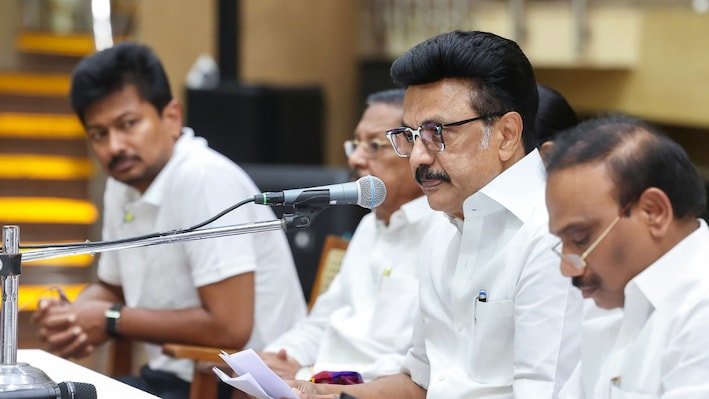

The Dravida Munnetra Kazhagam (DMK) on Saturday decided to support the revised Delimitation Bill proposed by the BJP-led Central government, subject to safeguards to protect the representation of Tamil Nadu and other states. The decision was taken at a meeting of the party’s Lok Sabha and Rajya Sabha MPs, chaired by DMK president and former Tamil Nadu Chief Minister M.K. Stalin at the party headquarters, Anna Arivalayam.
The party will support the proposal to increase the parliamentary representation of all states by 50 per cent, maintaining that the revised framework will not put Tamil Nadu at a disadvantage.
Stalin has also directed all DMK parliamentarians to attend the special session of Parliament, which begins on November 30.
Addressing reporters after the meeting, senior DMK leader and Lok Sabha MP A. Raja said the decision followed extensive deliberations and a detailed examination of the proposed amendments.
He maintained that the revised proposal would protect Tamil Nadu’s share of representation in the Lok Sabha, which is expected to rise marginally from 7.18 per cent to 7.21 per cent.
— ANI (@ANI) November 28, 2026
The DMK has consistently opposed delimitation based solely on population, arguing that states such as Tamil Nadu should not lose their share of parliamentary representation for successfully implementing family planning measures and controlling population growth.
A DMK leader, explaining the party’s position, said Stalin had been among the first to raise the demand for fair delimitation across states. The party’s stand is that Tamil Nadu’s existing share of representation must remain protected and that the freeze on delimitation based on the 1971 Census should be extended by another 25 years.
The leader also referred to two conditions outlined by Stalin: the state’s existing 7.18 per cent share of parliamentary representation should not be altered, and delimitation based on the Census should remain frozen for another 25 years.
Manithaneya Makkal Katchi (MMK) president M.H. Jawahirullah, whose party supports the DMK, said the alliance partners had discussed the proposed legislation with Stalin. He said the DMK had indicated that its support would come with conditions.
These included appointing two additional members representing individual states to the Delimitation Commission. Jawahirullah also said the DMK leadership had assured them that constituencies with a sizeable Muslim population would not be broken up through selective delimitation. He added that the recommendations of the Joseph Kurian Committee report tabled in the Tamil Nadu Assembly should also be implemented.
After the meeting, DMK MP Dayanidhi Maran said the party had consistently demanded a fair delimitation exercise and wanted the existing balance of representation among states to be maintained.
“If seats are increased by 50 per cent across the country, the situation that currently exists will continue even after the increase. No state is going to lose or gain disproportionately from this,” he said.
Maran added that the party’s demand had been accepted and that its objective was to protect the rights of southern states without allowing northern states to gain a disproportionate advantage.
He said Uttar Pradesh, Bihar and Tamil Nadu would each see a 50 per cent increase in seats under the proposed arrangement, preserving the existing balance for the next 25 years alongside the implementation of women’s reservation.
The Central government is reportedly preparing to introduce the 132nd Constitutional Amendment Bill and the Delimitation Bill during the special parliamentary session beginning November 30.
An earlier delimitation-related Bill, introduced by Union Minister Arjun Ram Meghwal in the Lok Sabha on April 16, failed to secure the requisite majority. The Centre is now reportedly preparing to withdraw the earlier legislation and bring in revised proposals.
Under the proposed framework, the maximum strength of the Lok Sabha would rise to 850 members, including 815 representatives from states and 35 from Union Territories.
Raja also rejected suggestions that the DMK’s decision was linked to its separation from the opposition INDIA bloc. Recalling that Tamil Nadu had lost two parliamentary seats following the delimitation exercise based on the 1971 Census, he maintained that the revised proposal would not put the state at a similar disadvantage.
Taking exception to criticism from the Congress, Raja said the DMK had not compromised its fundamental principles and would support Central government initiatives whenever they served the interests of Tamil Nadu. He also challenged the Congress to establish how the party had departed from its earlier ideological position.
Stay informed on all the latest news, real-time breaking news updates, and follow all the important headlines in india news and world news on Zee News English.