By Girish Linganna
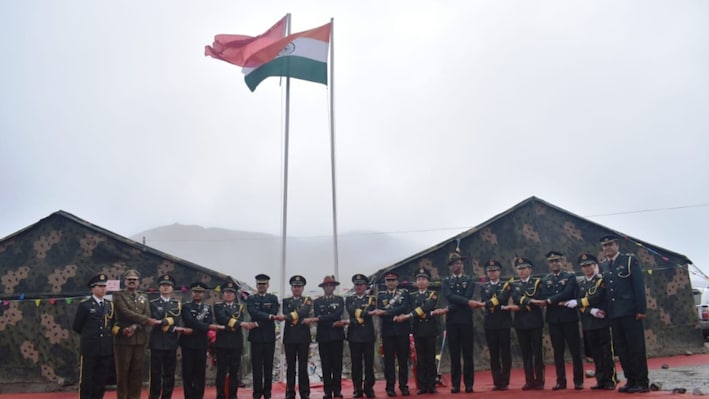
For months, villagers in the high valleys of Arunachal Pradesh whispered that their herders could no longer walk the old grazing paths near the border. Social media carried louder claims. Officialdom stayed quiet. That silence broke when Shatrujeet Kapur, Director General of the Indo-Tibetan Border Police, told an annual ceremony honouring his personnel that Indian and Chinese soldiers have been locked in tense face-offs at several points in Arunachal Pradesh since July, and that the stand-off was still on. It was the first time anyone in authority had confirmed it.
The trouble began around Taksing, a remote pocket close to Tibet. Reports said People's Liberation Army troops were blocking Indian patrols from reaching their patrolling points, the fixed spots soldiers walk to regularly to show the land is theirs, along the Line of Actual Control, or LAC, the unofficial border marking where each side currently stands because the two countries have never agreed on a formal boundary. The timing is awkward. The confrontations evidently continued even while Chinese President Xi Jinping was in New Delhi for the September BRICS Summit, a gathering of leaders from Brazil, Russia, India, China and South Africa, and even as top Army generals from both sides held their first formal peace meeting in the Arunachal sector.
Kapur, however, chose to speak of pride rather than alarm. He singled out the newly raised Shaurya commandos, an elite ITBP unit trained to fight at heights where the air is so thin that every breath is an effort and ordinary soldiers tire within minutes, for holding their ground admirably. He reminded listeners that the ITBP, born in 1962 in the shadow of war, was conceived as a mountain-fighting force working in small teams with surprise moves, and was handed the entire 3,488-km China frontier only in 2004. That frontier, he admitted, remains its hardest posting. Every border unit now has a drone team, underground shelters are being dug, and a new course called Strike, which teaches soldiers to survive and win the kind of hand-to-hand brawl seen at Galwan, will cover every ITBP member by the end of 2027.
Galwan is the memory behind all this. In June 2020, in Ladakh, Chinese troops attacked Indian soldiers with stones, nail-studded sticks, iron rods and clubs. Twenty Indian soldiers died. China admitted to four of its own, though many accounts put its losses far higher.
Kapur also spoke bluntly about drones, calling them both a danger and a gift. Matching China weapon for weapon is hard because Beijing has spent lavishly modernising the PLA. But a drone the size of a suitcase lets even a small country trouble a giant; it can watch enemy movements, collect intelligence and strike. India, he said, must use far more drones and far more anti-drone systems, the devices that spot, jam or shoot down hostile machines.
A serious shield works in layers, like a house with a boundary wall, a locked gate and an alarm. First, radars, special cameras and electronic sensors to catch drones too small for the eye. Second, jammers that scramble a drone's radio link and interceptors that physically stop it. Third, artificial intelligence that tells a drone from a bird and warns troops faster. Fourth, Indian-made drones and counter-drone gear, so spare parts never depend on a foreign supplier during a crisis. Fifth, routine training so soldiers know when to take cover and whom to call. Sixth, hardened shelters and early warning for posts, ammunition dumps and communication hubs. Seventh, reliable communication across deep valleys and brutal weather. Eighth, DRDO, research institutes and private firms building affordable kit that survives extreme cold and altitude. No single tool suffices, because some newer drones do not need constant radio signals, so ordinary jammers cannot stop them.
The politics has been fierce. In July a team from the People's Party of Arunachal, which has two MLAs, reported the Taksing blockade and rising Chinese activity in Upper Subansiri district. The government rejected the claims and reiterated that Arunachal Pradesh is and will remain an inseparable part of India. Union Minister Kiren Rijiju told India Today that China had seized no new ground, while acknowledging that local worries over lost grazing access were genuine. Congress demanded answers from Prime Minister Narendra Modi and Home Minister Amit Shah. On X, Jairam Ramesh mockingly called Modi "Vishwaguru" (world teacher), accused him of calculated compromises with China, asked what the September generals' talks had achieved, and pointed to Ladakh-style loss of patrolling points, Beijing's renaming of Arunachal towns, and a 60,000 MW Chinese dam he said threatens India's water security.
Official sources counter that no land is quietly changing hands. They recall that China, which calls Tibet Xizang and Arunachal Zangnan or South Tibet, claimed some 69,000 sq km during the 1960 boundary talks; that it attacked an Assam Rifles post at Longju in 1959 and has held and built upon that patch since; and that its 1962 offensives through Kameng, Subansiri, Siyom, Siang and Lohit ended with the PLA pulling back north of the LAC. Better roads now let Indian patrols go further, which is partly why soldiers meet more often, and such meetings, the sources insist, are usually settled through the existing border agreements and talks between officials. Last week India answered China's naming game by placing 27 Arunachal mountains, rivers and landmarks on its official map under their Indian names.\
Doklam and eastern Ladakh taught the country that these contests are long and lonely for the men who stand in them. Relations with Beijing have warmed of late. Whether that warmth reaches the frozen patrol tracks of Taksing is the question every family with a son on that line is quietly asking.
(Girish Linganna is an award-winning science communicator and a defence, aerospace and geopolitical analyst. He is the managing director of ADD Engineering Components India Pvt. Ltd.)
Stay informed on all the latest news, real-time breaking news updates, and follow all the important headlines in india news and world news on Zee News.