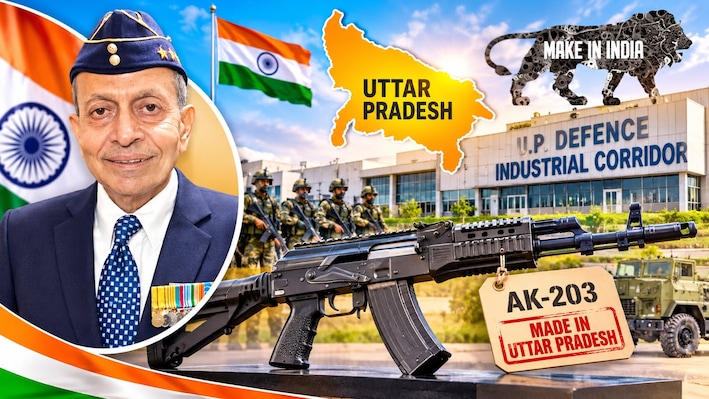
National security cannot rest indefinitely on the ability to purchase weapons from abroad. A country aspiring to strategic autonomy must possess the industrial capacity to manufacture, maintain, and progressively improve the equipment required to defend its borders. Dependence on external suppliers can expose military preparedness to geopolitical pressures, supply disruptions, and changing international equations. Self-reliance in defence, therefore, is not merely an economic ambition; it is a strategic necessity. For India, building domestic capabilities in small arms, ammunition, missiles, aircraft, and advanced systems is essential to ensuring that national security decisions remain guided by national priorities.
Indigenous defence capability also carries a significant economic dimension. Defence manufacturing generates skilled employment, encourages technological innovation, creates opportunities for domestic suppliers, and strengthens industrial infrastructure. For a state such as Uttar Pradesh, with its extensive workforce and large MSME base, becoming a dependable contributor to the country's defence requirements offers an opportunity to expand its manufacturing economy. The benefits extend beyond individual factories: a functioning industrial ecosystem can stimulate ancillary industries, deepen local supply chains, attract investment, and broaden the state's productive and revenue-generating base. Defence self-reliance can thus advance both India's security interests and Uttar Pradesh's economic aspirations.
A national mission supported by state-level commitment
The responsibility for defence preparedness rests primarily with the Union Government, which determines national procurement priorities, allocates resources, establishes strategic partnerships, oversees technology transfers, and shapes the policy framework. Yet these national objectives cannot translate into manufacturing capacity without states that are prepared to provide land, infrastructure, industrial incentives, connectivity, and administrative facilitation. The partnership between the Centre and the state illustrates this complementary relationship. The Centre establishes the strategic direction; the state works to create the industrial conditions in which that vision can be realised. This is the practical significance of Centre–State synergy under the double-engine government.
From colonial ordnance factories to a modern defense industry
India's organised arms manufacturing dates back to 1775, when the East India Company established the Board of Ordnance at Fort William, Kolkata. After Independence, the industrial base expanded, particularly following the security challenges of 1962 and subsequent conflicts. The Ordnance Factory Board eventually grew to oversee 41 production units. A major structural reform followed in October 2021, when these units were corporatised into seven government-owned, public sector defense undertakings, intended to improve autonomy, efficiency, and accountability. Alongside DRDO's research capabilities and the gradual entry of private manufacturers, this transformation has helped move the sector beyond its historical dependence on conventional production towards a more diversified industrial ecosystem.
The Modi era: From import dependence to expanding manufacturing capacity
The scale of India's progress is reflected in official production and export figures. According to the Ministry of Defense, domestic defense production increased from ₹46,429 crore in 2014–15 to ₹1,50,590 crore in 2024–25—an increase of more than three times. Defense exports, meanwhile, rose from ₹686 crore in 2013–14 to a record ₹23,622 crore in 2024–25. Thus further increased to ₹38424 crores in FY 25- 26, an increase of 62.66% from the previous year. The private sector contributed 45.16 per cent of total defense production in 2025- 26, reflecting its expanding participation alongside public-sector manufacturers. These figures represent more than an increase in industrial output: they indicate a gradual broadening of India's capacity to design, manufacture and supply equipment for its own armed forces and international partners.
The expanding manufacturing landscape encompasses ammunition, artillery, missiles, guided systems, aircraft, electronics and small arms. Public-sector enterprises such as Bharat Dynamics Limited are strengthening missile and guided-weapon production, while private manufacturers are entering ammunition, precision components, and advanced defence technologies. The objective is to develop an interconnected domestic supply chain rather than rely on isolated manufacturing facilities. The Centre government's emphasis on Make in India and Atmanirbhar Bharat has given this expansion a national framework, encouraging investment, indigenisation, and collaboration between public and private industry.
Uttar Pradesh's defence corridor: Building the industrial foundations
The present UP government's contribution becomes particularly visible in the Defence Industrial Corridor, launched following the Union Budget announcement of 2018–19. Developed through UPEIDA, the corridor spans six nodes—Lucknow, Kanpur, Jhansi, Agra, Aligarh, and Chitrakoot. Its purpose is not simply to establish factories but to create an integrated manufacturing environment supported by industrial land, road connectivity, utilities, research institutions, and streamlined clearances.
The scale of its progress is increasingly tangible. By March 2026, the state government reported investment proposals worth ₹35,526.76 crore, with 62 companies allotted land and nine units operational. Nearly 977.54 hectares had been allotted to industries from the land procured for the corridor. Kanpur had emerged as a major investment center, including Adani Defence's ₹1,500-crore ammunition facility. Aligarh is developing capabilities in electronic warfare, satellite systems, small arms and precision components, while Lucknow is advancing aerospace materials and missile manufacturing, including BrahMos Aerospace's assembly facility. Such developments demonstrate how the state government's efforts to facilitate investment are translating into a broader industrial ecosystem.
AK-203: The rifle that gives Uttar Pradesh a national defence identity
The most compelling illustration of this transformation is emerging from Korwa in Amethi, where Indo-Russian Rifles Private Limited (IRRPL), an Indo-Russian joint venture, is manufacturing the AK-203 assault rifle. Although Amethi is not one of the corridor's six designated nodes, the facility complements Uttar Pradesh's wider defence-manufacturing ambitions. The joint venture, established in 2019 with Indian partners holding a 50.5 per cent stake, represents a model of international collaboration combined with domestic industrial participation.
Under an approximately ₹5,200 crore contract signed in December 2021, IRRPL is to manufacture over 600,000 AK-203 rifles for the Indian armed forces. The weapon is intended to replace the aging INSAS rifle as a major standard infantry weapon. More importantly, the programme has moved beyond the initial stages of assembling imported components. In August 2026, IRRPL manufactured and successfully test-fired its first AK-203, named 'Sher', using entirely Indian components and input materials. The company subsequently prepared fully indigenous prototypes for Indian Army trials. This is a substantial indigenization milestone, although the rifle's final adoption and service-wide status remain subject to the requisite military evaluation and procurement process.
Yogi government's role in a larger national vision
The contribution of the Yogi government lies in recognising that national defence manufacturing requires more than political announcements. It demands sustained administrative coordination, industrial land, infrastructure, investor confidence, policy support, and an ecosystem in which smaller enterprises can become suppliers to larger manufacturers. Through UPEIDA, state-level facilitation and the development of the six corridor nodes, Uttar Pradesh is working to provide these foundations. The emergence of operational facilities, investment commitments, and MSME participation reflects the importance of this sustained effort. It is a significant contribution to the larger national mission being pursued under Prime Minister Modi.
A strategic achievement beyond one rifle
The AK-203 is therefore more than a manufacturing milestone for Amethi. It represents the possibility of an Indian defence supply chain progressively taking responsibility for equipment that the country's armed forces require. For Uttar Pradesh, it offers a powerful industrial identity: a state increasingly capable of contributing to the nation's strategic requirements while creating opportunities for investment, employment, and technological advancement. The larger achievement lies in the partnership itself—national vision supported by state-level execution, international collaboration strengthened by domestic capability, and industrial growth aligned with national security. *When India's principal infantry rifle carries the imprint of manufacturing in Uttar Pradesh, it reflects not merely the success of a factory but the promise of a more self-reliant nation and a more industrially capable state.
(The author is a distinguished former Indian Army officer and recipient of the PVSM, AVSM and VSM. He served as the Signal Officer-in-Chief and General Officer Commanding of Dakshin Bharat Area.)
Stay informed on all the latest news, real-time breaking news updates, and follow all the important headlines in india news and world news on Zee News English.