
Veteran statesman and Chairman of the J&K Dharmarth Trust, Dr Karan Singh, has strongly condemned the use of heavy earth-moving machinery to widen the Amarnath Yatra track near Sheshnag Lake, warning that aggressive road-widening projects threaten the fragile ecology of the young Himalayas.
Dr Singh’s intervention follows massive protests in Kashmir and an urgent appeal from Peoples Democratic Party (PDP) MLA from Budgam, Aga Syed Muntazir Mehdi, who wrote to the former Sadar-I-Riyasat urging him to use his influence with the Centre and the Border Roads Organisation (BRO) to halt excavation near the high-altitude waterbody.
Drawing parallels to ecological disasters in Uttarakhand, specifically the 2013 Kedarnath tragedy, Dr. Singh questioned the push to convert traditional trekking routes into motorable roads in the name of tourism and convenience.
"For many years I have been raising the disaster being caused to the Himalayas due to avoidable road widening, particularly on the pilgrim routes in Uttarakhand," Dr Singh stated. Expressing shock over reports of heavy machinery operating at a vantage point overlooking Sheshnag, he urged authorities to halt the deployment of earthmovers, adding, "We do not have to make every pilgrim route into a motorable road just for the convenience of tourists. Genuine pilgrims will not mind walking or riding towards this great shrine."
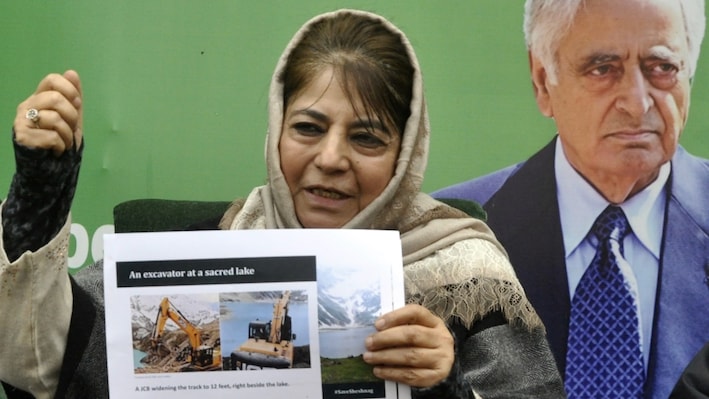
The controversy erupted earlier this week after a video went viral on social media showing JCB excavators operating and dumping earth along the slopes overlooking Sheshnag Lake, situated at an altitude of roughly 3,590 meters (approx. 11,780 feet) along the traditional Pahalgam-Amarnath axis.
Following the outcry, Budgam MLA Aga Syed Muntazir Mehdi formally appealed to Dr. Karan Singh. Highlighting Sheshnag’s dual status as both a delicate alpine ecosystem and a deeply revered site in Hindu mythology where Lord Shiva is believed to have left behind his serpents before entering the holy cave Mehdi warned that slope-cutting and heavy machinery would cause "irreparable loss" to natural terrain and water systems.
He urged Dr. Singh to press for an immediate suspension of all construction activities. The excavation has snowballed into a major political and environmental flashpoint across Jammu and Kashmir:
PDP president Mehbooba Mufti, alongside legislators Waheed Para and Aga Muntazir, attempted to visit the site earlier this week but were stopped by police at Chandanwari citing security reasons.
Environmentalists, including climate activist Raja Muzaffar Bhat, and J&K Congress chief Tariq Hameed Karra have demanded transparency regarding forest clearances and warned that Sheshnag is classified among high-risk glacial lakes vulnerable to Glacial Lake Outburst Floods (GLOFs). Meanwhile, an online petition to save the lake has crossed 11,000 signatures.
The Border Roads Organisation has pushed back against claims of a new road project, clarifying that it is merely widening and stabilising the existing pilgrimage track to ease congestion and ensure pilgrim safety, while adhering to environmental norms.
Further, J&K Forest and Environment Minister Altaf Ahmad Kaloo also maintained that the lake remains completely unharmed, stating that a 200-to-300-foot buffer separates the track from the waterbody. Meanwhile, the BJP has defended the upgrades as essential for pilgrim safety and accused opposition parties of selective activism.
With Dr. Karan Singh a towering figure in Jammu and Kashmir’s cultural and religious landscape, lending his weight to the protests, pressure is mounting on the administration to order an independent scientific review of the works before permanent damage is done to the glacial basin.
Stay informed on all the latest news, real-time breaking news updates, and follow all the important headlines in india news and world news on Zee News English.