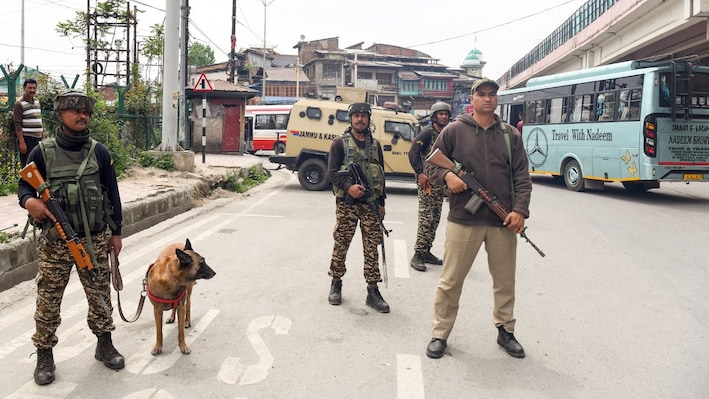
Security forces in Jammu and Kashmir have shifted their focus to dismantling the Over Ground Worker (OGW) network following the killing of the last active local Lashkar-e-Taiba (LeT) commander, Mohammad Latif Bhat, in Kulgam. With the recruitment of local youth into terrorist organisations falling to almost zero, security agencies are now concentrating on disrupting the logistical and financial networks that support foreign terrorists operating across the Union Territory.
End of an era of local terrorism in Kashmir
The killing of Lashkar-e-Taiba commander Mohammad Latif Bhat in the Jangalpora area of Kulgam, along with his associate Umar Nisar, marks a significant moment in Jammu and Kashmir's fight against terrorism.
Bhat was considered the last active local LeT commander operating in the Union Territory. His killing, following the neutralisation of Nisar, has prompted security agencies to intensify operations against the wider terror ecosystem, particularly the network of Over Ground Workers who allegedly provide logistical support to armed terrorists.
For years, counter-terrorism operations in Kashmir revolved around eliminating local terrorists, only for fresh recruits to take their place. However, according to Jammu and Kashmir Director General of Police (DGP) Nalin Prabhat, this cycle has now been broken, with the recruitment of local youth into terrorist organisations falling to almost zero.
Following the Kulgam operation, DGP Prabhat said security agencies were now targeting the entire terror ecosystem rather than limiting their operations to armed terrorists.
"In this ongoing battle, we are fighting against terrorism. Under the leadership of the Hon'ble Lieutenant Governor, we are consistently striking at its entire ecosystem. Our primary objective is to completely dismantle and eradicate this terror ecosystem. In 2025, 246 individuals were apprehended under the UAPA (Unlawful Activities (Prevention) Act). Similarly, 210 arrests have been made under the UAPA this year. Whether it involves financial aid or logistical support, those responsible cannot escape our surveillance or our reach. Regarding the attachment of properties, we have following due process of law seized assets belonging either to terrorists based in Pakistan or to other individuals involved in terrorism under the UAPA. In 2025, 155 such properties were attached, and this year, the figure stands at 122," DGP Prabhat said,
Local recruitment into terrorist organisations falls to almost zero
DGP Prabhat also highlighted the decline in the recruitment of local youth into terrorist organisations over the past two years, describing it as a significant achievement for security agencies.
"Over the last two years, we have brought the recruitment of local youth into terrorist organisations in Jammu and Kashmir to near zero. During this period, only two Kashmiri youths joined Lashkar-e-Taiba. The last of these, a terrorist named Latif, was killed in Kulgam; two days prior, another individual, Umar Nisar, was also neutralised in Kulgam," he said.
The decline in local recruitment has prompted a change in operational priorities, with security agencies increasingly concentrating on dismantling the networks that enable foreign terrorists to survive and operate in the region.
Why security forces are targeting the OGW network
Security strategists believe that eliminating armed terrorists addresses immediate threats, but dismantling their support networks is essential to ensuring long-term peace.
Intelligence reports suggest that between 15 and 30 foreign terrorists remain active in Jammu and Kashmir. They are believed to be hiding in the dense forests of North Kashmir, the high-altitude mountainous areas of South Kashmir and parts of the Jammu region.
Unlike local terrorists, foreign terrorists often lack familiarity with the region's geography, languages and routes. Consequently, their ability to remain underground for extended periods depends heavily on assistance from local facilitators.
Suspected Over Ground Worker networks allegedly provide terrorists with essential logistical support, including safe houses, food, transportation, encrypted communication devices and information about security force movements.
By targeting these support structures, security agencies aim to isolate foreign terrorists and prevent them from accessing the resources needed to sustain their operations.
UAPA arrests and property seizures intensify across J&K
To weaken the financial and logistical foundations of terrorism, the Jammu and Kashmir Police, in coordination with the Army, the Central Reserve Police Force (CRPF) and central intelligence agencies, have intensified raids, preventive arrests and investigations across the Union Territory.
According to figures cited by the DGP, 246 individuals were apprehended under the Unlawful Activities (Prevention) Act (UAPA) in 2025, while another 210 arrests have been made so far in 2026.
Security agencies have also stepped up action against properties allegedly linked to terrorism. Following due process of law, authorities attached 155 properties in 2025 and another 122 in 2026.
The action is aimed at disrupting the financial resources and safe havens available to terror operatives, including terrorists based in Pakistan who allegedly direct activities through local networks.
The crackdown also extends to individuals suspected of facilitating the movement and activities of foreign terrorists, as well as terrorists originally from Jammu and Kashmir who are currently operating from across the border.
Hundreds questioned following Kulgam security incident
Security agencies have also intensified investigations following a recent incident involving the CRPF in Kulgam, during which an individual identified as Bhat came under scrutiny.
As part of efforts to identify possible sleeper cells and their support networks, security forces questioned hundreds of suspects across South Kashmir.
The questioning is aimed at identifying individuals suspected of providing shelter, intelligence or logistical assistance to terrorists operating in the region.
Foreign terrorists remain a challenge despite decline in local recruitment
Although the killing of the last active local LeT commander is being viewed as a significant achievement, senior security officials remain cautious about declaring the threat eliminated.
Continued infiltration attempts from across the border and the presence of experienced foreign terrorists indicate that terrorism in Jammu and Kashmir has evolved rather than disappeared.
The changing security situation has therefore prompted agencies to adapt their counter-terrorism strategy. Rather than concentrating primarily on tracking down locally recruited terrorists, operations are increasingly focused on identifying foreign terrorists and dismantling the networks that help them survive.
From the Pir Panjal range in the Jammu region to the forests and mountainous terrain of Kashmir, security agencies are working to cut off access to shelter, food, funding and local intelligence.
The broader objective is to ensure that foreign terrorists are deprived of the local support systems they need to operate in Jammu and Kashmir, making it increasingly difficult for them to sustain their activities.
Stay informed on all the latest news, real-time breaking news updates, and follow all the important headlines in india news and world news on Zee News English.