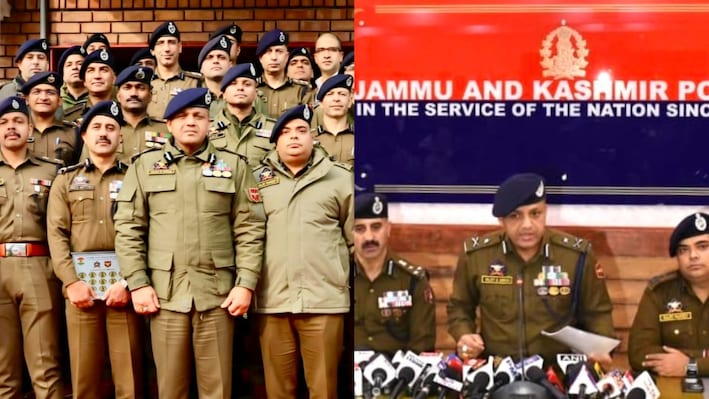
The Kashmir Zone Police has announced an integrated winter security and community outreach plan aimed at addressing seasonal security challenges while improving public trust, accountability and accessibility.
The strategy was outlined at a one-day conference on Citizen-Centric Policing and Winter Security Review, chaired by Inspector General of Police (IGP) Kashmir Zone Sujit Kumar Singh in Srinagar.
The conference brought together Range Deputy Inspectors General (DIGs) and Senior Superintendents of Police (SSPs) from across the Valley's districts.
Building on recent deliberations at police station and police post levels on SMART and beat policing, the meeting focused on two priorities: sustained action against terrorism and narcotics, and more transparent, accessible and people-friendly policing.
Winter security and counter-terror operations
With falling temperatures and approaching snowfall expected to affect infiltration patterns and movement across mountainous terrain, winter security preparedness was a key focus of the conference.
Senior officers reviewed the security situation in each district, vulnerable routes and actionable intelligence inputs.
Singh directed district SSPs to strengthen area domination and night vigilance by reviewing deployment plans, intensifying night patrolling and strengthening checkpoints along key arterial routes, inter-district boundaries and sensitive areas, including the Jhelum belt.
The measures are aimed at preventing hostile elements from exploiting harsh weather conditions to carry out activities in the Valley.
The conference also stressed the need to dismantle the support networks aiding terrorism. Officers were directed to maintain pressure on Over Ground Workers (OGWs), strengthen surveillance of released suspects and expedite legal procedures, including property attachment and financial tracking of networks supporting terrorist activities.
Singh also called for closer coordination among the Jammu and Kashmir Police, the Army, Central Armed Police Forces (CAPFs) and intelligence agencies.
Real-time intelligence sharing, supported by modern surveillance technology, was emphasised to improve monitoring of high-altitude passes and urban fringes.
Focus on narco-terror networks
The conference reviewed anti-narcotic operations across the Valley, with Singh calling for a zero-tolerance approach towards the narco-terror nexus.
Officers were directed to treat drug trafficking not only as a social menace but also as a source of funding for anti-national activities.
The focus, he said, should be on choking supply chains and identifying the kingpins behind drug trafficking networks.
District heads were instructed to shift attention from low-level peddlers to interstate and cross-border smuggling syndicates. They were also asked to seize illegally acquired properties under the NDPS Act and PIT-NDPS Act and trace financial links between drug proceeds and terror funding.
Alongside enforcement, police units were directed to expand awareness campaigns in schools, colleges and rural areas under the broader Nasha Mukt campaign.
The initiative will involve civil society groups, religious leaders and rehabilitation centres to help vulnerable young people avoid drug addiction.
Police stations to strengthen public outreach
The conference also focused on improving police-public relations and strengthening accountability at the grassroots level.
Singh called for the institutionalisation of "Police-People Policing", stressing that enhanced security measures must not come at the cost of citizens' dignity or convenience.
He said local police stations remained the primary point of contact between the administration and the public.
Beat officers were directed to maintain regular and non-intrusive contact with residents, shopkeepers, senior citizens and young people in their respective areas.
The aim is to make policing more proactive, helping officers identify and resolve local issues at an early stage while building public confidence.
Singh also directed Station House Officers (SHOs) and supervisory officers to ensure the prompt, courteous and time-bound disposal of public complaints, verification services and emergency requests.
The directive assumes particular importance during winter disruptions, when residents depend heavily on local administration for essential assistance.
Senior officers were further advised to ensure strict adherence to human rights, transparent investigation practices and courteous conduct at checkpoints and police stations.
The conference underlined that public cooperation remains essential for maintaining lasting peace in the Valley.
Singh said security and public trust were mutually reinforcing, adding that the Kashmir Zone Police would combine a strong winter counter-terror and anti-narcotic strategy with grassroots accountability and community-oriented policing.
The plan aims to ensure a peaceful, safe and resilient winter for residents across Kashmir.
Stay informed on all the latest news, real-time breaking news updates, and follow all the important headlines in india news and world news on Zee News English.