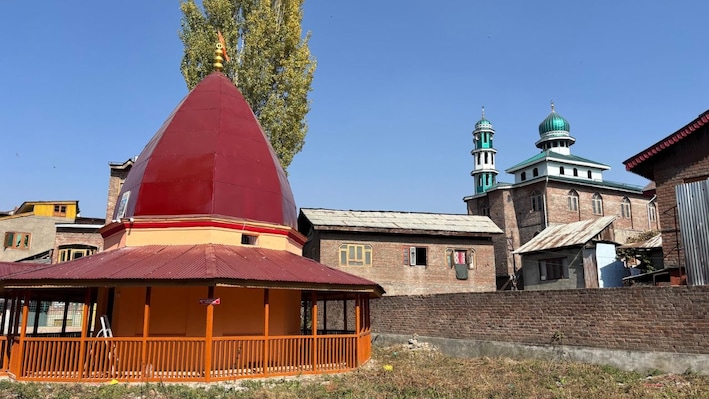
For the first time ever in Kashmir, a historic shrine is rising from decades of abandonment entirely through public resolve, completely independent of government support. The ancient Shri Durgeshwari Temple, located in Srinagar's Bana Mohalla near Fateh Kadal, has become the center of a powerful display of community revival. Dedicated to Maa Durga, the nearly 700-year-old sacred structure is being restored primarily by former Kashmiri Pandit residents, who are receiving active, hands-on support from the local Muslim families currently living in the neighborhood.
A living link to ancestral roots
Believed to have been built around 1350 during the golden reign of King Zain-ul-Abidin Budshah, the temple long served as both a revered sanctuary and a vital community institution. This spirit of inclusion dates back over a century; in 1910, local residents of all faiths came together to establish the Durga Pathshala on the temple premises, a primary school offering free education to children irrespective of their religion. For generations of Kashmiri Pandit families from Bana Mohalla and Fateh Kadal, the shrine was far more than a house of prayer, it was a living anchor to their ancestral roots, festive traditions, and collective cultural identity.
Decades of abandonment and decay
This vibrant cultural continuity was abruptly shattered after 1989, when Pakistan-sponsored terrorism gripped the Kashmir Valley. A targeted campaign of violence and killings forced around three lakh Kashmiri Pandits to flee their homeland overnight, leaving behind their houses, livelihoods, and centuries-old religious heritage. In the wake of this mass exodus, hundreds of temples across Kashmir were left deserted and slowly fell into deep ruin.
The Durgeshwari Temple was no exception to this tragedy. Over the next three decades, the sacred four-to-five-kanal premises were completely overtaken by stray dogs, roaming cattle, wild overgrown grass, and accumulating debris. For years, returning Pandits could do nothing more than offer a distant namaskar through the broken, rusted gates.
The spark of a collective movement
The turning point for the ancient shrine came about a month ago when Shashi Tickoo, a former resident, returned to his homeland and found the temple in an unrecognizable condition.
"I used to come here often," Tickoo recalled. "Every year when I came, I would just bow his head from outside with respect, offer namaskar, and leave. But this time I felt a deep ache seeing the broken gates lying on the ground, the stray animals, the garbage, and the tall grass. It came to my mind that just as we keep our own houses clean, I should clean this holy place as well. I knew that doing it alone was impossible, but as I was leaving the spot, local residents surrounded me. They said, ‘No, you go ahead and start, we will give you our full support.’ While they couldn't help much financially, they stepped forward to support me in countless other ways."
What began as one man's emotional initiative instantly transformed into a coordinated collective movement. Tickoo initially spent his personal resources to rebuild the main gates, successfully securing the temple compound. He then reached out to fellow displaced Kashmiri Pandit residents, setting up a dedicated WhatsApp network to organize logistics and pool funds.
Cross-community synergy on ground
As momentum grew, practical help poured in from the local Muslim neighborhood. Crucial water and electricity connections were swiftly secured, allowing cleaning, repairs, and structural painting to progress smoothly. To ensure long-term safety, CCTV cameras were installed across the premises, with the central control monitor intentionally set up inside an adjacent Muslim home, serving as a daily, practical symbol of the cross-community cooperation defining the project.
"Every stage of the work has fallen into place comfortably and slowly, making me feel that God Almighty is guiding our path," Tickoo shared. "The plumbing and electricity were connected without any hurdles, and small financial contributions began trickling in. However, we still need broader financial backing because most of our community elders survive on basic pensions. We haven't asked the local residents for money, as seeking financial help directly doesn't feel right. But their contribution beyond money has been invaluable. For instance, when we are painting, if you don't have water or a ladder, how do you climb to those heights? Whenever we needed a hammer, a tool, or manual help, the locals were right there."
The local residents echo this profound sense of shared ownership and nostalgic connection to the shrine.
Fayaz Ahmad, an electrician who lives a few doors away, shared his joy regarding the temple's revival: "I live nearby and have known about this temple since my childhood. Whenever I walked down this lane as a boy, I would see it bustling with activity. It used to be vibrant, with the Pandit community gathering regularly to perform their prayers. Seeing it lying abandoned and deserted for the past 20 to 30 years was painful. Now that the restoration work has started, everything feels different. It brings us immense joy to see the Pandit community coming back here to pray. It will bring peace of mind to them, and honestly, it brings peace of mind to us as well."
Reclaiming Kashmir’s Pluralistic Fabric
Alongside the physical restoration, Tickoo has actively engaged with local governance to secure the temple's future. He recently held a meeting with the Srinagar Deputy Commissioner, submitting a formal application detailing the shrine's infrastructural requirements. Furthermore, a community proposal has been put forward to develop the vacant land surrounding the temple into a beautifully landscaped public park, intentionally designed for children of all religious backgrounds to use and play together.
Today, the Shri Durgeshwari Temple is nearly ready to open its doors completely. After 37 years of silence, its bells will soon ring out once more, and the traditional sound of the conch shell will echo through the neighborhood lanes. For the displaced families of Bana Mohalla and Fateh Kadal, this initiative is not merely about repairing bricks and mortar; it is about reclaiming their dignity, recovering lost memories, and restoring a vital fragment of Kashmir’s plural cultural landscape.
The success of this project has already sparked widespread hope that similar community-led, grassroots efforts can be replicated to revive other neglected heritage sites across the Valley. If successful, these initiatives will achieve something far greater than structural preservation, they will actively heal old wounds and recover the centuries-old brotherhood that once defined Kashmir as the sacred land of Sufis and saints.
Stay informed on all the latest news, real-time breaking news updates, and follow all the important headlines in india news and world news on Zee News.