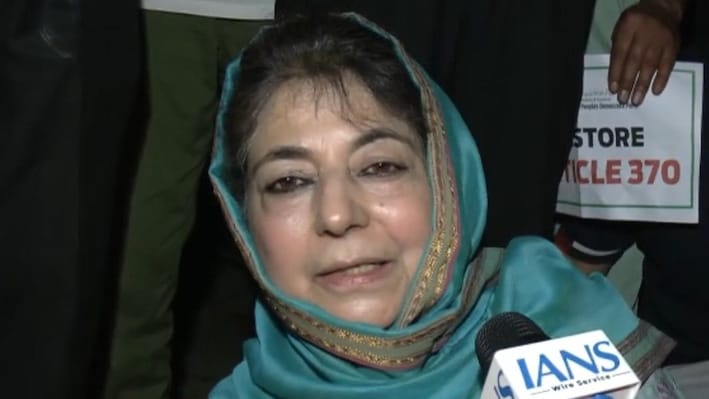
People's Democratic Party (PDP) president Mehbooba Mufti on Monday said Jammu and Kashmir's accession to India in 1947 was based on trust and assurances from the country's secular leadership, arguing that the arrangement was intended to protect the region's distinct identity rather than weaken its ties with the Union. She accused the subsequent breakdown of trust, including Sheikh Abdullah's shift towards a plebiscite demand, of fuelling suspicion about the people of Jammu and Kashmir.
Addressing party workers on Accession Day, Mufti recalled the historical circumstances surrounding October 26, 1947, when Maharaja Hari Singh signed the Instrument of Accession. She said the endorsement of the decision by Sheikh Abdullah, then the region's most popular leader, had reassured people that India did not intend to impose its will on Jammu and Kashmir.
Mufti said the accession was conditional and aimed at safeguarding the region's culture, land, employment and political identity. She said Articles 370 and 35A later reflected those safeguards, which she claimed had been supported by assurances from leaders such as Jawaharlal Nehru.
“We don’t know what went wrong that Sheikh Abdullah went against it by 1953 and to counter him RSS started one national one constitution campaign,” she said.
“Kashmir is highest militarized area today and it is result of the mistrust that arose after Sheikh Abdullah’s plebiscite campaign. BJP is trampling the constitution that gave us 370 across the country. I don’t have faith in courts and government but have faith in people of India.”
She said restrictions on protests and the presentation of what she called “enforced peace” as a political victory should concern the rest of the country.
“We are not allowed to protest on the streets, and BJP is projecting the ‘enforced peace’ as the victory. It is a warning for the whole country and today we want to remind the people of India of the promises made to the people of J&K. Today we celebrate the day we joined a great nation, but people of India should also fulfil their end of the bargain,” Mufti said.
Mehbooba Mufti Revisits 1947 Accession
Recounting the events leading to the accession, Mufti said the partition of British India had largely followed religious lines, with some Muslim-majority princely states joining Pakistan and Hindu-majority states acceding to India. She referred to Hyderabad to argue that the wishes of a ruler could not automatically override those of the majority population.
She said Pakistan had expected Muslim-majority Jammu and Kashmir to join it but made a “historical blunder” by sending tribal invaders into the region.
“A very big attack took place on the people of Jammu and Kashmir at that time, because the people of Jammu and Kashmir wanted to take their decision after thinking carefully. As a result, the Maharaja requested the Indian government that we confront this invasion that has taken place,” she said.
Mufti said India's leaders at the time, including Mahatma Gandhi, Jawaharlal Nehru, B R Ambedkar, Maulana Abul Kalam Azad and Sardar Vallabhbhai Patel, believed the country should remain secular, with people of different religions living together.
She said the Indian leadership had insisted that the accession would not be complete without the endorsement of Jammu and Kashmir's popular leadership. Sheikh Abdullah's support, she argued, helped reassure people that their identity and sentiments would be respected.
According to Mufti, Jammu and Kashmir's diverse population, including Hindus, Muslims, Sikhs and Christians, had a distinct mixed culture that needed protection. She said the conditions attached to the accession were intended to preserve that identity and prevent outsiders from buying land or taking local jobs.
“An Instrument of Accession was signed, which you are seeing, so that outsiders should not come and buy our land for a song, because our land is very limited, our land holding is very small,” she said.
She added that local employment also needed protection because the region's education system at the time did not place its people on an equal footing with those from outside.
Mufti said Jammu and Kashmir had joined India with trust and recalled Nehru's vision of making the region a “show-window” for the world.
“Jawaharlal Nehru said, ‘I want to make Jammu and Kashmir a show-window, a window for the world, so that the whole world keeps looking at it,’” she said.
Accuses Sheikh Abdullah's Plebiscite Campaign of Deepening Distrust
Mufti said relations between Sheikh Abdullah and the Centre deteriorated in the years following accession. She alleged that Abdullah's later demand for a plebiscite, and his statements favouring Pakistan, gave Hindutva groups an opportunity to intensify their campaign for “one nation, one flag, one constitution”.
She argued that Abdullah's change in position had consequences for the people of Jammu and Kashmir, who, she claimed, came to be viewed with suspicion for decades.
Although Sheikh Abdullah returned to the political mainstream through the 1975 Accord and abandoned the plebiscite demand, Mufti said that suspicion had continued.
“You have seen if you look today, Jammu and Kashmir is the area in the whole world that has the highest militarization. There are seven or eight lakh soldiers here, security forces, CRPF, BSF and so on,” she said.
Mufti cited police raids, arrests, restrictions on movement and blocked passports as examples of the difficulties faced by residents. She also referred to reports of Kashmiri people being assaulted in Haryana and alleged that young people continued to face obstacles when seeking employment and education outside the region.
She criticised the heavy security presence, saying journeys that should take an hour could stretch to three hours because of checkpoints and security deployments.
“Meaning, even after so many years, Jammu and Kashmir is still in trouble, and the biggest thing about Jammu and Kashmir is that the talk of Jammu and Kashmir happens everywhere,” she said.
Mufti also criticised the way Kashmir is discussed at international forums and during elections elsewhere in India. She argued that meaningful political engagement had been replaced by investigations, arrests and laws such as the Unlawful Activities (Prevention) Act (UAPA) and the Public Safety Act (PSA).
She alleged that the region's political concerns were being addressed through security agencies and restrictions rather than dialogue.
‘2019 Changes Fulfilled Hindutva Agenda’, Says PDP Chief
Mufti said the abrogation of Article 370 in August 2019 had fulfilled what she described as the Hindutva agenda and had been followed by further restrictions and difficulties for the people of Jammu and Kashmir.
She accused the BJP of dismantling constitutional protections and said she had little expectation that the current government would restore them. However, she appealed to people across India to take note of what she described as the treatment of Kashmiris.
Referring to incidents on July 22 and October 10, she alleged that young people had faced violence and that thousands had been detained or made to furnish bonds. She said restrictions on peaceful protests had become routine since 2019.
“We cannot even come on the roads to do peaceful protest. We are forbidden from going out, we are forbidden from speaking. And the BJP considers this silence as peace; it considers it as normalcy. It is not normalcy; this is terror, the taste of which the entire country is now experiencing,” she said.
Mufti said her message on Accession Day was intended to remind Indians that Jammu and Kashmir, despite being Muslim-majority and home to different religious and cultural communities, had chosen to join India.
She urged the Centre to honour the assurances given at the time of accession and said the region's people were entitled to dignity, constitutional rights and a political relationship based on mutual trust.
Appeals to Centre to Follow Vajpayee's Approach
In her concluding remarks, Mufti appealed to the Centre to follow the approach of former Prime Minister Atal Bihari Vajpayee, who had described Kashmir as a human problem requiring a humane response.
“The land is with you, but please try the way Atal Bihari Vajpayee had thought that this is a human problem. Here one will have to work with humanity. One will have to work with democracy; one will have to work with Kashmir,” she said.
She warned that increasing the number of security personnel would not resolve the region's political problems and said the situation should serve as a warning to the rest of the country.
Mufti reiterated that Jammu and Kashmir had joined India under the leadership of figures such as Gandhi, Nehru and Ambedkar, whom she described as advocates of equal rights and secularism.
She urged Indians to remember the promises made at the time of accession and called on the government to end what she described as oppression in the region.
“Do not drag it, it by holding its arm rather hold its hand and teach it to walk with you,” she said.
Stay informed on all the latest news, real-time breaking news updates, and follow all the important headlines in india news and world news on Zee News.