Dr. Ashish Pathak
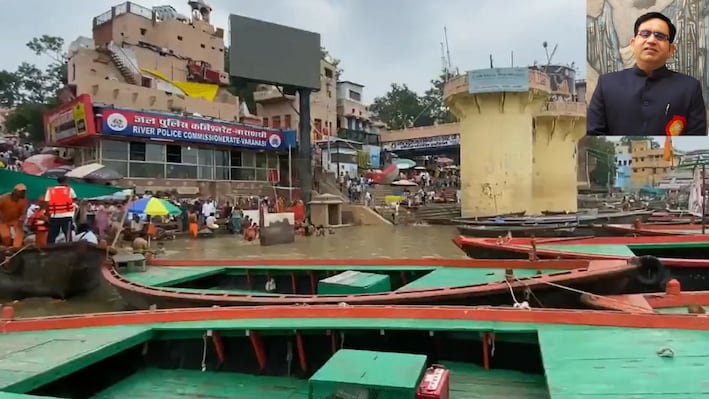
Varanasi is not being treated as a privileged exception. It is being used as a dense, high-footfall laboratory in which multiple transport modes long-distance rail, urban ropeway, inland waterway and last-mile services are being layered onto the same urban geography. The city’s combination of continuous pilgrim movement, narrow historic streets, riverfront activity and growing commercial traffic makes it a severe test of whether new-age connectivity can reduce congestion without simply adding more vehicles. The same logic that places a Vande Bharat Sleeper on the Delhi–Varanasi axis also places a ropeway over the old city and expands multimodal terminal capacity on the Ganga: each intervention addresses a different distance and density problem.
Overnight rail as a deliberate corridor, not a spectacle
The original Vande Bharat service of February 2019 already linked New Delhi and Varanasi over roughly 759 kilometers. The subsequent introduction of the Sleeper variant on the same axis extends that experiment to overnight travel. Unlike daytime chair-car services, the Sleeper is configured for longer journeys with three air-conditioned classes, automatic doors, CCTV, fire detection and Kavach. Its design capacity of 823 passengers per formation and reported introductory fares in the range of ₹2,300–3,600 (including catering on the inaugural route) signal an attempt to offer a more predictable alternative to conventional overnight trains. Nationally, the wider Vande Bharat network has carried more than 9.1 crore passengers cumulatively and 3.98 crore in FY 2025–26; the Varanasi corridor is one of the routes repeatedly cited for strong demand. The point is not volume for its own sake. It is whether reduced travel time and higher reliability can shift a measurable share of the Delhi–Varanasi traffic away from mixed road and conventional rail options, particularly for pilgrims, students and traders who currently absorb long and uncertain journeys.
Layering modes for different scales of movement
The rail upgrade sits alongside other interventions that operate at different distances. The Varanasi urban ropeway, still under construction and reported at 94–95 per cent completion in September 2026, is designed for roughly 3,000 passengers per hour per direction with a proposed fare of ₹50. Its purpose is not long-distance travel but the relief of internal congestion in a city whose core streets cannot absorb unlimited motorized traffic. Parallel investment in National Waterway-1, which runs through the Varanasi region, has raised cargo on that corridor from 5.05 million metric tonnes in 2014–15 to 16.38 million metric tonnes in 2024–25. The Varanasi Multimodal Terminal is intended to link river movement with road and rail; separate commitments of ₹1,350 crore for inland-waterway and river-cruise infrastructure in Uttar Pradesh (part of wider Ganga-related memoranda exceeding ₹6,000 crore) point to both freight and tourism uses. Nationally, National Waterways carried 10.56 crore passenger movements and 218.24 million metric tonnes of cargo in FY 2025–26, but these aggregates cannot be attributed solely to any single city. The Varanasi-specific elements matter because they test whether river capacity can absorb bulk goods and tourist circuits without further loading the city’s roads.
Last-mile options are also being added. Bharat Taxi, the cooperative-owned platform launched in 2026 with a zero-commission model for in-app rides, has begun driver onboarding in Lucknow and is part of a phased national expansion. In a city whose visitors include large numbers of non-local pilgrims and tourists, such services can, in principle, reduce dependence on unorganized intermediate public transport once the longer-distance modes deposit passengers at terminals or airports. None of these projects is yet fully mature; the ropeway remains non-operational as of early November 2026, and audited project-wise revenues for most of the new models are not publicly available. Their combined logic, however, is visible: different technologies for different trip lengths, rather than a single infrastructure solution.
State facilitation and the transferable test
Land acquisition, title clearance and local coordination remain the practical bottlenecks for any central transport project. Uttar Pradesh’s role has been to complete these steps for rail, waterway and urban projects so that construction can proceed. The political weight of the state makes such facilitation consequential; without it, central schemes stall regardless of their technical design. The resulting network is not limited to residents of Uttar Pradesh. Pilgrims, traders and tourists whose commitments are tied to Kashi but who originate elsewhere are also users. That is why the same corridor logic is being examined for other high-footfall cities: the time spent on land processes, the sequencing of modes, and the observed behaviour of passengers in Varanasi can shorten learning curves elsewhere.
What can be measured so far
The measurable gains remain partial: travel time and reliability on the Delhi–Varanasi rail axis have improved relative to older services, cargo on National Waterway-1 has more than tripled since 2014–15, and the ropeway’s design capacity is known though its effect on street congestion will be clear only after commercial operations begin. National aggregates indicate direction rather than local attribution, and financial sustainability is still an open question, since passenger growth does not automatically produce operating surpluses. What has made the layered experiment possible in practice is the coordination between the Centre and the state.
Land acquisition, title clearance, payment settlement and local facilitation tasks that routinely stall central infrastructure projects have been completed by the Uttar Pradesh government under Yogi Adityanath so that railway, waterway and urban works can proceed. This is the concrete content of the double-engine arrangement: the Centre supplies the policy framework, technology and capital, while the state supplies the ground-level execution that allows those inputs to become usable infrastructure.
The resulting network serves not only residents of Uttar Pradesh but also the large number of pilgrims, traders and visitors whose commitments are tied to Kashi yet who originate elsewhere. Whether the combination ultimately reduces total travel time and street-level pressure, or merely adds under-utilized parallel systems, will determine if Varanasi functions as a transferable template. Either result will be more instructive than treating any single project as an isolated demonstration.
(The author is a professor at Banaras Hindu University, and writes on contemporary issues. The views expressed in this article are those of the author and do not necessarily reflect those of Zee News.)
Stay informed on all the latest news, real-time breaking news updates, and follow all the important headlines in india news and world news on Zee News.