• हिन्दीEnglishमराठीবাংলাதமிழ்മലയാളംગુજરાતીతెలుగుಕನ್ನಡଓଡ଼ିଶାZ BharatPHHBusinessWION
  • facebookyoutubetwitterwhatsapp
Zee News Hindi
  • news
  • Live Blog
  • photos
Add Zee Business As A Preferred Source
App
  • Live TV
  • Latest News
  • India
  • World
  • Entertainment
  • Sports
  • Business
  • Lifestyle
  • Astrology
  • Auto
  • Education
  • Technology
  • News
  • /India News
  • /Why India’s next war drone could be useless in 14 days: The lethal lesson from Ukraine

Why India’s next war drone could be useless in 14 days: The lethal lesson from Ukraine

In the Russia-Ukraine war, drones become obsolete in weeks. Here is why Ukraine's fast battlefield adaptation and Russia's mass production offer a wake-up call for India's defense sector.

Written ByZee Media BureauEdited ByTarique Anwar
Published: Oct 14, 2026, 03:37 PM IST|Updated: Oct 14, 2026, 03:53 PM IST
joinshare
Why India’s next war drone could be useless in 14 days: The lethal lesson from Ukraine
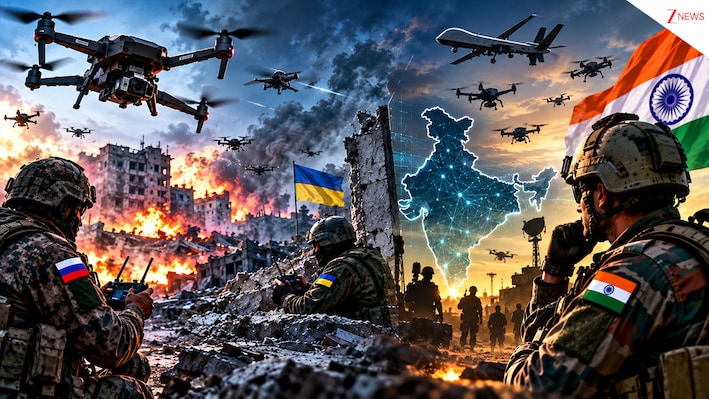
Image Credit: The war between Russia and Ukraine, which began with Moscow’s full-scale invasion in February 2022, has turned military innovation into a contest between combat troops, technology developers and factories. (Photo: AI)

About the Author

    Zee Media Bureau

    Zee Media Bureau

    Zee Media Bureau is the editorial news desk of Zee Media Corporation, one of India’s leading news networks.The bureau represents a collective of experienced journalists, editors, and correspondents who work across television, digital, and social platforms to deliver timely, accurate, and wide-ranging news coverage. Zee Media Bureau's coverage spans politics, business, economy, technology, health, entertainment, and global affairs. The bureau follows a collaborative newsroom model, where stories are researched, verified, and published by a team. This ensures speed, editorial consistency, and adherence to journalistic standards, particularly for breaking news and developing stories.
    Read More

    Trending

    • News
    • Photos
    'Don't know what cricket he was playing': Abhishek Sharma reacts to Yuvraj Singh's playful dig after 113-run carnage

    'Don't know what cricket he was playing': Abhishek Sharma reacts to Yuvraj Singh's playful dig after 113-run carnage

    2

    Hockey Asian Champions Trophy 2026: India make dominating start to title defence with 13-0 win over Bangladesh

    3

    Commonwealth Kabaddi Championship 2026: Indian men storm into semifinals with 48-20 win over Tanzania

    4

    AI bubble warning: Microsoft swings axe on 60,000 jobs as sector losses mount

    5

    IPL 2027: Zaheer Khan set for crucial meeting with MS Dhoni before CSK retention deadline

    logo
    • contact us
    • privacy policy
    • legal
    • investor info
    • advertise with us
    © 1998-2026 Indiadotcom Digital Private Limited, All Rights Reserved.

    New Delhi: A military drone can become outdated within weeks on the battlefields of Ukraine. A new design appears, soldiers test it in combat, the enemy finds a way to counter it and manufacturers must return to the drawing board. The cycle has become so fast that the ability to produce the next version is as important as the weapon in use on the battlefield.

    The war between Russia and Ukraine, which began with Moscow’s full-scale invasion in February 2022, has turned military innovation into a contest between combat troops, technology developers and factories. The experience offers lessons for India, where the ability to produce equipment at scale and respond to battlefield feedback will be crucial to preparing for future confrontations.

    An analysis by the Carnegie Endowment for International Peace describes how Ukraine has developed a system in which operational experience feeds directly into military technology and production. The traditional process of setting requirements, inviting tenders, developing equipment, conducting trials and inducting it into service can take years. Rapidly changing combat conditions leave less time for such lengthy cycles. 

    Battlefield, a testing ground

    Ukraine’s use of drones shows how fast military requirements can change. Small unmanned aircraft are used for surveillance, target identification, attacks and interception. Their performance also depends on how effectively they can operate against electronic interference and the enemy’s countermeasures.

    According to data cited in the analysis, Kyiv was producing around 1,500 interceptor drones a day by January 2026. Ukraine’s former Commander-in-Chief General Oleksandr Syrskyi has said Russia plans to manufacture approximately 20,000 drones everyday. These estimates refer to different production categories and should not be treated as a direct comparison of equivalent systems.

    The scale of production is important because drones are frequently lost during operations, while changes in battlefield tactics can reduce the usefulness of existing designs. Armies need a continuous supply of replacements and the ability to introduce improved versions without waiting for an entirely new procurement cycle.

    Ukraine has also built a digital system to connect battlefield activity with military planning. Its Delta platform combines information from drones, intelligence sources, sensors, satellites and reports from personnel into a shared operational picture. This helps commanders track developments and pass useful information to units making decisions on the ground. 

    Soldiers are part of design process

    Ukraine’s approach depends on direct communication between combat units and the people developing their equipment. Some units have repair facilities, small production workshops and teams that test modifications to existing systems. Volunteer groups and civilian technology specialists also contribute to the process.

    This allows lessons from one engagement to reach developers and manufacturers without having to pass through several layers of administrative approval. A component that fails in combat can be replaced, while a design that performs well can be modified and produced in larger numbers.

    The industrial structure has also become more flexible. Small production facilities can operate at different locations and reduce dependence on a single factory. The model offers some protection against attacks on manufacturing infrastructure and can bring assembly and repairs closer to the troops who need them.

    The lesson is that a weapon’s performance depends on the system supporting it. Production capacity, access to components, maintenance and the speed at which manufacturers receive feedback all influence how long a technological advantage lasts.

    Russia’s system of adaptation

    Moscow’s experience shows a different route to the same destination. Its initial invasion of Ukraine in February 2022 exposed problems with planning, coordination and the ability of lower-level commanders to respond to unexpected developments.

    It subsequently increased its defence production and studied battlefield experience to improve its equipment and tactics. Dara Massicot, a senior fellow at the Carnegie Endowment for International Peace, has examined the country’s efforts to learn from its failures and change how its forces operate. Her research describes a military that has adapted its methods during the war and invested in the industrial capacity needed to support those changes. 

    Russian forces have increased their use of Geran attack drones, first-person-view drones and fibre-optic models. Fibre-optic drones use a physical cable to transmit control signals and video to make them less vulnerable to some forms of radio-frequency jamming. 

    Their deployment illustrates how the spread of electronic warfare has encouraged the development of alternative ways to control unmanned systems.

    Moscow’s experience also shows how large-scale manufacturing can support military adaptation once a requirement has been identified. Standardised designs and production lines allow the armed forces to replenish stocks and deploy modified equipment across multiple units.

    What India needs to change

    India needs better coordination between its armed forces, defence labs, private manufacturers and technology start-ups. The country has built up its domestic drone industry and introduced programmes to encourage defence innovation. 

    In March 2026, the Ministry of Defence (MoD) said that 676 start-ups, micro, small and medium enterprises and innovators had joined the defence innovation ecosystem through the Innovations for Defence Excellence programme. It also announced procurement clearance for 58 prototypes worth Rs 3,853 crore.

    The next step proposed in the analysis is a system that collects information from actual operations and uses it to improve equipment. A joint programme involving the MoD and industry could build a drone-performance database, documenting successful interceptions, equipment failures and the conditions in which systems were used.

    Such a database would need to feed into military command structures so that lessons from operations could guide product development and procurement. It would also help manufacturers identify which systems require immediate modification and which are ready for larger orders.

    The proposal also calls for an organisation dedicated to autonomous operations under theatre commanders, along with changes to procurement rules. India’s planned theatre-based command structure is intended to improve coordination among the services. Integrating unmanned systems into this structure would require defined responsibilities for their deployment, maintenance, data collection and technical upgrades.

    Integrating unmanned systems into this structure would require defined responsibilities for their deployment, maintenance, data collection and technical upgrades. Equipment that performs well in one setting may need changes before it can be used effectively elsewhere. The Army’s recent procurement of 225 first-person-view drones after high-altitude trials illustrates the need to test systems in the conditions in which they may be deployed.

    Integrating unmanned systems into this structure would require specific duties for their deployment, maintenance, data collection and technical upgrades. The aim is to reduce the time between identifying a battlefield requirement and delivering equipment that meets it.

    Stay informed on all the latest news, real-time breaking news updates, and follow all the important headlines in india news and world news on Zee News.

    Add Zee News as a Preferred Source
    TAGS:
    India Drone Warfare
    Russia Ukraine War
    Military Drone Technology
    Indian Defence Procurement