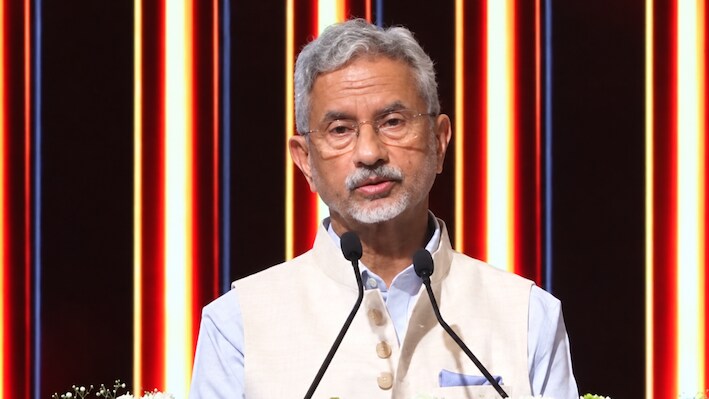
External Affairs Minister S Jaishankar on Sunday called on the United Nations to lead amid global conflicts and push forward long-pending structural reforms, warning that the international community cannot afford to remain a ‘passive observer’ as wars in Ukraine and West Asia disrupt economies and affect people far beyond the battlefields.
Speaking at the Chinmaya Amrit Mahotsav Global Sammelan on “Non-Dualism for World Understanding” at Bharat Mandapam on the occasion of United Nations Day, EAM S. Jaishankar called for reformed multilateralism, stressing that the global governance system must reflect the realities of the contemporary world and give developing nations a greater role in decision-making.
Jaishankar said the founding of the United Nations after the Second World War reflected a collective decision to prioritise cooperation over competition among nations.
He noted that the debate between countries pursuing their individual interests and those seeking collective solutions had long shaped international relations.
The UN’s establishment 80 years ago was an expression of the world’s commitment to working together, he said.
“Humankind has witnessed perpetual arguments between those who stress competitiveness and others who see a virtue in cooperation. These may be individual or even societal predicaments, but on the global stage, they translate into how nations behave with one another. The collective and cooperative instincts of the world were articulated, were expressed eight decades ago in the founding of the United Nations. It is fitting, therefore, that we gather to advance a sense of oneness as we celebrate the UN Day. After all, whether it is the challenges or the opportunities that confront the world, these can be best, most effectively addressed collectively,” the External Affairs Minister said.
Highlighting the consequences of ongoing conflicts, Jaishankar pointed to the wars in Ukraine and West Asia, saying their economic fallout was being felt well beyond the regions directly involved.
People and economies with little influence over the course of these conflicts are bearing the costs, including through higher fuel and food prices and wider economic disruption, he said.
“There are today two major conflicts going on in the world: in Ukraine and in West Asia or the Middle East. Societies and economies, peoples far away, who have little say in the matter, are actually paying the cost. We cannot remain helpless spectators,” Jaishankar said.
He reiterated India’s position that dialogue and diplomacy, rather than military action, offered the way towards resolving conflicts. India is making its own efforts to promote peace and remains willing to work with other countries towards that objective, he added.
“India expresses global sentiment when we urge that dialogue and diplomacy are the only solution. We are making efforts ourselves and are open to working with other partners to that end,” Jaishankar said.
#WATCH | Delhi: At the Chinmaya Amrit Mahotsav Global Sammelan on UN Day, EAM Dr. S. Jaishankar says, "... There are today two major conflicts going on in the world: in Ukraine and in West Asia or the Middle East. Societies and economies, peoples far away, who have little say in the matter, are actually paying the cost. We cannot remain helpless spectators. India expresses global sentiment when we urge that dialogue and diplomacy are the only solution. We are making efforts ourselves and are open to working with other partners to that end..."
— ANI (@ANI) October 25, 2026
Jaishankar also called for an overhaul of international decision-making institutions, including the United Nations Security Council, arguing that the existing framework could no longer justify excluding large parts of the developing world.
He said the need for reform was becoming increasingly pressing as countries, particularly those belonging to the Global South, continued to remain underrepresented in global governance.
“We live in an imperfect world, but we all continuously strive towards greater perfection. Where the UN is concerned, that means recognising its shortcomings and limitations, and seeking its improvement. The case for reformed multilateralism gets stronger by the day. Large parts of the world cannot be left out of decision-making,” he said.
EAM stressed that recognising the UN’s limitations must go hand in hand with efforts to improve its functioning and strengthen international cooperation.
He called on the organisation to take a more active role in addressing global challenges rather than remaining a bystander as conflicts escalate.
“On this occasion, even as we recognise the need for such long-awaited changes, let us renew our commitment to work together. We are common, we are shared, we are united,” Jaishankar said.
Observed on October 24, United Nations Day commemorates the anniversary of the UN Charter entering into force in 1945. The organisation formally came into existence after the founding document was ratified by a majority of its signatories, including all five permanent members of the Security Council.
The UN was established with the stated aim of preventing future generations from experiencing the devastation of war. Its founding charter opens with a commitment to “save succeeding generations from the scourge of war”.
Eight decades later, however, questions remain over whether its institutional structure can effectively address contemporary conflicts.
The Security Council remains dominated by the five permanent members, the United States, the United Kingdom, France, Russia and China, reflecting the balance of power that emerged after the Second World War.
Rising powers such as India, Brazil, Japan and South Africa remain outside the permanent membership, despite representing a substantial share of the world’s population. This imbalance has weakened the council’s legitimacy and its ability to respond effectively to international crises.
The veto power held by each permanent member presents another obstacle. A single permanent member can block a resolution, preventing the council from taking action even when other members support it.
The UN also depends on member states for troops and funding, leaving its operations vulnerable when countries withhold financial contributions or refuse to provide resources.
The limitations of the system have become increasingly apparent during conflicts in recent years.
When Russia’s war against Ukraine began, the international community looked to the Security Council for a response. In Gaza, resolutions calling for an immediate ceasefire were blocked by the United States, while alternative drafts were blocked by Russia and China. As the council remained divided, the conflict continued.
The UN has also struggled to respond effectively to the civil war in Sudan, the military takeover in Myanmar and the Taliban’s return to power in Afghanistan.
As the organisation’s ability to secure agreement among major powers has weakened, countries have increasingly pursued security cooperation through smaller groupings outside the UN framework, including the Quad, AUKUS and the Shanghai Cooperation Organisation (SCO).
Renewed rivalry among major powers has further complicated the Security Council’s work, making consensus increasingly difficult. The UN Secretary-General, once seen as a potential global mediator, has often been left issuing statements that member states are not obliged to follow.
Concerns have also grown over the disregard for international humanitarian law, with UN schools in Gaza, peacekeepers in Lebanon and other UN facilities coming under fire.
Financial constraints have added to the organisation’s difficulties. Major powers have withheld dues as leverage, leaving peacekeeping missions and humanitarian agencies struggling to maintain operations.
The challenges facing the UN have raised questions about its capacity to fulfil the purpose for which it was established in 1945. Jaishankar’s remarks on UN Day underscored India’s call for an organisation that can respond more effectively to global crises rather than remain a helpless spectator to the conflicts it was created to help prevent.
(with ANI inputs)
Stay informed on all the latest news, real-time breaking news updates, and follow all the important headlines in india news and world news on Zee News.