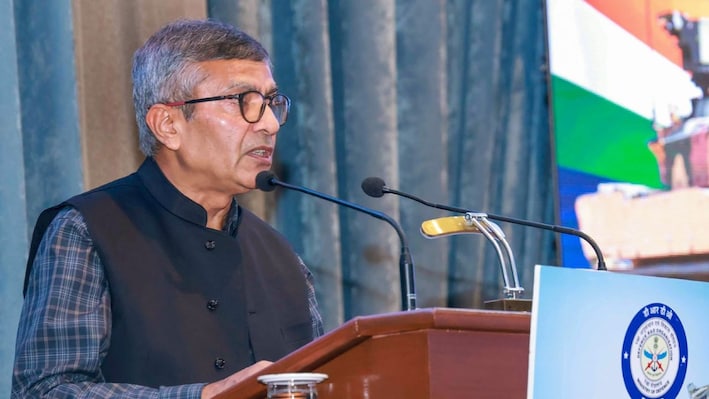
Defence Secretary Rajesh Kumar Singh on Monday stressed the need for India to strengthen its defence ecosystem in response to the changing nature of modern warfare, saying the country must develop the ability to anticipate threats, build capabilities and sustain them during future conflicts.
Addressing a session titled “Strengthening India’s Defence Preparedness” at the ANI National Security Summit 3.0, Singh said Operation Sindoor had brought several emerging dimensions of warfare into focus, offering important lessons for India’s future defence planning.
He said the country must prepare not only for conventional military confrontations but also for interconnected threats involving cyber disruptions, electronic interference, attacks on communication networks and damage to critical infrastructure.
#WATCH | ANI National Security Summit 3.0 | Delhi: Defence Secretary Rajesh Kumar Singh says, "As all of you are aware, the true strength of a nation's defence preparedness is not determined by what it possesses, but by what it can bring to bear, sustain, and adapt when confronted with a challenge. And the issue is: how do we acquire these capabilities and build a defence ecosystem capable of anticipating, developing, and sustaining capabilities required for tomorrow. As all of you are aware, the world is on fire in many ways. The character of warfare is also changing. And some of those dimensions of those changes were brought home to us also during Op Sindoor. Obviously, we had to take lessons from that. And we have to also consider the possibility of simultaneous and interconnected contingencies in the future: a combination of conventional military confrontations with cyber disruptions, electronic interferences, attacks on communication networks, and disruption to critical infrastructure. In that sense, the challenge is not merely to prepare for the next conflict, but to prepare for the changing conditions under which these future conflicts may be fought. And in that context, for comprehensive defence preparedness, we need first and foremost credible operational capabilities. We require technological and industrial strength, preferably with indigenous design and manufacturing capabilities. It calls for jointness and integration, a robust research and innovation ecosystem, sustained operational resilience through robust logistics, modern border infrastructure, assured availability of ammunition, skilled human resources and mutually beneficial international partnerships with trusted countries."
— ANI (@ANI) November 16, 2026
Highlighting the need to adapt to evolving security challenges, Singh said the strength of a nation’s defence preparedness depended not simply on the equipment it possessed but on its ability to sustain and adapt its capabilities when confronted with a challenge.
“True strength of a nation’s defence preparedness is not determined by what it possesses but what it can bring to sustain and adapt when confronted with a challenge. The issue is: how do we acquire these capabilities and build a defence ecosystem capable of anticipating, developing and sustaining capabilities required for tomorrow. The world is on fire in many ways,” he said.
The Defence Secretary said some of the changes in the character of warfare had become evident during Operation Sindoor, underlining the importance of drawing lessons from the operation.
“The character of warfare is also changing. And some of those dimensions of those changes were brought home to us also during Operation Sindoor. Obviously, we had to take lessons from that,” he said.
He also cautioned that India must account for the possibility of multiple, interconnected security contingencies in the future, where conventional military engagements could coincide with cyber and electronic attacks.
Singh said comprehensive defence preparedness required credible operational capabilities backed by technological and industrial strength. He emphasised the importance of developing indigenous design and manufacturing capabilities to strengthen the country’s ability to respond to future threats.
“In that sense, the challenge is not merely to prepare for the next conflict, but to prepare for the changing conditions under which these future conflicts may be fought. And in that context, for comprehensive defence preparedness, we need first and foremost credible operational capabilities. We require technological and industrial strength, preferably with indigenous design and manufacturing capabilities,” he said.
Outlining the broader requirements for a robust defence framework, Singh called for greater jointness and integration among the armed forces, alongside a stronger research and innovation ecosystem.
He also stressed the need to ensure sustained operational resilience through reliable logistics, modern border infrastructure and the assured availability of ammunition and spare parts.
Skilled human resources and mutually beneficial international partnerships with trusted countries were also among the key elements he identified for strengthening India’s defence preparedness.
(with ANI inputs)
Stay informed on all the latest news, real-time breaking news updates, and follow all the important headlines in india news and world news on Zee News English.