• हिन्दीEnglishमराठीবাংলাதமிழ்മലയാളംગુજરાતીతెలుగుಕನ್ನಡଓଡ଼ିଶାZ BharatPHHBusinessWION
  • facebookyoutubetwitterwhatsapp
Zee News English
  • news
  • Live Blog
  • photos
Add Zee Business As A Preferred Source
App
  • Live TV
  • Latest News
  • India
  • World
  • Entertainment
  • Sports
  • Business
  • Lifestyle
  • Astrology
  • Auto
  • Education
  • Technology
  • News
  • /India News
  • /‘Won’t go around begging’: Piyush Goyal rejects China’s TBM monopoly, vows India will build its own motors

‘Won’t go around begging’: Piyush Goyal rejects China’s TBM monopoly, vows India will build its own motors

Piyush Goyal added that some Indian start-ups had begun developing and producing motors without rare earth elements, offering comparable quality and efficiency.

Written ByZee Media BureauEdited ByAnjali Singh
Published: Nov 03, 2026, 07:30 PM IST|Updated: Nov 03, 2026, 07:37 PM IST
joinshare
‘Won’t go around begging’: Piyush Goyal rejects China’s TBM monopoly, vows India will build its own motors
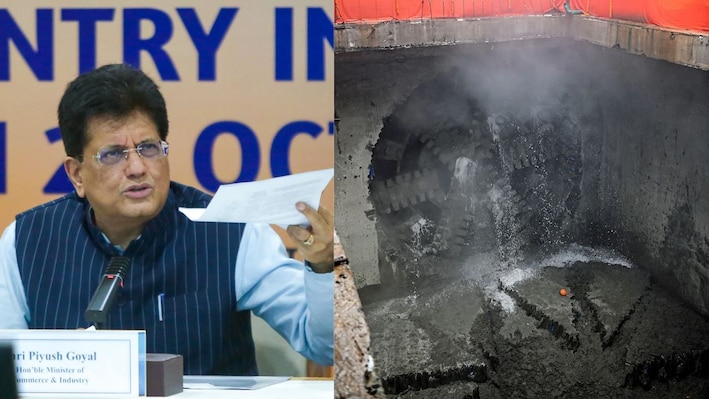
Image Credit: Left: Union Minister Piyush Goyal, Right: Tunnel Boring Machine (TBM).(Image: IANS)

About the Author

    Zee Media Bureau

    Zee Media Bureau

    Zee Media Bureau is the editorial news desk of Zee Media Corporation, one of India’s leading news networks.The bureau represents a collective of experienced journalists, editors, and correspondents who work across television, digital, and social platforms to deliver timely, accurate, and wide-ranging news coverage. Zee Media Bureau's coverage spans politics, business, economy, technology, health, entertainment, and global affairs. The bureau follows a collaborative newsroom model, where stories are researched, verified, and published by a team. This ensures speed, editorial consistency, and adherence to journalistic standards, particularly for breaking news and developing stories.
    Read More

    Trending

    • News
    • Photos
    Lost or stolen credit card: Who pays for unauthorised transactions?

    Lost or stolen credit card: Who pays for unauthorised transactions?

    2

    Tarot card reading for November 3, 2026: Honest conversations can clear misunderstandings, zodiacs

    3

    Dakar Youth Olympics 2026: India's Khushbu Rajakbai Darjada wins Judo silver after reaching final

    4

    One hospitalisation bill, two health insurance policies: Check conditions and common mistakes

    5

    ISSF World Championships: India win men's 50m pistol team gold as Ravinder Singh claims Individual silver

    logo
    • contact us
    • privacy policy
    • legal
    • investor info
    • advertise with us
    © 1998-2026 Indiadotcom Digital Private Limited, All Rights Reserved.

    Union Commerce and Industry Minister Piyush Goyal on Tuesday said India would develop its own tunnel boring machines if foreign countries refused to supply them, underlining the government’s push to strengthen domestic manufacturing and reduce dependence on overseas technology.


    Speaking at the Young Leaders Discourse Forum at Delhi University’s Kirori Mal College, Goyal highlighted India’s efforts to build indigenous capabilities in critical sectors, including tunnel boring machines and rare earth elements.


    He said the country would not compromise its self-reliance efforts even when faced with restrictions from foreign suppliers.


    “Regarding tunnel boring machines, India’s approach is different. Many other countries might bow down and enter into agreements. We do not wish to spoil relations with anyone; even today, our relations with China remain good. But if they refuse to provide tunnel boring machines, we will develop them ourselves in India,” said Goyal.

    #WATCH | Delhi | At the Young Leaders Discourse Forum at Kirori Mal College, Union Minister Piyush Goyal says, "...Regarding tunnel boring machines. India’s approach is different. Many other countries might bow down and enter into agreements... We do not wish to spoil relations with anyone; even today, our relations with China remain good... But if they refuse to provide tunnel boring machines, we will develop them ourselves in India... When they restricted rare earths, we did not go around begging. We held a meeting with various startups in this field. Can we not build our own motors without relying on rare earths? After all, rare earths didn't always exist... Some startups in India have begun innovating and have started producing motors without rare earths that offer equal quality and efficiency..."

    — ANI (@ANI) November 3, 2026

    Start-ups working on rare earth alternatives

    Goyal also referred to restrictions on rare earth elements, saying India had responded by bringing together start-ups to explore alternatives rather than relying on foreign supplies.


    He said the government had encouraged domestic innovators to develop motors that could operate without rare earth materials, with some Indian start-ups already making progress.


    “When they restricted rare earths, we did not go around begging. We held a meeting with various start-ups in this field. Can we not build our own motors without relying on rare earths? After all, rare earths didn’t always exist,” Goyal said.


    He added that some Indian start-ups had begun developing and producing motors without rare earth elements, offering comparable quality and efficiency.


    The minister said India’s broader strategy was to build alternatives to imported technologies and strengthen its domestic manufacturing ecosystem, particularly in areas considered critical to the country’s industrial and economic interests.

    Trade deals to protect India’s interests

    Goyal also outlined India’s approach to international trade agreements, saying negotiations were aimed at securing better market access for domestic industries while protecting sensitive sectors.


    He identified textiles, processed food, marine products, footwear, leather, gems and jewellery, and pharmaceuticals as key areas where Indian businesses could benefit from preferential access to international markets.


    “I think in the trade agreements we have two critical ways of negotiation. One is our offensive sectors, where there are a lot of opportunities. These would be things like textiles. It’ll be processed foods, our fish, marine products. We are very good at footwear and leather products; we are masters in gems and jewellery. We are called the pharmacy of the world for our strength in pharmaceuticals. So these are all our offensive interests, where we work to get preferential market access,” he said.

    Agriculture and dairy remain sensitive sectors

    The minister said India remained cautious about opening certain sectors, particularly agriculture and dairy, to foreign competition. He also stressed that the country maintained safeguards against genetically modified (GM) products, taking domestic and religious sensitivities into account.


    “We are very sensitive to opening up to certain agricultural produce, our dairy. We are very sensitive about not allowing any GM products to come to India. We are sensitive to our religious sensitivities. We have a list of sensitive items, and I can say with confidence that India has never compromised on a single sensitive item that we want to protect, whether of our farmers, our fishermen, or our MSMEs,” he added.


    Goyal said India had identified a list of sensitive products and had not compromised on protecting the interests of farmers, fishermen and micro, small and medium enterprises (MSMEs) during trade negotiations.


    (with ANI inputs)


    Stay informed on all the latest news, real-time breaking news updates, and follow all the important headlines in india news and world news on Zee News.

    Add Zee News as a Preferred Source
    TAGS:
    Piyush Goyal