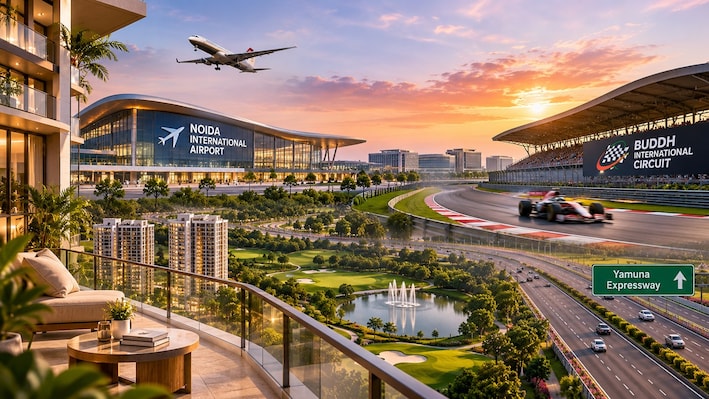
Greater Noida: The 165-kilometre Yamuna Expressway corridor was long seen as an infrastructure development whose potential depended on the arrival of major growth drivers. That phase now appears to be changing. Commercial flight operations began at Noida International Airport in Jewar in June 2026, while a corporate resolution has cleared the way for progress on the long-delayed Sports City project in Sector 25. Together, these developments are bringing fresh momentum to the Greater Noida–Yamuna Expressway corridor, marking a significant shift in its development prospects since the expressway opened in 2012.
Real estate benchmarks over the past five years capture the scale of this shift. Market intelligence tracking the corridor between 2020 and 2025 recorded a 53 percent surge in residential plot values – a more than six-fold jump from roughly Rs 1,650 per sq ft to Rs 10,500 per sq ft-while apartment prices climbed 158 percent, rising from an average of Rs 3,950 per sq ft to Rs 10,200 per sq ft. Simultaneously, the Yamuna Expressway Industrial Development Authority (YEIDA) has steadily revised its institutional allotment benchmarks upward, signalling that official land valuations are aligning with private market demand.
Inside the YEIDA Master Plan 2041 Blueprint
Unlike earlier real estate cycles in the National Capital Region (NCR) that relied primarily on residential speculation, Greater Noida’s current upswing is anchored in multi-sector economic zoning. Notified across 3,352 sq km spanning 1,149 villages in six districts with Phase-I covering 759 sq km in Gautam Buddh Nagar and Bulandshahr - the YEIDA Master Plan 2031 and 2041 framework is engineered as an integrated Aerotropolis and manufacturing hub rather than a dormitory suburb.
Beyond Stage 1 of the Jewar airport spanning 1,334 hectares with an initial capacity of 12 million passengers annually and a long-term master plan scaled for 70 million passengers dedicated industrial and commercial clusters are moving from land allotment to physical execution. Key nodes mapped across the Phase-I corridor include the 230-acre International Film City in Sector 21, a 350-acre Medical Device Park, a 40-acre Data Centre Park, and a 60-acre Software/IT Park in Sector 28, alongside 325 acres earmarked for Semiconductor and Electronics Manufacturing Clusters across Sectors 10 and 28.
Complementing these high-tech zones are a 250-acre FinTech Park in Sector 11, a 175-acre Apparel Park in Sector 29, a 100-acre Toy Park in Sector 33, and two 500-acre mixed-use industrial townships Japanese City (Sector 5A) and Korean City (Sector 4A) located within five kilometres of the airport. Multi-modal connectivity links anchored by the Yamuna Expressway, Eastern Peripheral Expressway, Delhi-Mumbai Expressway interchange, proposed RRTS-cum-Metro extensions, and a planned high-speed rail station at the airport are designed to compress commute times across NCR. For urban economists, the implication is clear: industrial capex and white-collar job creation are now preceding residential occupancy, giving property valuations a firmer economic floor.
Sports City Resolution and the 2029 F1 Horizon
Nowhere is this turnaround more tangible than in Sector 25, home to the 5,000-acre Jaypee Sports City special development zone. Conceived around 775 acres of residential neighbourhoods, a 14-to-15-kilometre landscaped Green Boulevard spanning 480 acres, 245 acres of parks and lakes, a 222-acre PGA golf course, and international cricket and hockey stadiums, the integrated district spent years held back by corporate insolvency.
That logjam has begun to clear following the Adani Group’s emergence as the winning bidder to acquire debt-laden Jaiprakash Associates Limited, the corporate parent behind the Buddh International Circuit (BIC). Earlier in 2026, Adani Ports and Special Economic Zone Managing Director Karan Adani confirmed that the conglomerate is actively engaging with YEIDA officials to revive Formula 1 racing at the Greater Noida circuit, which last hosted the Indian Grand Prix in 2013. While international motorsport homologation and Formula 1’s locked global race calendar make 2029 the earliest realistic window for cars to return to the grid, the prospect of a revitalised Sports City has already transformed end-user and investor sentiment across Sector 25.
Low-Density Design and Architectural Differentiation
As land values climb and the buyer profile shifts toward aviation executives, business owners, and non-resident Indians, residential planning in Sector 25 is evolving away from dense, uniform towers toward low-density, experiential enclaves.
While established developments such as Solitairian City and Aurum helped anchor early residential activity in the micro-market, newer luxury entrants are competing on architectural identity, open greens, and sightlines. A notable example is The Sephyra by Imperia Group (UP RERA Reg. No. UPRERAPRJ761382/10/2025), located on Plot GH A-4 in Sector 25 SDZ roughly 250 metres opposite the Buddh International Circuit and five minutes from the proposed Galgotias University metro station, with seamless access to three major expressways.
Spread across 4.7 acres with 552 residences distributed across six towers four G+25 towers offering 1,200 sq ft 2 BHK apartments and two G+20 towers housing 2,680 sq ft 4 BHK-plus-staff residences alongside 5,360 sq ft 5 BHK duplex penthouses the project adopts a European classical architectural vocabulary. Its master plan centres on more than 2.5 acres of curated open landscapes, integrating a grand tiered entrance fountain, Spanish parterre gardens, sculpture courts, topiary lawns, and dedicated fragrance and sensory gardens.
Expansive private decks - stretching over 40 feet in larger residences frame direct views of the F1 circuit and surrounding green belt, while internal golf-cart parking under trellises, EV charging stations, grass-paved parking bays, and a resort-style clubhouse support low-emission, pedestrian-friendly living. According to company management, over 50% of the released inventory has already been absorbed, reflecting sustained buyer appetite for differentiated luxury housing backed by Imperia Structures’ four-decade track record of delivering more than 23 residential and commercial projects across Delhi-NCR.
Execution Discipline as the Next Benchmark
Even as capital inflows into Greater Noida and the YEIDA belt reach record levels, market analysts note that the corridor’s next phase will be judged on delivery discipline. Past NCR cycles underscored the importance of RERA transparency, dedicated escrow compliance, and timely civic infrastructure execution.
Today, however, Greater Noida’s fundamentals rest on firmer ground than at any point in its history. With an operational international airport, a 2041 industrial master plan taking shape on the ground, and the prospective return of Formula 1 to Sector 25 by the end of the decade, the Yamuna Expressway corridor has graduated from a speculative frontier into NCR’s primary growth engine.
Stay informed on all the latest news, real-time breaking news updates, and follow all the important headlines in india news and world news on Zee News English.