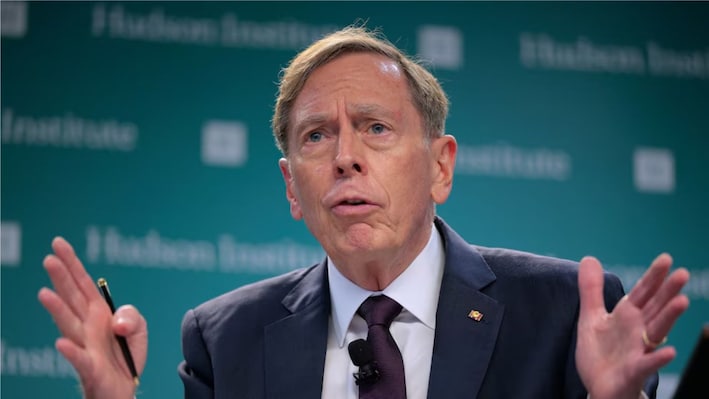
New Delhi: Former CIA Director David Petraeus has warned that militaries have little time to adapt to modern warfare. Drones, autonomous weapons and frequent software updates are changing battlefield tactics and the way soldiers fight and survive.
He said the war between Russia and Ukraine had demonstrated how fast new technology could make established military tactics ineffective. He argued that armed forces must overhaul their training, equipment and decision-making processes at a pace that traditional military procurement systems often cannot match.
Petraeus has commanded US-led coalition forces in Iraq and Afghanistan and served as head of US Central Command, which oversees American military operations across a region stretching from Egypt to Pakistan. His experience in these roles has given him first-hand knowledge of how military strategy changes during prolonged confrontations.
“The high-tech drone war between Russia and Ukraine shows one of the biggest changes in the way wars are fought in our time. Every military in the world needs to understand how important revolutionary institutional change has become,” Petraeus said while addressing the NDTV World Summit in New Delhi.
His warning comes as countries, including India, assess the rising use of drones for surveillance, attacks and air defence. The war in Ukraine has shown that relatively inexpensive unmanned systems can threaten tanks, troops, supply routes and naval vessels. Militaries now have to rethink how they deploy their forces.
Why old war tactics no longer work
Drones and smart weapons have changed the way infantry and armoured units operate along the Russia-Ukraine front. Surveillance drones can detect troops and vehicles from above, allowing forces to direct attacks against targets that would previously have been difficult to locate.
Soldiers stationed along Ukraine's line of contact spend much of their time underground to avoid detection. Supplies are delivered through remotely operated ground vehicles and drones instead of conventional trucks. Troops may spend as long as 60 days at their positions because travelling to and from the front can expose them to enemy attacks.
Petraeus said that conventional military formations and battlefield methods could become easy targets in an environment where drones can identify movement across open ground.
“Traditional warfare, tanks, infantry, engineers, air defence, electronic warfare... all of these can no longer survive in their existing form. Even if you have built trenches, a drone can be flown into them. Anything out in the open will be easily visible," he said.
He said military leaders must find ways to protect troops and equipment while allowing forces to move, communicate and receive supplies under constant surveillance.
‘Armies must adapt within a year’
Petraeus believes the lessons from Ukraine must be adopted much faster by armed forces around the world. He said that Russia and Ukraine were changing battlefield tactics at a pace that other countries had not matched.
Asked what he would do if given five years to rebuild a modern military, he said the job would have to be completed in a year.
"The first thing I would say is that this will not be done in five years, but in one year, because we do not have five years," he said.
The process involves more than buying different types of drones. Militaries must also update the software that controls these systems and modify their hardware to respond to new battlefield threats.
Petraeus said armed forces should be able to make software changes every week and hardware changes every few weeks.
Such a pace poses a challenge for countries where defence procurement can take years, from selecting a weapon system to completing trials and bringing it into service. By the time a system is deployed, the technology and tactics used by an adversary may have changed.
Will AI drones decide who lives or dies?
Petraeus expects faster advances in autonomous weapons. These systems can identify and attack targets with limited or no human intervention. He said that fully autonomous systems were at the experimental stage, but their numbers could increase considerably by the end of 2026 or during 2027.
Asked whether he was comfortable with machines making decisions that could determine whether a person lived or died, he said that he trusted a properly programmed machine to follow the laws of war.
"If a machine has been programmed correctly, I have confidence that it will follow the laws of war. And that 'if it has been programmed correctly' part matters a great deal," he said.
His answer also shows why the design and testing of these weapons are so important. The ability of an autonomous system to distinguish between military targets and civilians, follow rules of engagement and operate reliably will determine how it is used in combat.
Ukraine's drones take on costly missiles
The war has opened a new front, with drones being used to destroy other drones. Ukraine has stepped up its use of interceptor drones to shoot down Russian unmanned aircraft, including Shahed-type attack drones.
In January 2026, Ukrainian President Volodymyr Zelensky said that the country was producing about 1,000 interceptor drones a day. His military chief, Oleksandr Syrskyi, said that these systems destroyed more than 1,500 Russian drones in February 2026, including a substantial share of the Shahed drones launched towards Kyiv.
According to Reuters, interceptor drones were bringing down around 40% of Russia's Shahed-type drones across Ukraine by April, compared with about 25% during the winter.
The economics of air defence have helped drive this change. Petraeus said that some militaries had used Patriot missiles costing about $2 million each to destroy Shahed drones priced at around $50,000. Repeatedly using expensive missiles against cheaper targets places a heavy burden on defence budgets and can fast exhaust supplies.
Interceptor drones offer a less expensive way to counter some incoming threats, although their effectiveness depends on the type of target, detection systems and battlefield conditions.
How Ukraine's drones hit Russia's Black Sea fleet
Ukraine's use of unmanned systems has also changed naval warfare. Despite lacking a conventional navy comparable to Russia's, Kyiv has used aerial and sea drones to attack Russian vessels in the Black Sea.
Petraeus said that Ukraine had destroyed more than a third of Russia's Black Sea Fleet. Aerial drones help locate targets, while unmanned surface vessels carry out attacks against the ships. The threat has forced Russian vessels to operate from ports and other protected locations rather than move freely across the open sea, he said.
He also stated that Ukraine had sunk around 300 vessels carrying supplies to Crimea and attacked refineries within a range of 3,000 kilometres from its borders.
The use of relatively inexpensive unmanned systems against warships and energy infrastructure has added another challenge for military strategists. Navies now have to protect ships and ports against threats that can approach at low cost, operate without crews and be deployed in large numbers.
Stay informed on all the latest news, real-time breaking news updates, and follow all the important headlines in india news and world news on Zee News.