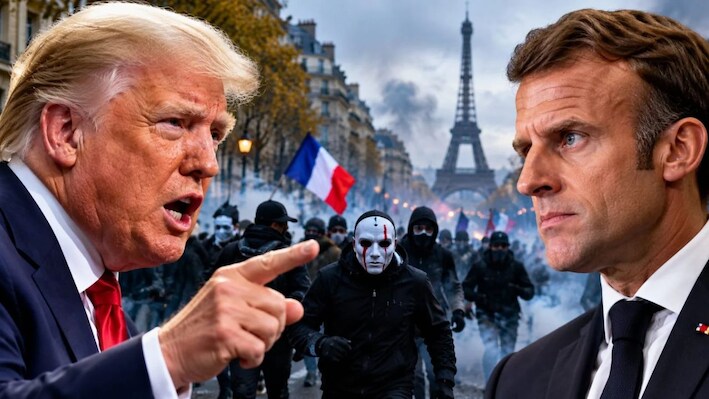
Nearly 1,000 people were arrested in France on Saturday after protests over rising living costs and poorly funded public services turned violent. While the government said 4.10 lakh people joined the demonstrations nationwide, unions put the figure at nearly 8 lakh. The clashes also drew a fresh comment from US President Donald Trump, who blamed immigration for the unrest, an explanation French President Emmanuel Macron has publicly rejected.
Nearly 1,000 arrested in France
French Interior Minister Laurent Nunez said the number of arrests was expected to rise as police reviewed reports from across the country. "As I speak to you, we are at nearly 1,000 arrests," he said at a briefing.
At the same stage of the previous Saturday's protests, authorities had recorded 385 arrests.
The latest demonstrations were held under a heavy security operation involving about 70,000 police officers and gendarmes. Authorities sought to prevent a repeat of the looting and damage that followed the protests on October 17. The Interior Ministry recorded 289 demonstrations across France on Saturday.
Police use tear gas in Paris
Most marches passed off peacefully, but confrontations broke out in some areas late in the day. In eastern Paris, masked individuals threw projectiles and fireworks at police officers near the end of a march.
Police responded with tear gas, sound grenades and water cannon before dispersing the crowd near Cours de Vincennes. A helicopter was also deployed to help officers monitor the area.
Official figures put the number of people who joined the protest march in Paris at 1.10 lakh, while unions estimated the turnout at 2.50 lakh.
Violence reported in several cities
Clashes were also reported in Marseille, Lyon, Lille, Nantes, Toulouse and other cities. In Marseille, groups set bins on fire and threw objects at police officers.
In Lyon, about 10,000 people marched despite restrictions on gatherings in the city centre. Local authorities reported around 26,500 protesters in Toulouse.
Nunez said two people suffered serious injuries, one in Toulouse and another in Clermont-Ferrand. He said the stronger security presence had helped prevent destruction on the scale seen the previous weekend.
Why are people protesting in France?
The protests began more than a month ago when school students demanded more teachers, better school buildings and improved classroom conditions.
Workers, trade unions and other groups later joined the movement, seeking relief from high food, housing and energy costs and greater investment in public services.
Trump blames immigration for France unrest
The French protests also became a talking point in US politics. US President Donald Trump while addressing a Republican campaign rally in Perry, Georgia on Saturday said, "France is right now burning down because it opens its borders to people who hate it."
The demonstrations have been organised around education funding, living costs and public services, although some groups involved in the violence have attacked police and damaged property.
Macron rejects Trump's claims
France President Emmanuel Macron had already rejected similar allegations earlier in the week. Speaking in Qatar on Wednesday, he criticised foreign leaders for using France's domestic unrest in their political campaigns and warned that misleading, AI-generated images were circulating online.
Asked whether he was referring to Trump, Macron replied, "Among others."
Israeli Prime Minister Benjamin Netanyahu also blamed the disorder on extremist Islam in an interview on Tuesday.
Left-wing leader Jean-Luc Melenchon, meanwhile, accused the police of using excessive force and criticised television coverage for focusing on clashes rather than peaceful protesters.
More Protests Planned on November 5
The General Confederation of Labour (CGT), a major French trade union, has called for another nationwide day of strikes and demonstrations on November 5.
Stay informed on all the latest news, real-time breaking news updates, and follow all the important headlines in india news and world news on Zee News.