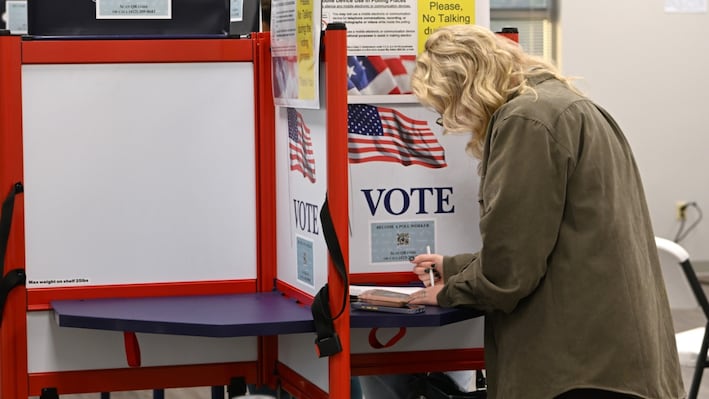
Voting has begun across the United States in the 2026 midterm elections, with more than 230 million eligible voters expected to cast their ballots in a closely watched contest that could reshape the balance of power in Washington. The elections are seen as a key test of public opinion on the second half of President Donald Trump's term.
All 435 seats in the House of Representatives and 35 seats in the Senate are being contested. Voters in 36 states will also elect their governors. Republicans currently control both chambers of Congress, but pre-election polls and forecasting models point to possible gains for Democrats.
The latest polls released by The New York Times and Siena University show Democratic candidates leading in five of the seven key battleground states that could decide control of the Senate, with the party effectively tied in another.
Democrats are ahead in Kansas, Maine, Ohio and Texas, while holding a narrow lead in Alaska. The race in Iowa remains too close to call. The findings also point to Democratic strength in traditionally Republican states such as Texas, which has not elected a Democratic senator since 1988, and Kansas, which last sent a Democrat to the Senate in 1932.
However, the path to a Senate majority remains difficult. Democrats must defend all the seats they currently hold and flip at least four Republican-held seats to take control of the chamber. Several of their target races are in strongly Republican states, making the task challenging.
President Trump’s approval rating and concerns over the economy could also influence the outcome. The latest polling puts his approval rating among likely voters at 38 per cent, with dissatisfaction over his economic management weighing on Republican candidates.
Earlier on Tuesday, American statistician Nate Silver's FLIPR 2026 midterm election forecast also showed Democrats leading in polling averages across several key battleground states.
The forecast gives Democrats a 4.9-percentage-point lead in Michigan, 3.9 points in Maine, 3.3 points in Texas, three points in Ohio and 1.1 points in Iowa. The Kansas Senate race also shows a four-point lead for the Democratic candidate. Georgia and North Carolina, meanwhile, appear less competitive in the forecast.
More than 57 million Americans have already voted through early voting, according to ABC News. Voters can also cast their ballots by mail or in person on Election Day.
The US Department of Justice has released a list of locations where it plans to deploy election observers, describing the exercise as the largest federal monitoring initiative in the country's history.
According to ABC News, the department has announced plans to send around 1,000 monitors across all 50 states. However, an official told a court that the actual deployment was likely to be closer to 900 personnel, citing difficulties in identifying and training enough staff before Election Day.
Election monitoring is a regular practice under successive US administrations, with observers usually drawn from the Voting Section of the Justice Department's Civil Rights Division.
The planned deployment has, however, drawn criticism from Democrats in recent months. Their concerns are linked to the Trump administration's efforts to obtain voter registration data as part of its push to identify possible non-citizen registrations.
Several closely contested Senate races are also drawing attention as both parties seek control of the upper chamber.
In Michigan, Democrat Abdul El-Sayed is facing Republican Mike Rogers. The contest drew further attention after Democratic Representative Haley Stevens endorsed Rogers on Sunday.
In Florida, Democrat Angie Nixon is challenging Republican Senator Ashley Moody, while Georgia Democratic Senator Jon Ossoff is facing Republican Mike Collins.
Maine Republican Senator Susan Collins is contesting against Democrat Troy Jackson. In New Hampshire, Democratic Representative Chris Pappas is up against former Republican Senator John Sununu.
In North Carolina, Democrat Roy Cooper and Republican Michael Whatley are competing for the Senate seat.
The first results are expected to emerge on Tuesday as polling stations close across different states. Counting will continue through the evening and into Wednesday as election officials process ballots and release updates.
However, the outcome of some closely fought races may take longer to establish. Mail-in, provisional and other ballots are often counted after Election Day, meaning final results could take several days or, in some cases, weeks.
The elections will decide which party controls Congress for the next two years. Democrats need a net gain of four seats in the Senate and three in the House of Representatives to secure majorities in both chambers.
Stay informed on all the latest news, real-time breaking news updates, and follow all the important headlines in india news and world news on Zee News.