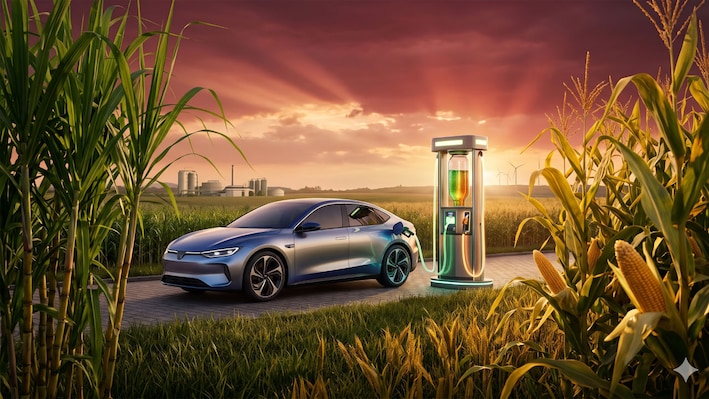
Picture a car whose tank is filled not with petrol pumped from under the sea, but with alcohol distilled from sugarcane and maize grown by Indian farmers. That vision moved closer on October 26, when the Ministry of Road Transport and Highways under Nitin Gadkari amended the Central Motor Vehicles Rules, 1989, the official rulebook deciding which vehicles may be sold in India to clear the way for flex-fuel vehicles. These are cars and two-wheelers built to burn petrol blended with varying amounts of ethanol, or ethanol almost on its own.
Two fuels now sit inside the government's emission testing and approval system, the checks every vehicle must pass to prove it meets pollution limits. E85 contains roughly 85 per cent ethanol; E100 is nearly pure ethanol. The number after the "E" simply tells you the ethanol share. Manufacturers can now design and sell vehicles running on very high ethanol content.
One reassurance deserves plain statement. The notification applies only to vehicles specially engineered, tested and certified for these fuels. Owners of ordinary petrol vehicles are not being asked to switch, modify their engines, or change anything.
How does a flex-fuel car cope with such different fuels? Its tank, pipes and seals use materials ethanol cannot corrode, and an onboard computer senses the petrol-ethanol ratio and quietly retunes the engine, much as a seasoned cook adjusts the flame for different dishes. One tank accepts any approved blend, and the driver touches nothing. Brazil and the United States already rely on this technology, and the government hopes it will spur Indian firms to make flex-fuel components, build more distilleries, and expand storage and supply networks.
The decision carries a political message too. Since April, ethanol blending has stirred argument among vehicle owners, carmakers, Opposition leaders and even the courts. The sharpest worries centre on E20, petrol with 20 per cent ethanol, now standard nationwide. As India Today has reported, drivers complain of poorer mileage and fear damage to older engines designed for lower blends, while petrol with less ethanol has all but vanished from pumps, leaving many asking whether they truly have a choice.
The Centre has stood firm. It says E20 was technically tested for safety and performance, and no confirmed evidence shows large-scale engine damage. It concedes that cars built for E10, carrying 10 per cent ethanol, may travel slightly fewer kilometres per litre on E20, but calls the loss small. Ethanol's higher octane rating, a measure of how well fuel resists burning too early inside the cylinder, can lift performance and trim harmful exhaust. Senior executives of major automobile companies were brought forward to assure owners that newer vehicles handle E20 safely.
Demands to restore a lower-ethanol option have been refused. Stocking several petrol grades at thousands of pumps would need separate storage, tankers and supply chains, raising costs and complicating logistics. More fundamentally, officials argue, offering E10 beside E20 would undermine E20's very purpose: cutting dependence on imported crude.
The numbers are large. The Ministry of Petroleum and Natural Gas says blending has saved more than ₹1.97 lakh crore in foreign exchange since 2014–15, dollars India would otherwise have spent abroad. Nearly 31.6 million tonnes of crude oil were never imported, and farmers received over ₹1.66 lakh crore for ethanol crops. India reached the 20 per cent blending goal five years ahead of schedule.
Yet questions do not end at the engine. Critics ask about the cost of producing ethanol, about turning rice and maize into fuel rather than food, and about how much money reaches distilleries versus farmers. The government insists rural incomes rise and food security is not threatened.
Environmentally, higher blends can reduce carbon monoxide and certain hydrocarbons in exhaust, though the true greenhouse-gas benefit depends on the crops and the factory process. For the government, this is one road towards net-zero emissions by 2070, when India will release no more heat-trapping gases than it removes.
Stay informed on all the latest news, real-time breaking news updates, and follow all the important headlines in india news and world news on Zee News.