

• हिन्दीEnglishमराठीবাংলাதமிழ்മലയാളംગુજરાતીతెలుగుಕನ್ನಡଓଡ଼ିଶାZ BharatPHHBusinessWION
  • facebookyoutubetwitterwhatsapp
Zee News English
  • news
  • Live Blog
  • photos
Add Zee Business As A Preferred Source
App
  • Live TV
  • Latest News
  • India
  • World
  • Entertainment
  • Sports
  • Business
  • Lifestyle
  • Astrology
  • Auto
  • Education
  • Technology
  • News
  • /Business
  • /India’s economy to sustain growth in Q3 FY27; Middle East crisis, El Niño pose inflation risks

India’s economy to sustain growth in Q3 FY27; Middle East crisis, El Niño pose inflation risks

According to the Monthly Economic Review released for November, sustained volatility, as supply-side shocks threaten to feed into broader wholesale and retail price indices, may persist in the coming months.

Edited BySandal Khan
Published: Nov 28, 2026, 17:49 IST|Updated: Nov 28, 2026, 17:52 IST
joinshare
India’s economy to sustain growth in Q3 FY27; Middle East crisis, El Niño pose inflation risks

About the Author

Sandal Khan

Sandal Khan

Sandal Khan is a sub-editor on the business team at Zee Media. She started her media journey in 2025 before joining Zee to pursue a career in business journalism. Having completed her bachelor’s degree in German and a master’s in mass communication from Aligarh Muslim University, she has always been fascinated by the power of words and the role language plays in informing the public and building the right narrative.  Beyond business, her interests include entertainment, culture, history, and geopolitics. An occasional reader, she almost always picks up books by Japanese authors.  She can be reached at Sandal.Khan@India.com 
Read More

Trending

  • News
  • Photos
Abhishek Banerjee questions Centre's Delimitation Bill, says 'What transpired over last 3-4 months’

Abhishek Banerjee questions Centre's Delimitation Bill, says 'What transpired over last 3-4 months’

2

RBI likely to keep liquidity tight, use forex swaps to manage cash conditions: Report

3

India’s economy to sustain growth in Q3 FY27; Middle East crisis, El Niño pose inflation risks

4

7 killed, 5 injured as overloaded car plunges into gorge in Uttarakhand's Pauri; CM Dhami orders probe

5

Four days after Tamil Nadu failed to follow SC order, Deepam lit at Thiruparankundram

logo
  • contact us
  • privacy policy
  • legal
  • investor info
  • advertise with us
© 1998-2026 Indiadotcom Digital Private Limited, All Rights Reserved.

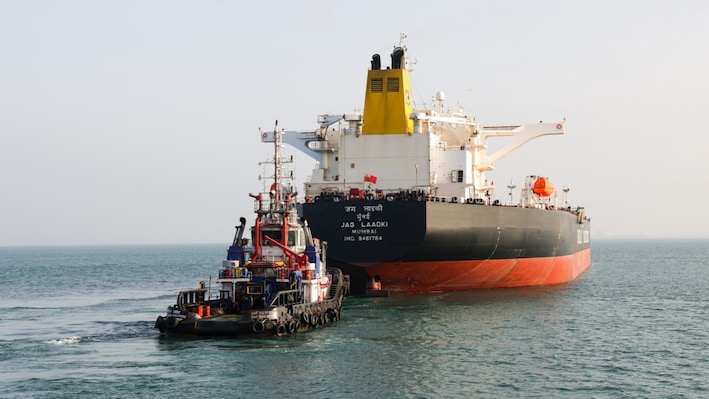
New Delhi: The Ministry of Finance has cautioned about the impact of the Middle East crisis on volatility in India's import bills. The ministry on Saturday said that the continued conflict in the Middle East and the risks to the Strait of Hormuz may keep the oil import bill and maritime freight rates volatile.

According to the Monthly Economic Review released for November, sustained volatility, as supply-side shocks threaten to feed into broader wholesale and retail price indices, may persist in the coming months. However, it further explains that recent moderation in global crude oil prices, with benchmarks falling below US$100 per barrel in early November, and the strengthening of the rupee following robust capital inflows have may have eased imported inflationary pressures, contingent on the persistence of this trend.

The RBI is allowing the rupee to appreciate to encourage exporters to sell their future dollar earnings through forward contracts and reduce the imbalance between importer and exporter hedging.

Domestic economic activity is expected to sustain its momentum into Q3 FY27, with high-frequency indicators pointing to continued expansion across goods movement, tax collections, energy consumption and freight. Business activity is likely to remain firm, with new orders gaining pace and input cost pressures easing.

The report attributes this to expected strong domestic demand, with sequential momentum in vehicle sales and continued strength in rural consumption. Moreover, it says, "Comfortable fertiliser availability bodes well for the rabi season, although sowing is at an early stage and reservoir storage is below last year's level."

However, the World Meteorological Organisation has warned of a strong El Niño, which could peak towards the end of 2026. It could potentially impact weather conditions. A positive Indian Ocean Dipole Index reading of 0.8° Celsius could help counter some of that impact, while inflation risks remain. Moreover, November marks the beginning of the wedding season in the country, which follows the festive season and indicates higher consumer spending. Higher demand can push prices up, particularly when supplies are limited, creating additional inflationary pressure.

Overall, industrial activity continued to expand, although industrial production growth moderated in September and the manufacturing PMI eased in October while remaining in the expansionary zone.

"Bank credit to industry and infrastructure increased, alongside steel consumption. Recent government measures have focused on strengthening domestic manufacturing capabilities," the Review further noted.

Overall, India's external sector has demonstrated resilience amid heightened geopolitical uncertainty. Robust merchandise export growth, supported by broad-based growth across key sectors, alongside a sustained services trade surplus, has helped cushion the overall trade deficit.

Higher foreign direct investment inflows, along with substantial capital inflows, continue to support the overall BoP. Meanwhile, adequate foreign exchange reserves continue to provide a strong buffer against external shocks.

(With inputs from IANS)

Stay informed on all the latest news, real-time breaking news updates, and follow all the important headlines in india news and world news on Zee News English.

Add Zee News as a Preferred Source
TAGS:
Strait of Hormuz
Inflation