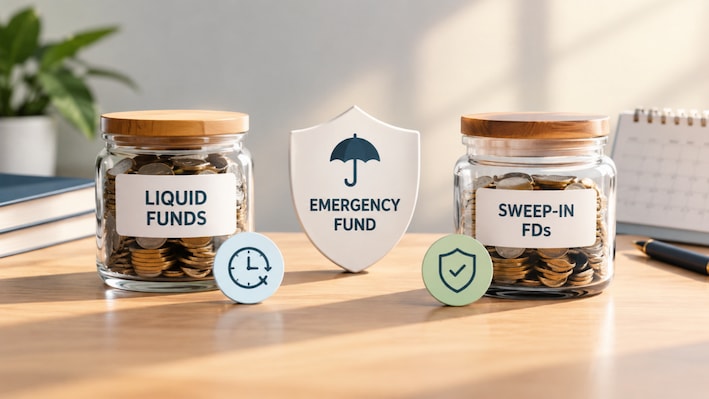
New Delhi: As soon as a person starts earning, it becomes crucial to inculcate the habit of saving. Savings can be done for goals depending on one's personal preferences, however, setting money aside for emergencies should be of foremost importance.
Emergency Fund is that part of one's savings which is kept aside to deal with unforeseen circumstances. Such situations bring expenses that may not be easy to deal with at hand. It could be a medical emergency, job loss, or an accident.
Thus, building an emergency buffer should be of primary importance to the earner before he/she goes on to invest in stocks and other high risk instruments.
A contingency fund is kept aside to use in times of urgency which makes it important to maintain its liquidity. The motive behind this money is to have an amount kept in an accessible place.
While building an emergency fund, returns must not be chased at the cost of liquidity. Hence, choose an option which gives quick access to your money when an emergency strikes while giving decent returns.
A sweep-in Fixed Deposit might be a good option for those who prefer stability while allowing the money to grow at the rate applied by the bank. The sweep-in facility acts as a link between the savings account and the Fixed Deposit. When the money in the account crosses a certain limit, the surplus is automatically transferred to the FD.
The money can be withdrawn without breaking the entire deposit. Sweep-in FDs offer immediate access through the savings account. When the person needs money and the balance in the savings account is inadequate, the bank transfers the money from the FD back into the account.
This method is efficient since the buffer keeps getting the FD's interest while being accessible without having to break the whole deposit.
Liquid Fund, on the other hand, is a market-linked product. It is a kind of mutual fund that invests in short-term, low-risk debt such as treasury bills, commercial papers, and certificates of deposit. Even though they are low-risk, high-liquidity investments, the returns are still market-linked, and thus not guaranteed.
People choose liquid funds to park their money for the short term instead of long term investments meant for wealth generation.
The redemption period may differ based on the scheme, with some providing instant money capped at a certain amount and others by the next day. However, there might be restrictions on the amount that can be withdrawn instantly.
Timing: For those who need instant money for an urgent medical bill or other emergencies, a sweep-in FD would provide quick access as and when needed, along with a certain pre-defined interest rate. Whereas redeeming money from a liquid fund might be slightly lengthy as one may have to put in a request and wait for the proceeds. Moreover, liquid funds come with a graded exit fee, commonly up to 7 days.
Investors with a smaller time horizon may find a sweep-in FD lucrative since it is highly liquid and brings certain returns. Those who are not comfortable with market-linked returns and do not wish to move money themselves may choose a Sweep-in FD.
On the other hand, the emergency buffer kept for the long term may go into Liquid Funds.
Taxation: The taxation should also be accounted for while making the choice. Both are taxed as income at the applicable slab rates. In sweep-in FDs, the interest earned is taxed as it is accrued. Also, when the interest amount crosses a certain threshold, TDS may apply.
Meanwhile, Liquid Funds are debt-oriented, and therefore attract tax applicable to debt mutual funds. Tax applies on the gains once the money is redeemed, thus allowing the whole sum to compound while it is still invested.
Thus, comparisons should not be made based only on the interest rates offered by the FDs and performance of the mutual funds. Taxation must also be factored in.
One may divide the buffer into both. FD works best for money which is required at short notice, while Liquid Funds work for the portion kept aside for longer-term contingency savings while still being accessible.
Stay informed on all the latest news, real-time breaking news updates, and follow all the important headlines in india news and world news on Zee News.