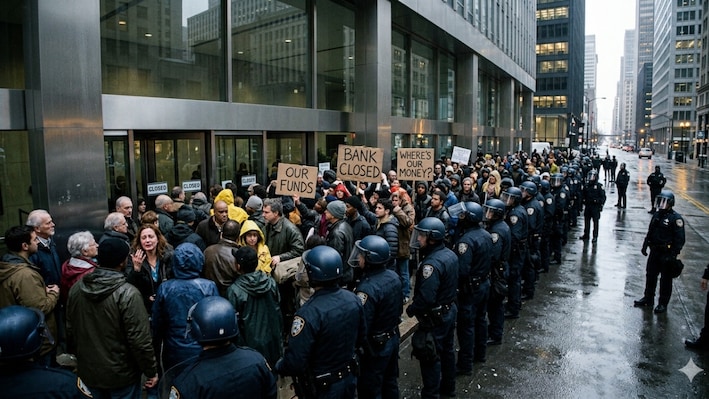
New Delhi: The current political upheaval in Paraguay, led by the Ueno Bank crisis, has resulted in the impeachment and detention of President Santiago Peña. Peña announced his resignation after the rapidly expanding bank collapsed, putting a substantial amount of public funds at risk.
Peña, who has served as an economist at the International Monetary Fund (IMF), is accused of aiding the acceleration of the bank's growth. Peña is said to have held a stake in Grupo Vázquez, which is the parent company of Ueno Bank. The digital lender came under scrutiny after the central bank identified a deterioration in the bank's financial condition. The bank lent money beyond the legal limit to connected companies without adequate collateral, and its capital fell to less than half the minimum requirement.
Following the findings, the central bank intervened, leaving millions of customers unable to access their savings. The impact went beyond this, as state pension and healthcare funds deposited or invested in the bank also became inaccessible to retirees.
Although Peña claims to have sold his stake in March 2025, other controversies related to the bank surrounded him, including the appointment of Carlos Carvallo, who headed Financiera Ueno (Ueno's predecessor), as president of Paraguay's central bank.
This is not the first time that a financial crisis has caused political upheaval in a country. History has recorded government collapses and resignations of heads of state due to economic failures.
During the global financial crisis, Iceland experienced the collapse of its three major banks, Landsbanki, Kaupthing and Glitnir, within a week in October 2008. The banks accounted for around 90 per cent of the country's banking system, which became a major economic concern for the masses. As per reports, their combined liabilities exceeded Iceland's GDP by eight times, crossing $60 billion.
The government lacked the capital required to cope with the losses and rescue the three banks, and the krona (Iceland's currency) lost over 50 per cent of its value against a basket of currencies.
Iceland's banks relied heavily on foreign-currency borrowings due to aggressive expansion into international markets. When the global crisis hit, the banks lost their ability to refinance their debt. The country's central bank's foreign-currency liabilities far exceeded Iceland's financial capacity, and it could not act effectively as a lender of last resort.
Public agitation grew over the government's handling of the banking collapse, following which Prime Minister Geir Haarde resigned in January 2009. His coalition government collapsed.
The roots of the crisis lie in 1991, when Argentina pegged the value of the peso to the US dollar at a fixed exchange rate of 1:1 to control hyperinflation. Later, external financial shocks hit the economy. The Asian financial crisis and Brazil's devaluation of its currency in 1999 also affected Argentina's competitiveness. These events pushed the country into a recession.
In 2001, the crisis deepened. Investors lost confidence, and people started taking their money out of banks. On December 1, the government imposed restrictions on bank withdrawals, limiting access to $1,000 per month. The move, called the corralito, triggered anger among the public as people were unable to access their savings.
The crisis deepened when the IMF withheld a $1.24 billion loan in December 2001 because Argentina had not met its targets. Strikes, riots and looting spread across the country. President de la Rúa declared a state of siege on December 19. The countrywide protests forced him to step down from his position. The violence killed 28 people.
His successor, Adolfo Rodríguez Saá, also resigned on December 30 amid continued political turmoil.
Indonesia's financial crisis of 1997-98 led to the failure of many banks, economic hardships and the eventual end of President Suharto's 32-year rule. The country's GDP fell by 13 per cent in 1998. The rupiah dropped by about 80 per cent against the US dollar. The crisis revealed problems in Indonesia's banking sector, such as weak regulation, ties between banks and powerful business groups, low capital, risky lending and large exposure to foreign currency.
When the rupiah fell sharply, banks that had failed to hedge their foreign-exchange risks faced insolvency. The government set up the Indonesian Bank Restructuring Agency (IBRA) in January 1998 to stabilise the banking sector. The rescue programme, however, cost about $65 billion, or about 60 per cent of Indonesia's GDP.
The economic collapse caused many people to lose their jobs, sparked unrest and riots, and led to widespread panic buying.
Stay informed on all the latest news, real-time breaking news updates, and follow all the important headlines in india news and world news on Zee News English.