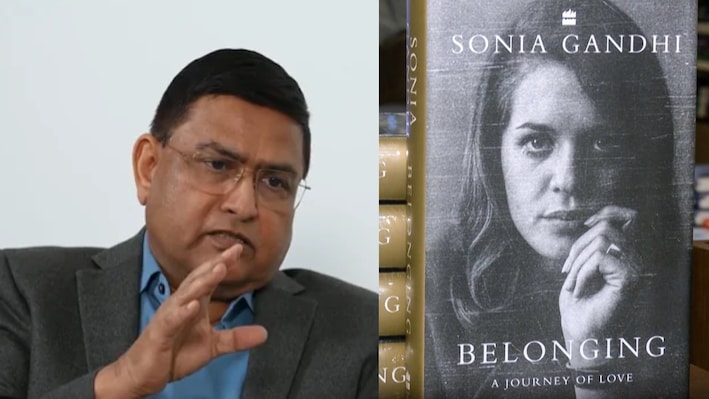
Former CBI Special Director Rakesh Asthana has rejected Congress leader Sonia Gandhi’s assertion in her memoir that the cause of the 2002 Godhra train burning remains disputed, maintaining that the investigation, forensic evidence and subsequent court proceedings established that the fire was deliberately set.
Asthana, who headed the Gujarat Police Special Investigation Team (SIT) probing the Sabarmati Express fire incident, said the investigation examined all possible theories and presented the collected evidence to the court. He also questioned attempts to revive doubts about the findings, calling them politically motivated.
In an interview with news agency ANI, Asthana was responding to a passage in Gandhi’s recently released memoir, Belonging: A Journey of Love, in which she writes, “The cause of the fire remains disputed, but the turmoil that followed spread to many parts of the state.”
Rejecting the statement, Asthana said, “That is completely wrong; the investigation is authentic. It has been proved in the court of law. Even now, if someone is creating doubt about it, then it is for political reasons; there can be no other explanation for it.”
Asthana says investigation examined all possible theories
Recalling the investigation, Asthana said the authorities had considered different possibilities before reaching their conclusions. He maintained that the evidence gathered during the probe connected the accused to the crime and that the findings were subsequently tested in court.
The Gujarat Police’s CID Crime began investigating the incident, with the probe continuing until 2008 under the SIT headed by Asthana.
In 2008, the Supreme Court constituted another SIT under former CBI Director RK Raghavan, with former Uttar Pradesh Director General of Police CB Satpathy also part of the team. Satpathy headed the investigation in Raghavan’s absence.
Asthana said the Supreme Court-appointed team re-examined the entire investigation, visited the site and questioned the officers who had conducted the original probe.
“They examined the entire investigation again. In fact, they examined us as well. We explained to them what investigation we had carried out. They visited the site and examined everything. They then concluded that they could not find any flaw in the investigation conducted by the Gujarat Police,” he told ANI.
He added that Raghavan and Satpathy submitted their findings to the Supreme Court, which accepted the report.
Nanavati Commission also found fire was deliberate
Asthana also cited the findings of the Justice Nanavati Commission, constituted by the Gujarat government in 2002 to examine the Godhra incident and the communal riots that followed.
Initially, the government appointed the KG Shah Commission in March 2002. Justice Nanavati was subsequently appointed to head the commission in May that year.
According to Asthana, the inquiry examined the train burning and the subsequent riots separately. Its report on the Godhra incident, submitted in 2008, concluded that the fire was the result of a pre-planned conspiracy.
He said around 44,000 affidavits were submitted before the commission and more than 1,000 witnesses were examined during the proceedings.
“The commission again concluded the same thing. It is a part, it is a result of a pre-planned conspiracy. Fire has been deliberately set,” Asthana said.
Asthana challenges Banerjee committee’s findings
Addressing the conflicting findings of the Justice UC Banerjee Committee, which had described the fire as accidental, Asthana said it was constituted by the then Union Railway Minister Lalu Prasad Yadav after the change of government at the Centre in 2004.
The committee had suggested that a stove allegedly being carried inside the karsevaks’ coach caused the fire.
Asthana said its constitution was challenged before the Gujarat High Court in 2005 or 2006. The court held that the committee was illegal because a commission had already been appointed under the Commission of Inquiry Act to examine the incident. Its report was subsequently set aside.
He also pointed out that the Railway Act provided for the Commissioner of Railway Safety to independently examine railway accidents.
Political motive alleged over Godhra investigation
Asked whether attempts to question the findings were linked to vote-bank politics, Asthana said the investigation had been treated as a criminal case, irrespective of the religious identities of those killed.
“All the people who died in Godhra were Hindus. And whoever’s death it may be, whether a Hindu’s, a Muslim’s, a Christian’s, or a Sikh’s, death is death, murder is murder. So we investigated it as a criminal act,” he said.
He alleged that the investigation was subsequently portrayed in political terms, with attempts being made to suggest that the probe had been conducted to benefit Narendra Modi, who was Gujarat’s chief minister at the time.
What happened in the 2002 Godhra train burning case?
On February 27, 2002, coach S-6 of the Sabarmati Express was set on fire near Godhra railway station in Gujarat, killing 59 people, including women and children. The train was carrying Hindu karsevaks returning from Ayodhya.
The incident was followed by widespread communal violence across Gujarat, in which hundreds of people were killed.
In 2011, a special court convicted 31 people in connection with the train burning. In October 2017, the Gujarat High Court commuted the death sentences of 11 convicts to life imprisonment while upholding the life sentences of the remaining 20.
The convicts’ appeals have been pending before the Supreme Court since 2018. The apex court resumed final hearings in the case in May 2025.
Reiterating his position, Asthana said the findings of the police investigation, the Supreme Court-appointed SIT, the Nanavati Commission and the subsequent court proceedings all supported the conclusion that the fire was deliberately set.
Godhra train burning incident
Stay informed on all the latest news, real-time breaking news updates, and follow all the important headlines in india news and world news on Zee News English.