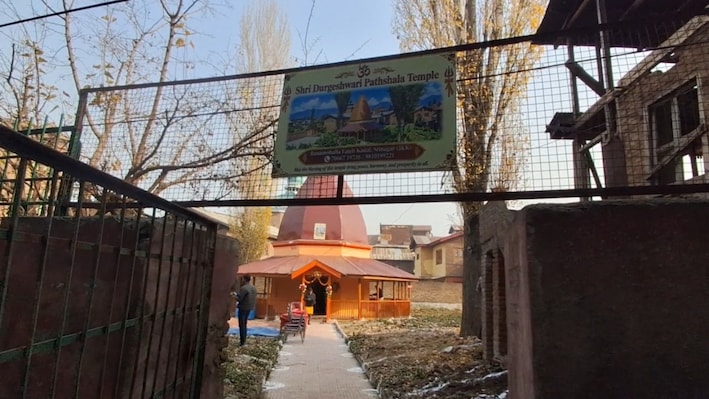

After 36 years, the bells of the 700-year-old 'Shri Durgeshwari Temple' rang out once again, accompanied by prayers and rituals. Expressing their joy, Kashmiri Muslims stated that they are eagerly awaiting the return of Kashmiri Pandits, without whom Kashmir feels incomplete.
These visuals are from the Fateh Kadal area of Srinagar's 'Old City'—a place once considered a hub of militancy. Today, it has become a beautiful example of Hindu-Muslim brotherhood.
After 36 years, the doors of the Goddess Durga temple were opened and prayers were offered. A 'Havan' was performed, attended by many Kashmiri Pandits alongside members of the local Muslim community, as well as civil administration and police officials. Joy was evident on everyone's faces as one of Srinagar's oldest temples was renovated, filling the area once again with the sound of bells and conch shells.
This centuries-old temple of Goddess Durga also houses an ancient Shivling of Lord Shiva, which remains there to this day. Notably, the Kashmiri Pandit community came together to renovate the temple without any government assistance. Both Kashmiri Pandits and residents jointly revived this temple that had lain deserted for decades, bringing vibrancy back to the area.
Local Kashmiri Muslims recalled memories of how, until the 1990s, a large community of Kashmiri Pandits lived in this neighborhood. The 'Azaan' from the mosque would blend seamlessly with the prayers and the sound of the 'Shankh' (conch) from the temple. However, circumstances changed; the Kashmiri Pandits left, and the temples fell silent.
It is said that in the 1990s, an attempt was made to set this temple on fire, but people living nearby prevented it from happening. However, due to remaining deserted for decades, the temple fell into ruins. Appreciative locals said it was their wish to see it renovated, reopened for worship, and to hear the temple bells ring morning and evening again. For this, they extended their full support to the Kashmiri Pandits. Finally, that day arrived, and the doors of the temple were reopened.
Local resident Abdul Majeed said, “I have known this place since childhood. I am sixty years old today, and I used to come here from Rainawari when I was six or seven. Functions like fairs used to take place at this temple. Then, due to the situation—it was Allah's will—our Pandit brothers left from here, the temple closed, and it became deserted. Due to the circumstances, it was locked up. Today, after at least 30–35 years, a grand prayer ceremony took place here. It feels wonderful; I am very happy. Everyone has their own religion, what of it? We helped a lot—not financially, of course, but with moral support—and Tiku Sahab did a great deal of work. He is a Pandit, a resident of this very place; Tiku Sahab is a son of this soil. We want to live together in unity so that brotherhood remains intact. What is there to take from this world? Everything must be left behind.”
A school named 'Durga Pathshala' also used to operate within this historic temple complex. Until the 1990s, Muslim and Hindu children from the area studied here together. Today, the condition of this school reflects the painful reality of what happened to many ancient temples and their associated schools in Kashmir following the exodus of the Kashmiri Pandit community. However, there is joy in the fact that the dream seen by a few Kashmiri Pandits to revive this temple after so many years has finally come true, particularly through the tireless efforts of Shashi Tiku.
Deputy Commissioner Srinagar, Akshay Labroo, and SSP Srinagar, who were present at the reopening, stated that the government is committed to restoring the dignity and glory of all historic religious sites, temples, gurdwaras, and churches in the district, and ensuring a good experience for the pilgrims visiting them.
Deputy Commissioner Akshay Labroo said, “Today, it was a privilege for both me and the SSP Sahab that after so many years, prayers were offered at the Durgeshwari Temple in Fateh Kadal following its renovation and upgrade. We felt fortunate to be part of this worship. Whether it is the district police, civil administration, our line departments, SMC, or all the residents living nearby—everyone worked together to ensure that today's festival was celebrated well. Whether it is the line departments, the police department, or especially the residents—as you can see in the visuals—everyone came together to celebrate this day. Historically speaking, I would like to tell you about a scheme of the Government of J&K called the Heritage Preservation Scheme. As the District Magistrate of Srinagar, I am very pleased to share that whether you look at Imambaras, our shrines like Naqshband Sahab, gurdwaras, temples, or churches in Srinagar, all hold immense value not just from a heritage perspective, but also in terms of people's faith. Under this scheme, we have taken up all these sites to upgrade and renovate them, preserving their heritage value.”
SSP Srinagar G.V. Sundeep Chakravarthy said, “First of all, I would like to extend greetings for Kartik Purnima and Gurpurab to all the people of Kashmir. As you rightly asked, Kashmir has always been an example of brotherhood and communal harmony. Taking forward and preserving this beautiful tradition is our responsibility. Whatever the
Srinagar Police does here is for peace and security in the city and in Kashmir. To keep it secure and peaceful, brotherhood and communal harmony are essential. Everyone together—civil administration, police, and all our stakeholders—must carry this brotherhood and communal harmony forward. You must have seen our Muslim brothers and Sardar's brothers here; we all worshipped together at this temple today. This is true brotherhood, and we must continue this good run.”
In the 1990s, the Fateh Kadal area was considered an epicenter of militancy. At that time, a large population of Kashmiri Pandits resided there. There was no sharp divide between the homes of Muslims and Hindus; people went to school together, celebrated every festival jointly, and respected each other's faith. It is a bond that the Kashmiri Muslims there still have not forgotten, and they hope that the same spirit of brotherhood and vibrancy will soon return to Kashmir.
Shashi Tiku, who spearheaded the temple's restoration, said, “It feels like a dream, but yes, the dream has come true. Much remains to be done. Today, DC Sahab also came for a brief prayer, though there is still work left. The people of the area supported me immensely, so it becomes my duty to fulfill my responsibility. This temple had been closed since '89—for about 36–37 years. I took the initiative back then, gradually building a small group. I also reached out to organizations, offering whatever contribution I could make. I received immense support from the locals here. I must also mention that the police personnel themselves came in the morning to make many of the arrangements. I am not a politician or part of any institution; I am a common man. Looking at the common people, Kashmiris are very peaceful. Even in '47, when turmoil swept across India and the country was partitioned, I have heard that no such unrest happened here meaning the people here are fundamentally peaceful.
However, just as all five fingers are not equal, there are bad elements everywhere, and there might be some in this area too. If the administration keeps those mischievous elements—from whichever side—under control, there will only be brotherhood and no trouble here. Come here, visit, travel around; so many tourists are visiting right now. If even a minor untoward incident happens, they will flee. So, my message is that common people should also keep a check on these bad elements. If they keep them in check and don't let them come forward, there will be no issues. The situation has improved greatly, and circumstances cannot be improved by force. People have contributed a lot; they have understood that progress is necessary—there should be good roads and electricity.”
For Kashmiri Pandit families, this temple holds deep religious and emotional significance, connecting them to their ancestral roots, traditions, and memories.
Residents and well-wishers came together to restore and preserve this historic site. This renovation initiative began in September 2026 under the leadership of Shashi Tiku, who first took on the responsibility of overseeing the temple's repairs.
Gradually, it became a collective community effort. Notably, prior to this, the historic Sheetla Nath Temple in Srinagar—which had also lain deserted since the 1990s—echoed with the sound of temple bells again after 36 years. Slowly, the ancient religious sites and culture of Kashmiri Pandits are being revived in the Valley, which could greatly encourage displaced Pandits to return home.
Stay informed on all the latest news, real-time breaking news updates, and follow all the important headlines in india news and world news on Zee News English.