
For generations, Indian sport has been synonymous with cricket. Every conversation about national pride, heartbreak, or triumph began and ended on a 22-yard pitch. The roar of a packed stadium for a World Cup final or the quiet intensity of a Test match has long overshadowed nearly everything else.
Other sports disciplines existed largely in the margins - briefly celebrated every four years during the Olympic cycle before fading back into obscurity, starved of funding, broadcast hours, and public memory.
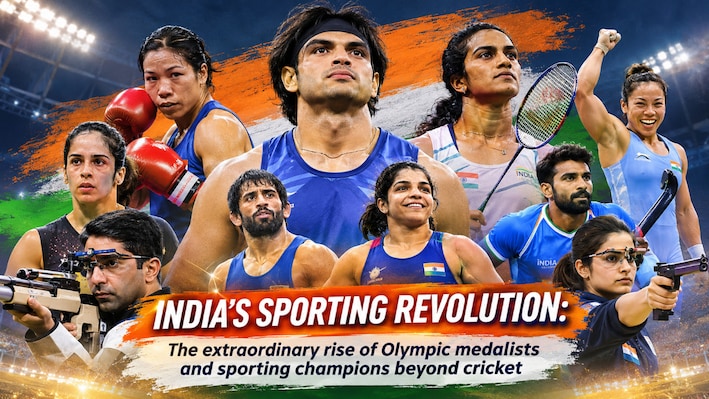
Yet over the past decade and a half, a quieter but profound shift has taken place and cricket's monopoly has quietly fractured. Athletes in badminton, athletics, shooting, weightlifting, wrestling, boxing, and hockey have forced the country to look beyond the boundary rope - and the results have been transformative.
From dusty wrestling akharas in Haryana to high-tech shooting ranges and elite badminton academies in Hyderabad, a wave of non-cricketing athletes has forced a billion-strong nation to widen its gaze.
Today, a javelin throw in Zurich, a badminton final in Basel, or a championship endgame on 64 squares commands the kind of prime-time collective breath once reserved exclusively for cricket.
The Spark Before The Blaze
The transformation did not happen overnight; it was built on isolated breakthroughs that proved global podiums were not off-limits to Indians.
In 1996, Leander Paes ended a 44-year individual Olympic medal drought with a tennis bronze in Atlanta. Four years later in Sydney, Karnam Malleswari lifted 240 kg to become the first Indian woman to win an Olympic medal.
The medal that reignited India's Olympic journey. 🥉🇮🇳 #OnThisDay, Leander Paes won bronze in men's singles tennis at Atlanta 1996, ending India's 44-year wait for an individual Olympic medal. 🎾 https://t.co/21HBjhBGlR
— Olympic Khel ™ (@OlympicKhel) August 3, 2026
Yet the true psychological turning point arrived at Beijing 2008. When Abhinav Bindra fired a near-perfect 10.8 on his final shot to claim India’s first individual Olympic gold in the 10m air rifle, alongside bronze medals from boxer Vijender Singh and wrestler Sushil Kumar, the narrative shifted.
The moment India made history. 🇮🇳 #OnThisDay, Abhinav Bindra won gold in the men's 10m air rifle at Beijing 2008, becoming India's first individual Olympic champion. 🥇🇮🇳 https://t.co/cn7awoKzdM
— Olympic Khel ™ (@OlympicKhel) August 11, 2026
Indian athletes were no longer content with just participating; they had learned how to win.
PV Sindhu And Badminton Revolution
If Abhinav Bindra lit the fuse, Indian badminton turned it into a sustained movement. Following Saina Nehwal's historic bronze at London 2012, Pusarla Venkata Sindhu emerged as the ultimate big-stage competitor.
Training under Pullela Gopichand in Hyderabad, Sindhu combined towering reach with relentless patience from the backcourt. At just 21, she announced herself to the world with a silver medal at the 2016 Rio Olympics. Three years later, she shed every label of falling short in finals by dismantling Nozomi Okuhara in 38 minutes to become India’s first-ever Badminton World Champion.
By adding a bronze at the Tokyo Games, she became the first Indian woman to win two individual Olympic medals - transforming badminton into the country’s second-most-watched sport and inspiring a generation of shuttlers, including men’s doubles pioneers Satwiksairaj Rankireddy and Chirag Shetty.
Rio 2016 🥈 Tokyo 2020 🥉 Only Indian woman to win two Olympic medals! Take a bow PV Sindhu 🙌 #Badminton | @Pvsindhu1 | @BAI_Media | @bwfmedia https://t.co/jYpEPyyUCw
— Olympic Khel ™ (@OlympicKhel) August 19, 2022
Neeraj Chopra: Ending A Century-Long Wait
For over a hundred years, track and field remained India’s hardest frontier - defined by agonizing near-misses from Milkha Singh and PT Usha. On August 7, 2021, in Tokyo, Neeraj Chopra erased that history with a single spear launch of 87.58 meters.
Winning India’s first-ever Olympic gold in athletics, Chopra did more than break a century-old barrier; he turned a technical field event into household entertainment.
Unlike past one-off flashes, Chopra brought unprecedented consistency to Indian athletics: a World Championships gold in Budapest in 2023, a Diamond League title, an Olympic silver in Paris 2024, and finally breaching the coveted 90-meter barrier in 2025.
5️⃣2️⃣ seconds of absolute brilliance! 🇮🇳 From the hockey greats of the past to the likes of Neeraj Chopra and PV Sindhu, these stars made sure India shone bright at the Olympics. 🌟 Next up, Paris 2024! 💪 @WeAreTeamIndia https://t.co/4N1eeS2gEY
— Olympic Khel ™ (@OlympicKhel) December 21, 2023
As Chopra himself noted after Tokyo, his greatest victory was simple: "Now everyone in India knows what a javelin is."
A Multi-Sport Vanguard
What makes the current era fundamentally different is that the spotlight no longer rests on just one or two solitary figures. Across disciplines, Indian athletes are rewriting record books simultaneously:
Shooting's New Precision: At the 2024 Paris Olympics, Manu Bhaker became the first athlete from independent India to win two medals in a single Olympic edition - bronze in both the women’s 10m air pistol and the mixed team event alongside Sarabjot Singh.
The Chess Renaissance: Building on Viswanathan Anand’s pioneering legacy, a fearless teenage wave led by World Champion D. Gukesh, R. Praggnanandhaa, and Arjun Erigaisi has turned India into an undisputed global chess superpower.
Mat, Ring, and Ring-Side Grit: From Mary Kom’s six world boxing titles and Mirabai Chanu’s Olympic weightlifting silver to wrestlers like Sakshi Malik, Bajrang Punia, and Paris medalist Aman Sehrawat, combat and strength sports have consistently delivered on the biggest stages.
The Revival of Hockey: After decades in the wilderness, the Indian men’s hockey team reclaimed its pride with back-to-back Olympic bronze medals in Tokyo and Paris.
What Changed Behind The Scenes?
Talent in India was never scarce; ecosystem support was. Over the last fifteen years, structural shifts finally caught up with athletic ambition:
Targeted Institutional Backing: Initiatives like the Target Olympic Podium Scheme (TOPS), alongside non-profit foundations such as Olympic Gold Quest (OGQ) and others ensured elite athletes received world-class foreign coaches, sports science, nutritionists, and international exposure rather than bureaucratic red tape.
Franchise Leagues and Visibility: The rise of domestic leagues in kabaddi, badminton, hockey, and table tennis created sustainable livelihoods and turned regional players into recognizable television personalities.
Digital Storytelling: Social media and streaming platforms bypassed traditional broadcast gatekeepers, allowing fans to follow live Diamond League meets, BWF tours, and chess streams in real time.
A New Sporting Identity
Cricket remains India’s undisputed cultural giant, and likely always will. Yet it no longer stands alone in a vacuum.
When Neeraj Chopra steps onto the runway, when PV Sindhu rallies at match point, or when Gukesh calculates thirty moves ahead, an entire nation now watches with the same fluency and passion it once reserved for a cover drive.
India hasn’t fallen out of love with cricket - it has simply discovered how much bigger its sporting heart can be.
Stay informed on all the latest news, real-time breaking news updates, and follow all the important headlines in india news and world news on Zee News English.