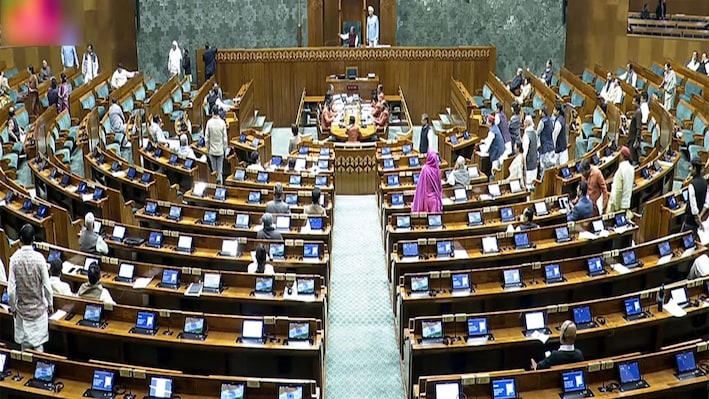
Three years have passed since Parliament enacted a law to reserve one-third of the seats for women in the Lok Sabha and state legislative assemblies; however, this quota has yet to be implemented. The government has now decided to reconvene Parliament, with the session set to begin on Monday. A Cabinet meeting scheduled for Friday may consider new proposals concerning the women’s reservation quota and the redrawing of electoral constituencies (delimitation) across India.
Minister of Parliamentary Affairs Kiren Rijiju said on Thursday that the government has requested Lok Sabha Speaker Om Birla and Rajya Sabha Chairman CP Radhakrishnan to reconvene the respective Houses on November 30 and December 2.
Rijiju noted that Parliament will convene to address "essential government business," with proceedings expected to conclude on December 3. He did not, however, specify which bills the government intends to introduce.
What can be expected from Friday's cabinet meeting?
Prime Minister Narendra Modi may chair a Cabinet meeting on Friday, November 27, The Tribune reported, citing sources. This meeting could see the consideration of revised proposals related to delimitation and the women’s reservation quota.
One of the proposals under consideration involves a 50 per cent increase in the number of Lok Sabha seats allocated to each state.
Why has the women's reservation law not been implemented yet?
In September 2023, Parliament passed the 'Nari Shakti Vandan Adhiniyam' (Women's Shakti Vandan Act). Enacted as the 106th Constitutional Amendment, this law provides for a 33 per cent reservation for women in the Lok Sabha, state legislative assemblies, and the Delhi Legislative Assembly. This provision also encompasses seats reserved for Scheduled Castes and Scheduled Tribes.
Although the law officially came into effect on April 16 of this year, women cannot yet avail themselves of this quota; this will only be possible once data from a new census is released and the subsequent delimitation process is completed.
Delimitation is the process of redrawing the boundaries of electoral constituencies and reorganising the distribution of legislative seats. Several southern states have expressed concern that a redistribution of seats based on population could reduce their share of representation in Parliament, as they have experienced a slower population growth rate compared to many states in the north.
Why did the Constitutional Amendment Bill fail in April?
In April, the government attempted to modify the existing framework to facilitate the implementation of the women's reservation system ahead of the 2029 Lok Sabha elections. The proposed constitutional amendment also included a provision to increase the maximum number of members in the Lok Sabha to 850.
However, on April 17, the Constitution (131st Amendment) Bill received 298 votes in favour and 230 votes against. A total of 528 Members of Parliament participated in the voting, whereas the government required 352 votes to pass the bill.
It fell short by 54 votes.
Under Article 368 of the Constitution, such an amendment requires the support of a majority of the total membership of each House, as well as a majority of at least two-thirds of the members present and voting in that House.
What are the demands of the Opposition?
The Congress has demanded that reservation for women be implemented immediately within the existing 543-member Lok Sabha, without altering the number of parliamentary seats allocated to individual states. Furthermore, they have proposed that this arrangement remain in place for 25 years.
However, there are differences among the Opposition parties regarding the issue of increasing the number of seats in the House. NCP (SP) leader Supriya Sule has indicated that her party might support a uniform 50 per cent increase in the number of seats across all states.
Why is the current session being resumed instead of convening a new session of Parliament?
Following the Monsoon Session, both Houses of Parliament were adjourned sine die on August 13; however, they were not formally prorogued by the President. Prorogation signifies the formal conclusion of a parliamentary session.
Therefore, the meetings proposed to begin on November 30 will not technically constitute the start of a new parliamentary session but rather an extension of the Monsoon Session.
Stay informed on all the latest news, real-time breaking news updates, and follow all the important headlines in india news and world news on Zee News English.