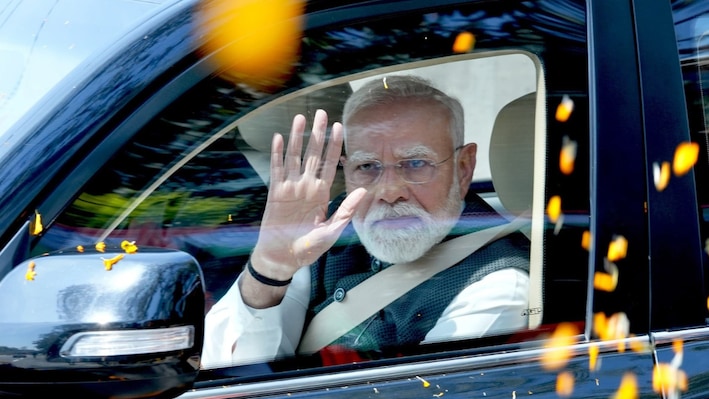
Prime Minister Narendra Modi is set to arrive in Manila on Monday for a three-day visit to attend the 23rd ASEAN-India Summit and the 21st East Asia Summit, with India looking to strengthen maritime security cooperation, deepen economic ties and consolidate its strategic engagement with the Indo-Pacific region amid growing geopolitical tensions.
The November 16-18 visit comes as the Philippines hosts the 49th ASEAN Summit and Related Summits under the theme “Navigating the Future”.
The gathering is expected to bring together leaders from major global powers and Southeast Asian nations to discuss regional security, maritime disputes, economic cooperation and the changing geopolitical landscape.
For New Delhi, the meetings offer an opportunity to advance its priorities in the Indo-Pacific, particularly closer naval coordination, stronger maritime partnerships and greater economic engagement with ASEAN member states.
Maritime security and regional stability high on agenda
One of India’s key objectives will be to expand maritime and naval cooperation with countries in the Indo-Pacific, where territorial disputes and security concerns continue to shape regional diplomacy.
The Philippines’ chairmanship has brought renewed attention to negotiations between ASEAN and China over a proposed Code of Conduct (COC) for the South China Sea.
Philippine Foreign Affairs Secretary Theresa Lazaro has acknowledged that the agreement is unlikely to be concluded during Manila’s tenure, despite progress in discussions.
Lazaro said ASEAN and China had provisionally agreed on around 80 per cent of the proposed code. However, differences over important provisions, including whether the agreement should be legally binding, remain unresolved.
“There is not enough time”, Lazaro said, indicating that negotiations would continue under Singapore, which is due to assume ASEAN’s chairmanship in 2027.
The East Asia Summit, established in 2005, provides a platform for leaders to discuss regional political, security and strategic developments.
Apart from ASEAN’s 11 members, it brings together India, China, Japan, South Korea, Australia, New Zealand, the United States and Russia.
India-ASEAN trade and AITIGA review
Economic cooperation will be another major component of Modi’s engagements in Manila. India has been seeking to expand trade and investment with Southeast Asian countries while strengthening defence and strategic partnerships.
An important issue on the agenda is the ongoing review of the ASEAN-India Trade in Goods Agreement (AITIGA), with New Delhi pushing for an early conclusion of negotiations.
Annual trade between India and ASEAN is estimated at around $122 billion. External Affairs Ministry Secretary (East) Rudrendra Tandon has described the regional grouping as a key pillar of India’s Act East policy and its vision for the Indo-Pacific.
“India strongly believes that as an Indian Ocean country that abuts this very important Southeast Asian maritime zone, a strong strategic relationship with ASEAN member states, as a collective as well as individually, is good for both of us”, Tandon said.
He added that closer engagement would help both sides respond to rapid geopolitical changes and contribute to peace and stability across Asia.
Asked about the progress of the AITIGA review, Tandon said discussions were continuing. “That conversation is ongoing”, he said.
Trump, global conflicts add to summit’s geopolitical significance
The Manila gathering is also expected to draw attention because of the participation of major global powers, including US President Donald Trump.
Trump is travelling to Asia following significant Republican losses in the US midterm elections, with the international visit offering an opportunity to regain momentum on the global stage.
His Manila engagements are expected to include discussions with Southeast Asian leaders and a meeting of the Quad, comprising India, the US, Japan and Australia. Trump is then scheduled to travel to China for the Asia-Pacific Economic Cooperation (APEC) summit, where he is expected to meet Chinese President Xi Jinping and Russian President Vladimir Putin, according to the Associated Press.
The wider regional discussions are also taking place against the backdrop of major international conflicts, including the war involving Iran and Russia’s ongoing war in Ukraine.
The conflict in Myanmar and tensions in the South China Sea are among the regional concerns likely to feature in the deliberations.
For India, the presence of major powers offers an additional opportunity to advance its strategic interests and strengthen coordination with partners across the Indo-Pacific.
Modi’s engagements in Manila
According to the Ministry of External Affairs, Prime Minister Modi’s programme includes participation in the ASEAN-India Summit and the East Asia Summit on November 17.
Philippine President Ferdinand Marcos Jr. is also scheduled to host a dinner for visiting dignitaries, while bilateral meetings with other leaders are part of the Prime Minister’s engagements.
Prime Minister is also expected to meet members of the Indian community in the Philippines. Tandon said there was considerable interest among members of the diaspora in interacting with the Prime Minister.
“There is also a very strong demand from the Indian community to meet the Prime Minister. So we are trying to adjust that also in his schedule”, he said.
At least 19 leaders representing sovereign nations and international organisations are expected to participate in the Manila gatherings.
Those attending include Chinese Premier Li Qiang, Brazilian President Luiz Inácio Lula da Silva, Canadian Prime Minister Mark Carney and United Nations Secretary-General Antonio Guterres.
Other participants include Australian Prime Minister Anthony Albanese, Indonesian President Prabowo Subianto, Malaysian Prime Minister Anwar Ibrahim, Thai Prime Minister Anutin Charnvirakul, Singapore Prime Minister Lawrence Wong and Timor-Leste Prime Minister Kay Rala Xanana Gusmao.
The summit has also confirmed the next phase of ASEAN’s rotating chairmanship, with Singapore set to take over in 2027, Thailand in 2028 and Timor-Leste in 2029.
As Manila hosts the regional leaders under the theme “Navigating the Future”, India’s focus will remain on strengthening its partnership with ASEAN, improving maritime coordination and expanding trade and commercial opportunities. Modi’s visit comes at a crucial juncture for New Delhi’s Indo-Pacific engagement, with regional stability and economic cooperation emerging as central priorities.
Stay informed on all the latest news, real-time breaking news updates, and follow all the important headlines in india news and world news on Zee News English.