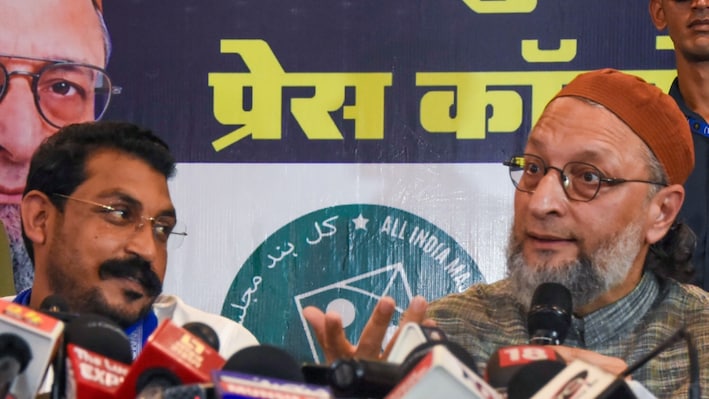
The announcement of the Samajik Parivartan Morcha has introduced a significant new dimension to Uttar Pradesh’s political contest ahead of the 2027 Assembly elections. Asaduddin Owaisi’s AIMIM and Chandrashekhar Azad’s Azad Samaj Party (Kanshi Ram) have formally joined hands, with Azad named as their chief ministerial candidate and both parties declaring their intention to contest all 403 Assembly seats. Their stated objective is to mobilise Dalits, minorities, backward communities, and other marginalised sections. Yet the political significance of this alliance extends beyond the formation of another electoral front: it directly challenges Akhilesh Yadav’s claim that the Samajwadi Party’s PDA formulation offers the most credible political platform for these very constituencies.
The battle for political ownership of PDA
Since popularising the PDA formulation in 2023—Pichhda, Dalit and Alpsankhyak—Akhilesh Yadav has attempted to reposition the Samajwadi Party beyond its traditional Muslim-Yadav support base. The proposition is politically straightforward: bring together numerically significant communities but, according to the party, insufficiently represented in political institutions and decision-making. The SP has presented this coalition as the foundation of a wider social-justice movement, and its 37-seat performance in Uttar Pradesh in the 2024 Lok Sabha elections provided considerable political momentum to that claim.
However, PDA is essentially an electoral and social-coalition formulation within the Samajwadi framework, not an independently articulated ideological doctrine. Its expanding interpretation, which has at different points included Pandits, the exploited and women, demonstrates its flexibility as a political slogan. But flexibility also raises a question: when a coalition is designed to represent almost every socially aggrieved constituency, what distinguishes its political commitment from the pursuit of a wider electoral arithmetic?
Two parties, two claims of independent representation
The emergence of the Samajik Parivartan Morcha exposes the central vulnerability in the SP’s strategy. Owaisi has consistently argued that Muslim voters should have an independent political voice rather than remain dependent on parties that seek their support during elections but do not necessarily accommodate their demand for political representation. AIMIM’s political identity is built around this claim, with its historical roots in the Majlis-e-Ittehadul Muslimeen and its contemporary expansion efforts extending beyond its traditional stronghold of Hyderabad.
Chandrashekhar Azad, meanwhile, has built his political identity around Dalit assertion, Ambedkarite thought, constitutional rights and social justice. The Bhim Army, established in 2015, provided the organisational foundation for his public activism before the formation of the Azad Samaj Party in 2020. His victory from Nagina in the 2024 Lok Sabha election—with 5,12,552 votes and a winning margin of 1,51,473—marked a substantial electoral breakthrough. It also strengthened his claim to be an independent Dalit political voice, rather than merely an auxiliary figure in a larger opposition coalition.
Their partnership therefore brings together two distinct political constituencies under a common proposition: communities that believe their electoral importance has not translated into commensurate political influence should organise and negotiate independently.
Samajwadi Party's ideological contradiction
The challenge for Akhilesh Yadav is not simply that two leaders have allied. It is that their political argument questions the SP’s credentials as the natural representative of the very communities around which its PDA narrative is constructed.
Founded by Mulayam Singh Yadav in 1992, the Samajwadi Party emerged from the politics of the Mandal era and presented itself as an advocate of democratic socialism, equality, secularism, and the empowerment of backward classes, farmers and minorities. Its ideological inheritance is associated with Ram Manohar Lohia. Yet, over time, the party’s leadership has remained closely identified with the Yadav political family, with Mulayam Singh Yadav serving as its central figure before Akhilesh assumed leadership.
This creates an uncomfortable political question for the SP. Can a party convincingly claim to champion broader social representation when its own organizational and leadership structure is frequently criticised for remaining concentrated around a particular political family? The question is not whether individual members of that family are entitled to participate in electoral politics; it is whether the party’s internal distribution of authority reflects the wider democratic representation it promises to deliver outside its organisation.
PDA may have broadened the SP’s electoral vocabulary, but it has not automatically resolved questions about internal representation, leadership concentration or the actual distribution of political influence.
Arithmetic of narrow-margin constituencies
The alliance’s potential significance becomes more apparent when viewed against Uttar Pradesh’s electoral geography. In the 2022 Assembly election, 49 constituencies were decided by margins of fewer than 5,000 votes. Twenty-five SP candidates lost by such margins, while BJP candidates and other alliance partners also experienced similarly narrow defeats. In several constituencies, the difference was only a few hundred votes: Dhampur was decided by 203 votes, Kursi by 217 and Chandpur by 234.
These results illustrate how even a relatively modest shift in voting patterns can alter constituency outcomes. The 2027 contest will therefore not be determined exclusively by the overall popularity of political alliances. Candidate selection, local social equations, turnout and the ability to transfer votes between allied parties will matter enormously.
For the SP, the difficulty is particularly acute. A new alliance that seeks to consolidate Dalit and Muslim voters independently could challenge the party in precisely those constituencies where its candidates have previously lost narrowly. Nevertheless, the existence of 49 close contests does not establish that the new alliance will win or even decisively influence all those seats. Its actual impact will depend on whether its leaders can translate public mobilization into votes and organizational presence across the state.
Coalition of communities or a coalition of political ambitions?
The Morcha’s announcement that it intends to contest all 403 seats, while naming Chandrashekhar Azad as its chief ministerial face, is an ambitious declaration. AIMIM has yet to establish a substantial electoral footprint in Uttar Pradesh: in 2022, it contested 95 seats but secured approximately 0.49 per cent of the statewide vote and won none. The Azad Samaj Party also remains organizationally limited despite its leader’s breakthrough in Nagina. Their challenge is to demonstrate that the alliance can move beyond concentrated community support and develop a credible statewide organisation.
There is also a larger question of political coherence. Dalit and Muslim communities are not homogeneous electoral blocs. Their interests, local priorities, economic circumstances and political preferences differ considerably. A shared demand for representation may provide a basis for cooperation, but it does not automatically resolve differences over leadership, candidates, policy priorities or the distribution of power within the alliance.
The wider contest: Representation versus governance
The BJP-led NDA enters this emerging contest with a different political proposition. While the opposition increasingly frames representation through specific social and community identities, the BJP seeks to combine its broader social coalition with an emphasis on governance, public-service delivery, and welfare schemes. Under the Yogi Adityanath government, beneficiaries of state- and centrally sponsored programmes have been drawn from different castes, communities, and religious backgrounds, subject to eligibility criteria. This offers the BJP an opportunity to argue that welfare delivery and administrative performance must be assessed by outcomes rather than political identity alone.
The question before Uttar Pradesh’s electorate, therefore, is not merely who claims to represent a particular community. It is whether political representation translates into effective administration, economic opportunity, public services and meaningful participation in decision-making. The Samajik Parivartan Morcha has made its challenge to the SP unmistakable. Whether it can convert that challenge into a durable political alternative remains to be seen. For Akhilesh Yadav, however, the immediate difficulty is already evident: before confronting the BJP’s governance narrative, he must defend his own claim to represent the constituencies that PDA was designed to bring together.
(The author is an Assistant Professor at Ramanujan College, University of Delhi, and writes on contemporary issues. The views expressed in this article are those of the author and do not necessarily reflect those of Zee News.)
Stay informed on all the latest news, real-time breaking news updates, and follow all the important headlines in india news and world news on Zee News English.