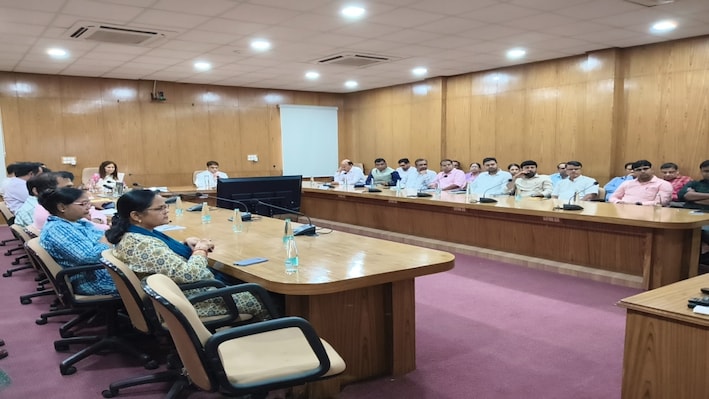
The eighth International Conference on Sustainable and Innovative Solutions for Current Challenges in Engineering and Technology (ICSISCET 2026) successfully concluded at Madhav Institute of Technology and Science (MITS), Deemed University, Gwalior. The conference brought together researchers, academicians, scientists and technology professionals to exchange insights on emerging areas such as artificial intelligence, computational intelligence, cybersecurity, renewable energy and sustainable engineering.
Held in hybrid mode on October 30-31, 2026, the two-day international conference was organised with technical support from the Soft Computing Research Society (SCRS). Participants from India and other countries presented their research on contemporary technological challenges and discussed innovative solutions with potential applications across industry and society.
The conference received 1,426 research paper submissions from seven countries: India, Czechia, Fiji, Nepal, Peru, Serbia and the United States. A rigorous review process involving 437 expert reviewers resulted in the acceptance and registration of 74 papers, representing an acceptance rate of approximately 5.2 per cent. The technical programme comprised 17 sessions, including online and offline sessions. The research was organised around four major themes: Sustainable Computing and Information Technology; Computational Intelligence and Machine Learning; Embedded Systems and VLSI Design; and Advances in Intelligent Computing, Sustainable Engineering Systems and Practices. The selected papers are to be submitted for publication in the Scopus-indexed Springer book series Lecture Notes in Networks and Systems.
The inaugural ceremony was held at the Convention Hall of MITS-DU on October 30 in hybrid mode. The programme began with a video presentation on the ICSISCET conference series, Saraswati Vandana, a welcome to the dignitaries and an overview of MITS-DU and ICSISCET 2026. Prof. Manjaree Pandit, Pro-Vice-Chancellor of MITS-DU and General Chair of ICSISCET 2026, addressed the gathering and highlighted the conference's research contributions, international participation and rigorous selection process. Dr. Manoj Kumar Gaur, Professor at MITS-DU and General Chair of the conference, and Dr. Sandeep Kumar of CHRIST (Deemed to be University), Bengaluru, also featured in the inaugural programme. Dr. R. S. Jadon, Professor at MITS-DU and Organising Chair, and Prof. J. C. Bansal, Professor at South Asian University, New Delhi, and President of the Soft Computing Research Society, were also among the speakers.
The inaugural address and plenary lecture were delivered by Prof. K. K. Aggarwal, Pro-Chancellor of MITS-DU, Gwalior, President of South Asian University, New Delhi, and Chief Patron of ICSISCET 2026. His participation highlighted the importance of research, innovation and interdisciplinary collaboration in addressing emerging challenges in engineering and technology. The conference programme emphasised the role of academic institutions in encouraging high-quality research and developing technology-driven solutions relevant to industry and society.
The conference featured invited talks by professionals with expertise in artificial intelligence, enterprise technology, cybersecurity, data engineering, software development, cloud infrastructure and digital transformation. The invited speakers included Santosh Swarna Sathya Chamarthy, Senior Technical Program Manager at Saviynt, who presented “Security-First Agentic AI: Identity, PAM, and Zero Trust by Design”; Suresh Reddy Mallepalli, Manager of Data Engineering at BrightSpring Health Services, who discussed “Automated Data Quality Engineering and Governance in Healthcare Analytics: A Cloud Lakehouse Framework”; and Venkata Niranjan Reddy Challa of Fluor Corporation, who presented “A Digital Twin of the Payroll Engine: Simulation-Driven Regulatory Change.” Santosh R. Deepika Addagalla of TriZetto Provider Solutions addressed “Engineering in the Age of AI: Leveraging Copilot for Enhanced Software Development,” while Venkateswara Rao Mekanaboina, Senior Systems Analyst at 3R Info, presented “Modern EDI Evolution in S/4 HANA Migration and Smart Approval Workflow for Pricing and Promotions.” Saddam Hussain, Data Scientist at Carmeuse, discussed “Beyond Algorithms: Building Reliable and Sustainable AI Systems for Real-World Industrial Applications.”
The second invited-talk session featured Kalyana Gajapathi Raju Konduru of the University of Phoenix, who presented “Architecting Enterprise Generative AI for Automated Pricing and Contract Decisioning in PBM.” Onkar Khadke, Senior Software Development Engineer in Test, discussed “AI-Augmented Quality Engineering for Continuous Test Optimization.” Rajendar Reddy Sama, Architect and Technical Delivery Manager at Quadrant Technologies, presented “Designing Globally Scalable Distributed Review and Certification Systems for Digital Marketplaces.” Prasada Rao Paleti, AWS Senior Solutions Architect, addressed “Resilience Engineering for Cloud-Based Tolling and Transportation Systems,” while Ramesh Kumar Varanganti, SAP Integration Lead, discussed “From API-Centric Integration to Agentic AI: Building Secure, Intelligent Enterprise Systems with Model Context Protocol (MCP).” These talks provided practical perspectives on the application of emerging technologies in enterprise systems, healthcare analytics, software engineering, cloud services and industrial operations.
The technical sessions covered a wide range of research problems and proposed solutions. Topics included trustworthy machine learning, privacy preservation, explainable artificial intelligence, solar photovoltaic power forecasting, renewable energy optimisation, cybersecurity, secure image encryption, intelligent transportation, smart agriculture, Internet of Things applications, embedded systems, VLSI design and cloud computing. Researchers also presented work on generative AI, large language models, digital twins, AI-assisted healthcare, medical image analysis, energy-efficient computing and carbon-aware data centre management. These presentations demonstrated how computational intelligence and emerging technologies are being applied to improve system performance, strengthen security, optimise energy consumption and address practical engineering challenges.
Research on renewable energy and sustainable engineering formed an important part of the programme. Presentations addressed short-term solar power forecasting, harmonic distortion analysis in solar photovoltaic-integrated distribution systems, energy-efficient electronic circuit design and optimisation of renewable energy resources. Other research explored the use of hybrid reinforcement learning to reduce energy consumption and carbon emissions in cloud data centres, digital-twin-based automotive safety testing, environmentally sensitive highway planning and intelligent precision agriculture. Such work highlighted the growing intersection of artificial intelligence, engineering optimisation and environmental sustainability.
The conference also provided a platform for research on cybersecurity and trustworthy computing. Topics included zero-trust security, privacy-preserving machine learning, cyber-threat detection, secure data transmission, phishing detection, cryptography, protection of large language models against prompt injection and secure enterprise integration. Research on AI-based healthcare applications, including disease prediction and medical image analysis, further illustrated the potential of intelligent systems to support decision-making in critical application areas.
Throughout the conference, researchers and participants engaged in technical discussions and exchanged ideas on emerging research directions. The hybrid format enabled broader participation by combining in-person activities at MITS-DU with online presentations and discussions, strengthening opportunities for interaction among researchers from different institutions and countries.
At the conclusion of the conference, Prof. Manjaree Pandit, General Chair of ICSISCET 2026 and Pro-Vice-Chancellor of MITS-DU, reiterated the importance of maintaining rigorous research standards and encouraging innovative work. Dr. R. K. Pandit, Vice-Chancellor of MITS-DU and Patron of the conference, congratulated the participants and organising committee and encouraged young researchers to translate their findings into practical solutions for challenges faced by industry and society. The proposed submission of selected papers to the Springer series Lecture Notes in Networks and Systems is expected to provide an additional avenue for disseminating the research presented at the conference.
ICSISCET 2026 concluded with a focus on advancing international academic collaboration and promoting research that connects emerging technologies with sustainable development. By bringing together contributions in artificial intelligence, machine learning, cybersecurity, renewable energy, embedded systems and intelligent engineering, the conference reinforced the role of interdisciplinary research in addressing current and future technological challenges.
Stay informed on all the latest news, real-time breaking news updates, and follow all the important headlines in india news and world news on Zee News English.