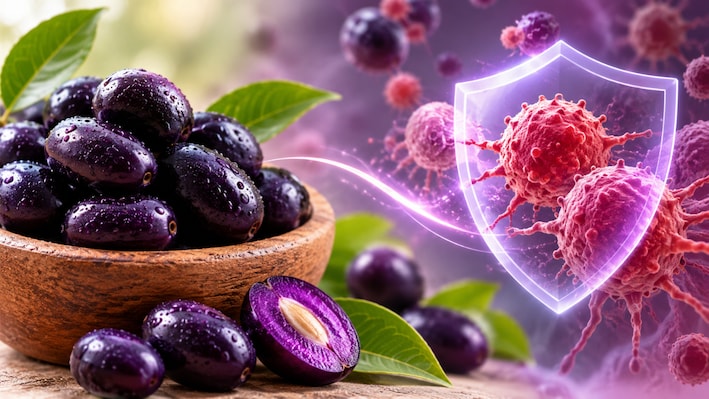
Known across Indian households for its sweet-tart flavour and deep purple hue, jamun has long been a summer staple. Beyond its refreshing taste and traditional uses, the humble fruit is now drawing growing curiosity in scientific circles for its potential role in supporting cellular health and influencing cancer-related pathways.
To separate promising laboratory findings from everyday dietary reality, leading oncologists weigh in on what current science actually reveals about jamun and breast cancer risk.
What makes jamun’s purple pigments and compounds scientifically interesting?
Dr Mansi Sandip Shah, Consultant Cancer Physician, HOC Rajpath, says, "Jamun, which is widely consumed in India, is gaining increased scientific attention due to its diverse content of bioactive compounds. The color of the fruit is purple because of anthocyanin, which is a pigment that has strong antioxidant properties. Other ingredients contained in jamun include polyphenols, ellagic acid, and other phytochemicals that may impact processes of inflammation, oxidative stress, and signaling pathways that are being researched by scientists in terms of cancer progression."
Echoing the significance of these plant compounds, Dr Amit Upadhyay, Senior Consultant – Medical Oncology, PSRI Hospital, says, "Jamun (Syzygium cumini) is a great source of anthocyanins, natural pigments that provide the fruit with its dark purple color. It also contains ellagic acid and other bio-active compounds which are antioxidants. The compounds are of scientific interest due to the potential to protect cells from oxidative damage and the possible involvement in biological processes related with cancer development. But lab results don’t always translate to preventing cancer in people."
How do jamun’s bioactive compounds affect inflammation and cellular damage?
Dr Shah adds, "Both oxidative stress and chronic inflammation can cause cellular damage, and both factors are considered risk factors of cancer development. According to some lab experiments, compounds found in jamun are able to mitigate these effects. Nevertheless, there is no guarantee that consuming a fruit with antioxidants can prevent people from developing cancer."
Dr Upadhyay adds, "Yes, maybe. Studies suggest that the bioactive compounds in jamun may affect pathways and cellular processes related to oxidative stress and inflammation that influence tumor growth. But these effects are compound-dependent, as well as dependent on the concentration and the biological environment. It is too early to tell if eating jamun can make a difference to these processes or prevent breast cancer in people."
What early research reveals versus human clinical evidence
Dr Upadhyay says, "Laboratory studies have found that jamun extracts can inhibit the growth of breast cancer cells and cause them to undergo programmed cell death. A study in rats in 2016 also showed less tumour development after a jamun-enriched diet. But these are early findings and do not prove that eating the fruit prevents breast cancer in people. Any preventive benefit must be demonstrated in well-designed clinical studies in humans."
Dr Shah says, "The results of preliminary research on the topic indicate promising prospects. It has been proved in vitro that jamun extracts can stop breast cancer cells from growing and even induce apoptosis or programmed cell death. Moreover, researchers tested the effect of the fruit on mice models with hormone-dependent breast cancer and discovered a reduction in the development of tumors and some alterations in proliferation and hormonal signalling pathways. What one needs to remember is that the laboratory-based studies rely on extracts in concentrations higher than what a person could consume normally in his/her diet. There is currently no proof, based on solid clinical evidence, showing that consumption of jamun decreases chances of breast cancer development in humans. More studies, including human trials, need to be done to prove a possible preventive effect."
Can adding jamun to your diet support long-term breast health?
Dr Shah adds, "Despite the lack of proof regarding breast cancer prevention, consumption of seasonal fruits such as jamun could improve one's diet. A proper diet rich in fruits, vegetables, whole grains, and fiber, together with exercise, keeping one's body weight within healthy limits and moderate alcohol consumption might be helpful in maintaining good health and reducing risks of some cancers. Therefore, one should enjoy jamun as a healthy seasonal fruit rather than as an anticancer therapy. Breast cancer prevention and early diagnosis require a comprehensive approach which involves leading a healthy lifestyle, being aware of personal risks of developing breast cancer, doing proper screening, etc. Interest in studying jamun shows once again that nature provides plenty of substances which are worth investigating."
Dr Upadhyay adds, "Yes, you can incorporate jamun in your diet as it contains beneficial plant compounds and other nutrients. But no one fruit can give you a breast cancer shield. Eating a variety of foods, including plenty of fruits, vegetables, whole grains and legumes, being physically active, staying at a healthy weight and limiting alcohol can all help promote health and help reduce the risk of some cancers.Women should also be given appropriate advice about breast screening according to their age and individual risk factors."
(This article features expert quotes provided for informational purposes only. It is not a substitute for professional medical advice. Always consult a qualified healthcare provider regarding any medical condition.)
Stay informed on all the latest news, real-time breaking news updates, and follow all the important headlines in india news and world news on Zee News English.