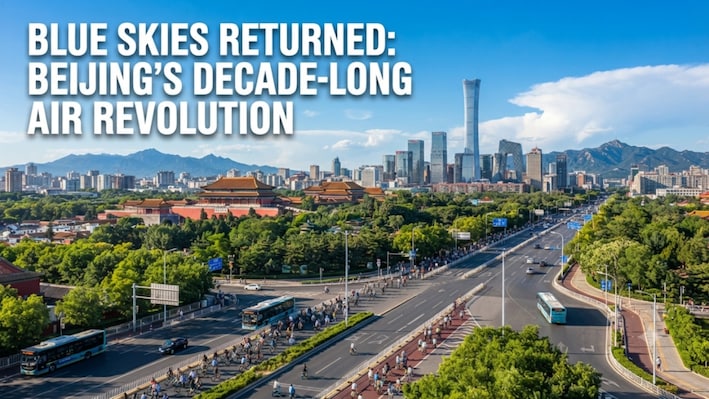
At 2:00 PM on November 14, 2026, New Delhi’s average Air Quality Index (AQI) surged to a hazardous 563, choking residents and shrouding the capital in thick smog. Roughly 3,780 kilometres away, Beijing recorded an AQI near 170 on November 13—still unhealthy, yet a radical transformation for a city where winter AQI routinely crossed 700 in 2013–14.
China achieved this turnaround not through temporary emergency bans, but through a decade-long, multi-billion-yuan overhaul of energy, industry, and regional transport.
How Beijing Fell Into the ‘Chinese Haze’ Trap
Once known globally as the "Kingdom of Bicycles," China’s rapid economic boom replaced pedal power with combustion engines, factories, and coal-fired heating.
By January 2013, pollution in Beijing grew so severe that skyscrapers vanished behind thick grey smog, prompting international observers to coin the term "Chinese haze." According to World Bank data, Beijing’s 24-hour average PM2.5 concentration spiked to 569 micrograms per cubic metre—mirroring Delhi’s November 2017 peak of 576 micrograms per cubic metre.
Residents suffered burning eyes, acute asthma attacks, and respiratory distress. In September 2013, China’s State Council launched the Air Pollution Prevention and Control Action Plan, targeting a 25% cut in Beijing’s annual PM2.5 levels by 2017 by attacking pollution at its source.
Four Pillars of Beijing’s Clean-Air Turnaround
While Beijing began preliminary anti-pollution efforts in 1998, real structural change arrived after 2013 when Beijing treated air quality as a national mission backed by heavy enforcement:
Eliminating Coal and Relocating Heavy Industry: Coal-fired boilers used for residential heating, power generation, and manufacturing were the primary culprits behind Beijing’s smog. Per the United Nations Environment Programme (UNEP), authorities banned coal boilers, switched households to clean natural gas and electricity, enforced strict factory emission standards, and shut down or relocated high-polluting industries outside the city.
Regional Enforcement Across Borders: Recognizing that smog ignores municipal boundaries, Beijing synchronized its crackdown with neighboring Tianjin and Hebei province so industrial smoke from surrounding belts could no longer drift back into the capital.
Overhauling Urban Transport: China tightened vehicular emission norms, phased out older high-emitting vehicles, expanded Beijing’s metro rail network, and revived bicycle commuting through large-scale bike-sharing systems for short-distance travel.
Dust Control and Ecological Restoration: Authorities enforced strict dust suppression at construction sites while expanding urban green belts and restoring degraded ecosystems around the capital.
The Numbers Behind Beijing’s Decade of Progress
China backed its regulations with massive capital, expanding Beijing’s pollution-control budget sixfold—from just over 3 billion yuan in 2013 to more than 18 billion yuan by 2017, according to UNEP.
The results reshaped both public health data and the city's skyline:
66% Drop in Annual PM2.5: Beijing’s annual average PM2.5 fell from 89.5 micrograms per cubic metre in 2013 to 58 micrograms in 2017 (a 35% drop), before plunging further to 30 micrograms per cubic metre in 2023.
Fewer Hazardous Days: Days with severe, heavy pollution dropped from 58 days a year in 2013 to just two or three days annually.
Clearer Skylines: Studies between 2015 and 2020 recorded a sharp rise in days with visibility exceeding 10 kilometres, bringing distant mountain ranges and skyscrapers back into clear view.
What Delhi-NCR Can Learn From Beijing’s Playbook
Delhi and Beijing share striking structural similarities: dense populations, heavy vehicle traffic, construction dust, industrial emissions, and transboundary pollution drifting in from neighboring states like Punjab, Haryana, and Uttar Pradesh.
Beijing’s experience proves that short-term measures—such as pausing construction for a few days or restricting cars temporarily—cannot solve a structural crisis. While Beijing’s PM2.5 levels still exceed World Health Organization (WHO) guidelines, China demonstrated that sustained political will, clean energy transitions, public transit expansion, and coordinated action across neighboring states can reclaim breathable air within a decade.
Beijing vs. Delhi: Pollution & Policy Comparison
Parameter / Metric Beijing (China) New Delhi (India)
Recent AQI Snapshot ~170 (Nov 13, 2026) 563 Average / Hazardous (Nov 14, 2026)
Historical Crisis Peak Over 700 AQI (2013–14); 569 µg/m³ PM2.5 (Jan 2013) 576 µg/m³ PM2.5 (Nov 2017)
Annual PM2.5 Trajectory Fell from 89.5 µg/m³ (2013) to 30 µg/m³ (2023) — ~66% drop Remains critically elevated each winter
Budget & Action Plan 2013 Action Plan; budget raised from 3B to 18B+ yuan Seasonal GRAP restrictions & state-level curbs
Core Strategy Coal bans, factory relocations, metro/bike-share, regional coordination (Beijing–Tianjin–Hebei) Temporary construction bans, vehicle restrictions, stubble management efforts
Stay informed on all the latest news, real-time breaking news updates, and follow all the important headlines in india news and world news on Zee News English.