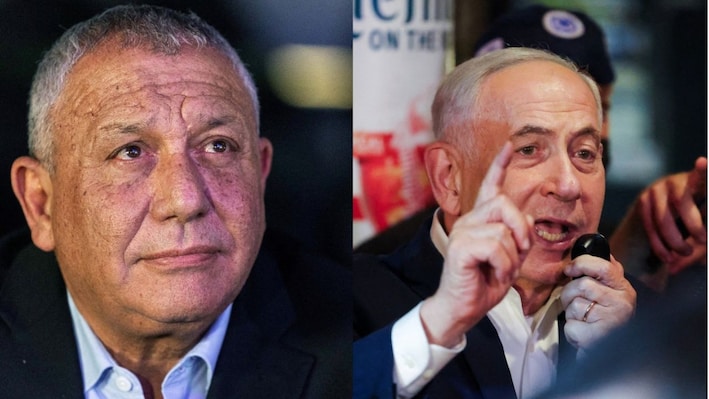
Jerusalem: In an election that could decide Benjamin Netanyahu’s political future after years of war and criticism of his government’s handling of national security, Israel will vote on Tuesday (October 27). With around 13% of voters still undecided, rival parties are trying to win over people who could determine the balance of power in the next Knesset.
US President Donald Trump has backed Netanyahu, who is seeking another term as prime minister. He has said that he is concerned about the election result but will not retire if he loses.
The contest has become especially important for centrist challenger Gadi Eisenkot, whose Yashar party is seeking support from voters who backed Netanyahu’s Likud party in the 2022 election. Recent polling suggests that Netanyahu’s coalition could struggle to secure a parliamentary majority, while Opposition parties also face difficulties in putting together a government.
How is Israel’s government formed?
Israel follows a parliamentary system. The Knesset is the country’s legislature. It has 120 seats, and a government needs the support of at least 61 lawmakers to command a majority.
The country uses proportional representation, which means seats are allocated according to the votes parties receive across the country, subject to an electoral threshold. No single party has ever won enough seats to govern alone. Coalition negotiations therefore play an important role in forming a government.
After the results are announced, President Isaac Herzog consults political parties before asking a candidate considered best placed to form a government to take the lead. The candidate is given 28 days to form a coalition. The deadline can be extended by up to 14 days.
If the first candidate fails, the president can give another lawmaker an opportunity. If those efforts also fail, further parliamentary steps may follow, potentially leading to another election.
The results are expected on November 4, while preliminary results should be available after voting ends. Israel’s political history shows how difficult coalition-building can be. The country held five elections between 2019 and 2022 after parties repeatedly failed to establish a stable government.
Netanyahu’s challenge among undecided voters
The Israel Democracy Institute’s Viterbi Family Center for Public Opinion and Policy Research estimates that about 13% of voters have not decided whom to support. Among people who voted for Likud in 2022, only 55% now say they plan to vote for the party again.
Around 15% of these former Likud voters say they will back parties opposed to Netanyahu, including 8% who favour Yashar. Another 14% say they will vote for other right-wing parties, while 9% are still undecided.
Michal Elmalem Abu, a city council member elected from Likud who is now leading Eisenkot’s campaign in Dimona, said that Netanyahu had a core of loyal supporters who were unlikely to change their minds. The main contest, she said, was for voters who “understand that we are in a state of crisis” and could be persuaded to support another party.
Dimona, a town in the Negev Desert with a long history of support for Likud, has become an important battleground. Some former Likud voters are campaigning for Eisenkot, blaming Netanyahu for the security failures surrounding Hamas’ October 7, 2023, attack. Other residents continue to support the prime minister, crediting his governments with investment in their communities.
Rain forecast on polling day
Southern and eastern Israel are expected to see cooler weather and rain. Heavier showers, thunderstorms, strong winds and possible hail are forecast for the afternoon.
Flash floods are a particular risk in dry riverbeds in the Negev and Arava regions and around the Dead Sea. However, polling stations are scheduled to remain open for 15 hours. Voters can cast their ballots before or after periods of rain.
Israel’s election calendar takes seasonal conditions into account. As per the 1959 amendment to the Basic Law, the Knesset set the usual election period after the Tishrei religious holidays and before the coldest part of winter.
If Tuesday’s vote takes place as scheduled, it will be the first Israeli general election held on its legally prescribed date since 1988. The election date of October 27 was confirmed after the Knesset’s legal adviser said that the ongoing parliament would complete its full term.
Stay informed on all the latest news, real-time breaking news updates, and follow all the important headlines in india news and world news on Zee News.