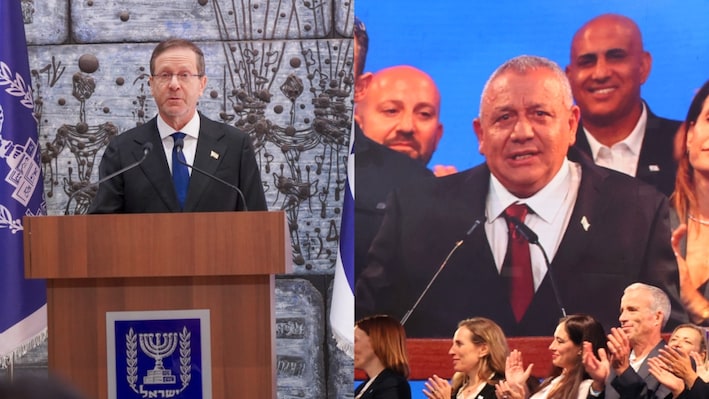
In a major political setback for Benjamin Netanyahu, Israeli President Isaac Herzog has formally tasked former military chief and Yashar party chairman Gadi Eisenkot with forming the country's next government, after he secured the backing of a majority of lawmakers in the 120-member Knesset.
Eisenkot, who led the centrist Yashar bloc in last month's parliamentary elections, now has up to six weeks to negotiate with potential coalition partners and secure the numbers needed to replace Netanyahu as prime minister.
The decision followed consultations between Herzog and representatives of all political factions in the Knesset, along with discussions with both Netanyahu and Eisenkot.
In a statement posted on X, the Office of the President of Israel confirmed that Eisenkot had received recommendations from factions representing 67 lawmakers, comfortably exceeding the 61 seats required for a parliamentary majority.
"President of the State of Israel Isaac Herzog has decided to task the chairman of the Yashar party, Gadi Eisenkot, with forming the government. The president’s decision was made at the conclusion of the round of consultations with Knesset factions, and after holding in-depth conversations and further inquiries with various figures in the political system over the past few days," the statement said.
It added that Herzog had met both Netanyahu and Eisenkot before making his decision.
The consultations showed that 67 lawmakers backed Eisenkot for the leadership of the 38th government, while 46 recommended Netanyahu. The remaining seven lawmakers, belonging to one faction, chose not to endorse either candidate.
Herzog has invited Eisenkot to the President's Residence for the formal mandate-conferral ceremony on Sunday, November 8, at 5 pm local time.
The backing for Eisenkot came after the Arab-led Joint List unanimously recommended his candidature, joining the opposition bloc and the Arab Ra'am party. According to the consultation figures, his support comprises 48 seats from the Jewish-led opposition parties, Yashar, Together, The Democrats and Yisrael Beiteinu, eight from Ra'am and 11 from the Joint List.
Netanyahu, meanwhile, received recommendations from lawmakers representing 46 seats, down from the 53 seats secured by his right-wing bloc in the elections. The ultra-Orthodox United Torah Judaism (UTJ) party, which holds seven seats, chose not to endorse him.
The move marks a significant break in UTJ's long-standing alliance with Netanyahu and further weakens his position following the election results.
Eisenkot's plan for emergency government
Eisenkot has rejected the prospect of Netanyahu continuing as caretaker prime minister during wartime and outlined a four-pillar framework for an emergency government.
His proposals include recognising Israel as a Jewish and democratic state, upholding the country's Declaration of Independence, introducing universal national and military conscription, and dismantling Hamas's military and political wings.
Eisenkot, a former Chief of Staff of the Israel Defence Forces (IDF), will now have to bring together the different political factions, finalise coalition agreements, and secure parliamentary approval to form the next government.
His tasking marks a significant turning point in Israeli politics, with Netanyahu facing the prospect of losing power after a majority of Knesset factions backed his rival.
(With ANI inputs)
Stay informed on all the latest news, real-time breaking news updates, and follow all the important headlines in india news and world news on Zee News English.