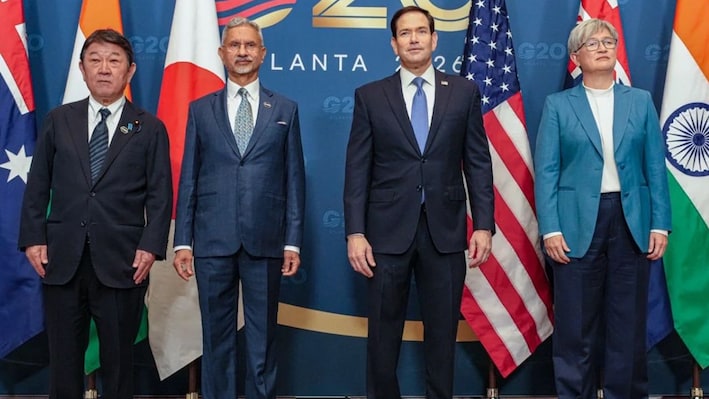
External Affairs Minister S Jaishankar has called for diplomatic efforts to end major international conflicts, warning that disrupted energy trade and concentrated supply chains are adding to economic pressure on developing countries.
Speaking after the G20 Foreign Ministers’ Meeting in the United States, Jaishankar said governments must keep markets predictable and expand manufacturing across a larger number of countries. He described the two days of talks in Atlanta, hosted by US Secretary of State Marco Rubio on October 30 and 31, as “very productive, very open, very animated”.
Jaishankar calls for diplomatic solutions to global conflicts
The first session focused on geopolitical tensions, particularly the war in Ukraine and the conflict in West Asia. Jaishankar said these conflicts were affecting countries far beyond the battlefields by disrupting trade and the movement of essential goods.
“There are no military solutions,” he said, adding that countries needed to “find a diplomatic pathway”. While India has been active in diplomatic efforts, no common peace proposal emerged from the discussions in Atlanta.
Jaishankar also highlighted the safety of commercial shipping. He said attacks on vessels and seafarers can interrupt deliveries of fuel, food and fertilisers even in countries distant from the fighting. India has consistently called for freedom of navigation and the protection of civilian shipping under international law.
Energy market disruptions pressure Global South
The second session examined energy and food security. Jaishankar objected to political restrictions and other disruptions affecting energy flows, saying their cost was being passed on to countries with fewer resources to absorb sudden price increases.
“This distortion of the energy markets, the politicisation of energy flows, is something which is very harmful,” he said. He added that the Global South, a term used for developing economies, was bearing a disproportionate share of the shortages and that the G20 needed to recognise this burden.
Jaishankar also pointed to the uncertainty facing energy importers. Supplies can become difficult to obtain because of attacks on infrastructure, sanctions or disruptions along major sea routes, even when production capacity exists. He sought more predictable access to fuel and highlighted India’s requirement for reliable liquefied petroleum gas supplies for household cooking.
He further distinguished between the routes affecting food and fertiliser shipments. While problems with grain supplies were mainly linked to the Black Sea, fertiliser trade faced disruptions connected to both the Black Sea and the Gulf-Red Sea region. This distinction is important for import-dependent countries because the routes serving different commodities are not the same.
India seeks production across more countries
At the final session on Saturday, Jaishankar argued that countries should avoid concentrating the production of essential goods in a single region. Wider manufacturing networks, he said, would give buyers alternative sources when conflict, extreme weather or transport failures disrupt one location.
“Today, we need more diversified supply chains,” he said, calling for production to be spread across a larger number of economies. He also urged G20 members to protect the right of countries to industrialise and resist trade practices that restrict competition or limit market access.
No joint communique after G20 talks
Rubio, who chaired the meeting, similarly identified secure shipping routes and critical mineral supplies as areas requiring cooperation. The US chair’s statement referred to safe passage through the Strait of Hormuz and Bab al-Mandab, as well as the need to prevent food trade from being used for political pressure.
Despite the discussions, the meeting ended without a joint communique agreed by all participating countries. The United States instead issued a chair’s statement outlining the topics discussed and its priorities. G20 leaders are scheduled to meet in Miami on December 14 and 15.
Stay informed on all the latest news, real-time breaking news updates, and follow all the important headlines in india news and world news on Zee News.