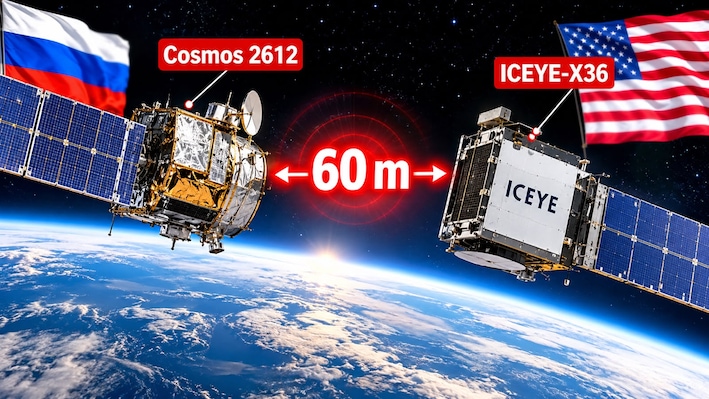
Cosmos 2612, a Russian satellite, reportedly came alarmingly close to ICEYE-X36, an American commercial satellite operated by the Finnish company ICEYE. The US delegation made its concerns known to the UN in October by suggesting that the incident resembled a "possible in-orbit weaponry manoeuvre."
ICEYE provides radar images that serve to support Ukraine in its armed defence. Thus, the company is involved in geopolitical tensions. Between October 16 and 18, the satellite-tracking company ComSpoc noted that Cosmos 2612 was within a distance of 2 km from ICEYE-X36 for around 24 hours.
Let's have a look at what commercial satellite-tracking companies noted regarding the minimum distance during this incident.
Closest approach estimates: ComSpoc said that the spacecraft has come within 60 m distance from one another, while LeoLabs estimated the distance at 500 m.
Slow relative drift: Both satellites appeared to be moving at a very low speed of 1 m/s, according to third-party observers.
Post-pass separation: On October 18, after making some maneuvers, Cosmos 2612 was at 480 km distance from ICEYE-X36.
Tracking data indicates that the close pass of the Russian satellite was the result of months of orbital manoeuvres rather than a coincidental occurrence. After the launch of Cosmos 2612 in April together with a number of other satellites, it took only a few weeks for some of them to attempt to get on a collision course with ICEYE-X36.
In late September, Cosmos 2612 began operating again and reached an altitude that allowed it to travel within the same orbit as ICEYE-X36 by October. According to defence experts and some space analysts, such behaviour may be used for surveillance activities or even as a preparation for an attack.
At the venue of the First Committee of the United Nations General Assembly, a representative of the United States claimed that the Russian satellite operated within dangerously close proximity, which breached the existing norms of responsible behaviour in space and made it necessary to demand further clarification and more transparency from Russia.
The accusations were deemed groundless by Russia, which insisted that its operations in space are peaceful and in compliance with international obligations. Russia has previously warned Western countries that commercial satellites involved in assisting Ukraine could be treated as potential targets.
At the same time, there were reports on the internet that SpaceX and Elon Musk took action to stop the satellite from approaching too close to ICEYE because a Starlink proximity alert and a condition set forth by the FCC did not allow the spacecraft to operate. A study of the FCC Usage Costs showed that the only risk was to assess and avoid collision, no approval from SpaceX was required. It should be noted that ICEYE-X36 did not execute any action when passing in October, though the company did use its satellites for some maneuver in September when some Russian activity was detected, the details, however, have not been specified.
The fact that ICEYE-X37 had companions in orbit further increased the risks as there were reports that two satellites behaving passively showed movement towards ICEYE-X37's orbit. Although there were no observed actions, it seems that technology allows the satellites to be moved.
The episode underscores how fragile commercial satellite security has become as military and civil space operations overlap amid thin international rules. US Space Command has previously cautioned that protection for commercial systems is not automatic, and analysts argue Moscow may be signalling that Western powers cannot curb its orbital reach—turning orbit into an active arena of strategic competition where transparency and continuous tracking remain vital.
Stay informed on all the latest news, real-time breaking news updates, and follow all the important headlines in india news and world news on Zee News English.