

• हिन्दीEnglishमराठीবাংলাதமிழ்മലയാളംગુજરાતીతెలుగుಕನ್ನಡଓଡ଼ିଶାZ BharatPHHBusinessWION
  • facebookyoutubetwitterwhatsapp
Zee News English
  • news
  • Live Blog
  • photos
Add Zee Business As A Preferred Source
App
  • Live TV
  • Latest News
  • India
  • World
  • Entertainment
  • Sports
  • Business
  • Lifestyle
  • Astrology
  • Auto
  • Education
  • Technology
  • News
  • /World
  • /US Army blows up stockpile of bomb-making chemicals in Iowa, plumes of smoke seen in sky

US Army blows up stockpile of bomb-making chemicals in Iowa, plumes of smoke seen in sky

The US Army carried out a controlled detonation of nearly five tonnes of ageing lead azide explosives in Iowa, prompting evacuations and concerns over potential toxic contamination and environmental risks.

Written ByZee Media Bureau
Published: Nov 25, 2026, 21:29 IST|Updated: Nov 25, 2026, 21:31 IST
joinshare
US Army blows up stockpile of bomb-making chemicals in Iowa, plumes of smoke seen in sky
Image Credit: US Army blows up stockpile of bomb-making chemicals in Iowa

About the Author

    Zee Media Bureau

    Zee Media Bureau

    Zee Media Bureau is the editorial news desk of Zee Media Corporation, one of India’s leading news networks.The bureau represents a collective of experienced journalists, editors, and correspondents who work across television, digital, and social platforms to deliver timely, accurate, and wide-ranging news coverage. Zee Media Bureau's coverage spans politics, business, economy, technology, health, entertainment, and global affairs. The bureau follows a collaborative newsroom model, where stories are researched, verified, and published by a team. This ensures speed, editorial consistency, and adherence to journalistic standards, particularly for breaking news and developing stories.
    Read More

    Trending

    • News
    • Photos
    Updated WTC points table 2025-27 after SA vs BAN 2nd Test: South Africa strengthen top spot, Bangladesh slip to sixth place; India at...

    Updated WTC points table 2025-27 after SA vs BAN 2nd Test: South Africa strengthen top spot, Bangladesh slip to sixth place; India at...

    2

    US Army blows up stockpile of bomb-making chemicals in Iowa, plumes of smoke seen in sky

    3

    Karan Johar says Akshay Kumar is the only superstar who gives a chance to debut directors

    4

    3 dead, 6 injured as speeding truck rams into students waiting at Pune bus stop | Video

    5

    2nd Test: Wiaan Mulder's seven-wicket haul powers South Africa to innings win over Bangladesh, seals 2-0 series win

    logo
    • contact us
    • privacy policy
    • legal
    • investor info
    • advertise with us
    © 1998-2026 Indiadotcom Digital Private Limited, All Rights Reserved.

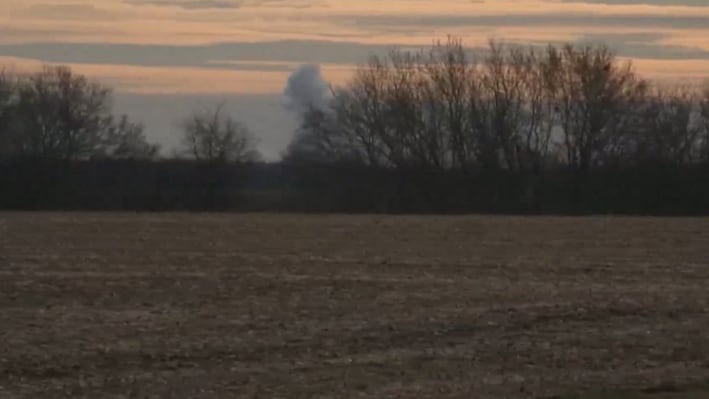
    The US Army detonated nearly five tonnes of ageing military explosives at an ammunition plant in southeast Iowa on Wednesday, after residents were evacuated over concerns about potential toxic contamination. The blast sent a plume of grey and white smoke several hundred feet into the air, which drifted southwards.

    Video footage captured from several kilometres away showed two white plumes rising above the detonation site before quickly dissipating. Journalists in the area also reported hearing a loud boom during the explosion. Despite warnings to stay indoors, some residents stopped along nearby roads to watch the blast from locations upwind of the ammunition plant.

    NOW: The exact moment of PLUMES FORMING as the US Army detonates unstable lead azide in Iowa They had INTENSE safeguards to block as much lead dust as possible from flying up and impacting nearby areas The Army said it could have exploded on its own at any time. This was the option against an unplanned, uncontrolled detonation

    — Eric Daugherty (@EricLDaugh) November 25, 2026

    The controlled detonation was carried out at the Iowa Army Ammunition Plant in Middletown, where 68 barrels of highly volatile lead azide had been kept in two earth-covered bunkers for more than two decades. The decision to destroy the chemicals on site, rather than remove them, led to evacuations and raised concerns among residents about potential environmental and health hazards.

    While military officials said the operation was intended to ensure “zero release” of toxic compounds, concerns persisted over the possibility of lead dust escaping containment measures and spreading beyond the blast site.

    Local media reports said it could take time to establish how much of the hazardous material was successfully contained during the explosion. The Army is expected to issue further updates as monitoring efforts continue. NASA is tracking the smoke plume using satellite imagery, while government agencies and independent researchers are evaluating the extent of potential pollution and its environmental consequences.

    The potential dispersal zone stretched southwest from Middletown towards Missouri. Army maps warned that, in the event of a failed detonation, toxic lead particles could spread across up to 150 square miles of farmland. In a worst-case scenario, the particles could travel as far as 100 miles.

    Authorities had asked residents within the anticipated dispersal zone, which extended up to five miles southwest of the ammunition plant, to evacuate ahead of Wednesday's blast. Government workers visited homes on Tuesday, handing out information sheets and urging people to leave. Residents who chose to stay were advised to keep their windows and doors shut, seal any gaps and set their heating systems to recirculation mode to prevent potentially contaminated air from entering their homes.

    Authorities had asked residents within the anticipated dispersal zone, which extended up to five miles southwest of the ammunition plant, to evacuate ahead of Wednesday's blast. Government workers visited homes on Tuesday, handing out information sheets and urging people to leave. Residents who chose to stay were advised to keep their windows and doors shut, seal any gaps and set their heating systems to recirculation mode to prevent potentially contaminated air from entering their homes.

    The reason why US Army decided to destroy the chemicals

    The explosives involved in the operation contained lead azide, a highly volatile compound used to trigger explosions in military ammunition. The chemicals had been stored in ageing bunkers for more than 20 years. However, an inspection found that the barrels had deteriorated significantly, prompting Army officials to consider opening them too dangerous.

    Instead of risking the transportation of the unstable material, the military opted for a controlled detonation, considering it the safer alternative. Officials had also warned that continued storage of the chemicals carried the risk of a spontaneous explosion. The Army, therefore, put in place an extensive containment operation to minimise the chances of toxic material escaping into the surrounding environment.

    Despite these precautions, concerns persisted over whether the containment measures would be effective enough to prevent hazardous particles from escaping.

    The officials' worst-case assessment was based on the assumption that no more than approximately a quarter of the dangerous material would escape the mitigation measures, raising concerns that the potential risks might have been underestimated.

    Lead exposure is particularly hazardous, as no safe level of exposure has been established. Children and pregnant women are especially vulnerable to its harmful effects.
     

    Stay informed on all the latest news, real-time breaking news updates, and follow all the important headlines in india news and world news on Zee News English.

    Add Zee News as a Preferred Source