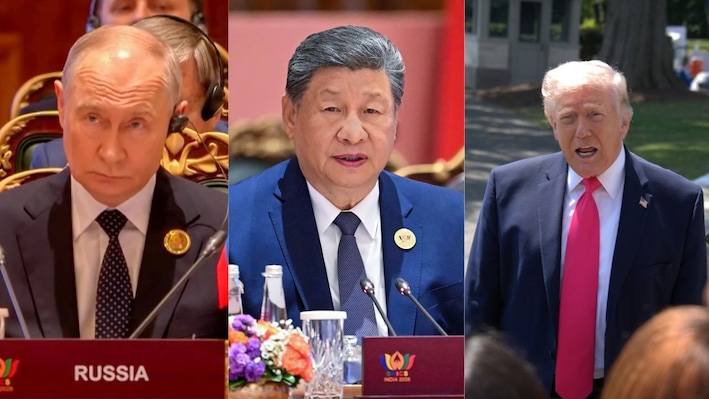
When three of the world’s most powerful leaders sit down for a meeting, the consequences are unlikely to remain confined to the room. Chinese President Xi Jinping, US President Donald Trump and Russian President Vladimir Putin are set to hold a historic first trilateral meeting in Shenzhen on November 19, bringing together three countries with competing interests in global security, trade and diplomacy.
There is an African proverb: “When elephants fight, it is the grass that gets trampled. When elephants make love, the grass also gets trampled.” The proposed meeting raises both possibilities.
A disagreement between Washington, Beijing and Moscow could unsettle security arrangements. An understanding between them could also change the rules for countries without a seat at the table, including India.
For India, the stakes are particularly important. New Delhi has strong ties with Washington and Moscow, while its relationship with Beijing remains complicated by border tensions and a growing trade imbalance. It is also a nuclear-armed country with its own security concerns.
China’s Foreign Ministry confirmed the meeting on November 16. Spokesperson Mao Ning said the leaders would discuss safeguarding world peace and promoting strategic stability in relations between major powers. A detailed agenda, however, has not been made public.
Each leader will arrive with different priorities. The question is how their discussions could affect the rest of the world, particularly India.
New START’s expiry: A new nuclear challenge
One of the biggest issues surrounding the meeting is the expiry of the New Strategic Arms Reduction Treaty (New START), the last remaining nuclear arms-control agreement between the US and Russia. The treaty expired on February 5, 2026.
With the treaty no longer in force, Washington and Moscow are without binding limits on nuclear arsenals for the first time in more than five decades.
UN Secretary-General Antonio Guterres warned that its expiry has a serious setback for global nuclear security.
Trump has expressed interest in a wider nuclear agreement involving China. In February 2025, speaking at the White House, Trump said he wanted to meet Chinese President Xi Jinping and Russian President Vladimir Putin to discuss cutting military spending, adding, "Let's cut our military budget in half".
Beijing, however, has resisted joining trilateral negotiations. On August 27, 2025, Chinese Foreign Ministry spokesperson Guo Jiakun described the proposal as "neither reasonable nor realistic", arguing that the US and Russia, which possess significantly larger nuclear arsenals, should take the lead in reducing their stockpiles.
This debate matters to India, which has its own nuclear deterrent and security concerns involving both China and Pakistan.
According to the Stockholm International Peace Research Institute’s (SIPRI) 2025 estimates, India had 180 nuclear warheads, making it the world’s sixth-largest nuclear-armed country by estimated inventory. China had 600, Pakistan 170, while Russia and the US had 5,459 and 5,177, respectively.
Can Shenzhen break the Ukraine deadlock?
For Putin, the meeting offers direct engagement with Trump and strengthens Russia’s position in discussions involving global security pertaining to the war in Ukraine
Ukraine remains a major flashpoint of disagreement between Moscow and NATO countries. Russia continues to press its territorial and security demands, while Ukraine has rejected Moscow’s claims.
Trump has expressed an interest in discussing the conflict, although there have been differing indications about whether Ukraine will feature formally in the trilateral agenda. China’s position will also be closely watched, given its close relationship with Moscow.
India has consistently called for dialogue and diplomacy to end the war.
Addressing the UN General Assembly on September 4, 2025, India’s Permanent Representative Parvathaneni Harish said, “No solution can be found on the battlefield”.
China’s rare-earth trump card
Trade is another major issue between Washington and Beijing. While the US wants to protect its technology and manufacturing sectors, China has a strong hold over the processing of rare earths and the production of permanent magnets.
These materials are used in electric vehicles, wind turbines, electronics, radar systems and defence equipment. China’s export restrictions have exposed how dependent several countries are on its supply chains.
Government data show that China’s share of India’s permanent-magnet imports ranged between 59.6 and 81.3 per cent by value and 84.8 and 90.4 per cent by quantity across the reported categories during 2024–25.
This dependence is significant as India expands its electric vehicle, renewable energy and defence manufacturing sectors. The government expects domestic consumption of rare-earth permanent magnets to double by 2030, while efforts to build local manufacturing capacity continue.
A possible trade understanding between Trump and Xi could affect the availability of these materials.
If restrictions ease, Indian manufacturers could benefit from more reliable supplies. If tensions increase, industries dependent on Chinese imports could face fresh difficulties.
The spark that could shake global tech
Taiwan remains one of the most sensitive issues in US-China relations. Beijing considers the island part of its territory and opposes foreign interference, while Washington continues to support Taiwan’s defensive capabilities.
Any escalation across the Taiwan Strait could disrupt shipping, trade and semiconductor supplies.
Taiwan is a major player in the global semiconductor industry, making the region important to technology companies and manufacturers worldwide.
For India, the concern is both economic and strategic. Disruptions could affect electronics manufacturing and other industries dependent on semiconductor supplies.
The situation also has implications for stability in the Indo-Pacific, where India has growing economic and security interests.
India’s membership of the Quad, alongside the US, Japan and Australia, adds another dimension to its regional engagement.
Iran: Energy markets and regional tensions
Iran is another issue Trump has indicated he wants to discuss with Xi and Putin. The three countries have different relationships with Tehran.
The US maintains sanctions and has been directly involved in the conflict; Russia has strategic ties with Iran, while China remains an important economic and diplomatic partner.
For India, developments in Iran matter largely because of their wider impact on energy supplies, oil prices and regional stability.
Any prolonged conflict or disruption in the region could push up energy costs and affect shipping routes. India, as a major energy importer, remains exposed to fluctuations in international oil markets.
The positions taken by Washington, Beijing and Moscow could therefore influence the wider regional situation, even if no agreement on Iran emerges from the meeting.
India’s growing trade dependence on China
India’s economic relationship with China presents another challenge. Despite continuing border tensions, the two countries remain important trading partners. However, the gap between India’s exports and imports has widened considerably.
According to the Ministry of Commerce and Industry, India’s exports to China stood at USD 14.25 billion in 2024–25, while imports reached USD 113.46 billion. This left India with a trade deficit of USD 99.21 billion.
At the same time, the US remains an important trade, technology and defence partner, while Russia continues to be a major source of energy and military equipment.
Any change in US-China trade relations or Western sanctions on Russia could affect India’s economic calculations.
If the Elephants make a deal, who pays the price?
The Shenzhen meeting could take different directions. If the leaders fail to bridge their differences, tensions over trade, nuclear weapons, Ukraine and Taiwan could continue to affect global markets and security.
If they reach an understanding, their decisions could still have consequences for countries outside the negotiations.
India has relationships with all three countries, but those relationships serve different purposes.
Washington is an important partner in defence, technology and the Indo-Pacific. Moscow remains significant for energy and military supplies. Beijing is both a major trading partner and a strategic competitor.
India is also the world’s sixth-largest nuclear-armed country by estimated warhead inventory, with its own security priorities and regional responsibilities.
The familiar saying about elephants captures the uncertainty. When major powers fight, other countries can bear the economic and security costs. When they reach agreements, the consequences can be just as far-reaching.
Whether the Shenzhen meeting produces concrete decisions or simply opens the door to further talks remains to be seen. For India, both possibilities matter.
Stay informed on all the latest news, real-time breaking news updates, and follow all the important headlines in india news and world news on Zee News English.