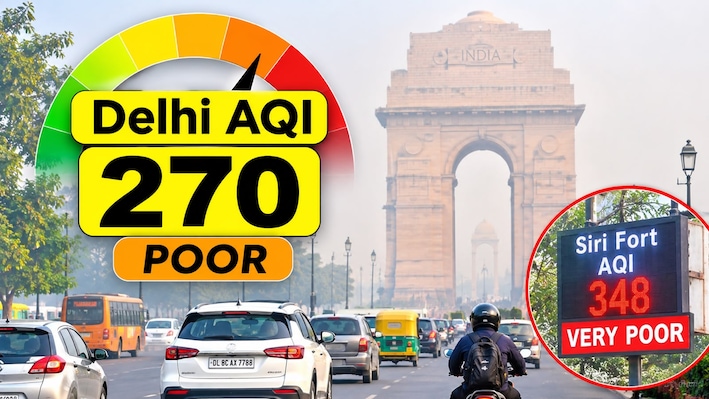
Delhi's air quality stayed in the ‘poor’ category on Friday morning, recording an overall Air Quality Index (AQI) of 270 at 7:05 am with PM2.5 emerging as the dominant pollutant, according to the Central Pollution Control Board (CPCB).
Despite the citywide average remaining under 300, localized pollution hotspots pushed nine key monitoring stations across the national capital into the ‘very poor’ bracket (301–400).
Station-Wise Delhi AQI Breakdown: Nine Hotspots Breach 300 Mark
CPCB monitoring data from 7:05 am showed sharp variations across residential, institutional, and transit corridors:
‘Very Poor’ Category (301–400): Siri Fort recorded the highest reading at 348, followed by JNU (338), Pusa (337), Chandni Chowk (331), and Burari Crossing (331). Elevated readings also hit ITO (322), Jahangirpuri (311), Punjabi Bagh (309), and North Campus (308).
‘Poor’ Category (201–300): Anand Vihar registered an AQI of 267, while RK Puram stood at 259.
Under CPCB standards, an AQI between 0 and 50 is classified as ‘good’, 51–100 ‘satisfactory’, 101–200 ‘moderate’, 201–300 ‘poor’, 301–400 ‘very poor’, and 401–500 ‘severe’. Elsewhere in the country, dense early-morning fog blanketed several parts of Thiruvarur in Tamil Nadu on Friday.
GRAP Stage III Revoked; Physical Classes Resume in Delhi Schools
Friday’s readings come three days after the Commission for Air Quality Management (CAQM) revoked Stage III of the Graded Response Action Plan (GRAP) across Delhi-NCR on November 17, citing an overall improvement in air quality dispersion.
Following the CAQM sub-committee’s decision to withdraw Stage III curbs with immediate effect, the Delhi government directed all government, government-aided, and recognized private schools to resume physical classes for all students.
CM Rekha Gupta Orders Strict Dust Control and Mechanised Sweeping
Ahead of Friday’s spike at local hotspots, Delhi Chief Minister Rekha Gupta chaired a high-level review of winter pollution-control measures on Wednesday at the Delhi Pollution Control Committee’s (DPCC) Integrated Command and Control Centre (ICCC).
While noting that Delhi experienced relative air-quality relief this November compared with the past decade, Gupta stressed that enforcement agencies will sustain strict action against every pollution source:
Intensified Road & Verge Cleaning: Gupta directed the Municipal Corporation of Delhi (MCD) and Public Works Department (PWD) to step up mechanised sweeping, water sprinkling, and road washing across major thoroughfares, footpaths, and central verges.
Construction Site Crackdown: Enforcement teams have ramped up inspections at construction and demolition sites, with strict orders to install green nets, barricades, and windbreakers rather than treating dust mitigation as a mere formality.
Stay informed on all the latest news, real-time breaking news updates, and follow all the important headlines in india news and world news on Zee News English.