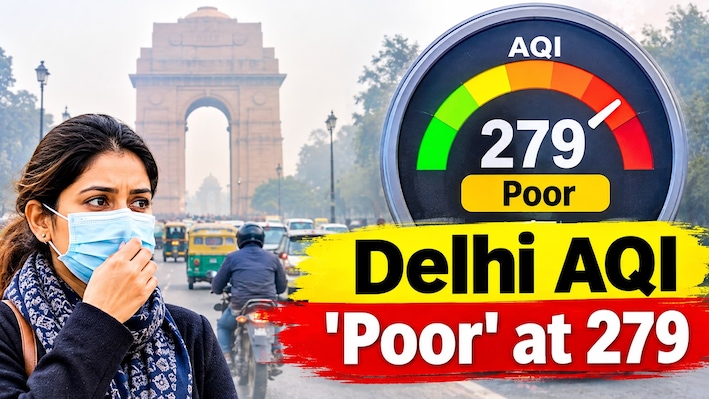
Air quality in Delhi was still considered 'poor' on Saturday morning, with the capital recording an overall Air Quality Index (AQI) score of 279 at 7:00 a.m., according to the Central Pollution Control Board (CPCB). Although the citywide AQI score was below 300, localised pollution in pockets pushed six monitoring stations across central, east, north, and south Delhi into the 'very poor' (301-400) category.
The CPCB's AQI data released at 7:00 am witnessed major differences across areas in Delhi:
'Very Poor' category AQI (301-400): AIIMS followed by Chandni Chowk recorded the highest AQIs of 369 and 365, respectively. Wazirpur’s was 332, Anand Vihar’s was 327, IIT Delhi's was 308, and Bawana’s AQI was 304.
'Poor' category (201-300): R K Puram recorded 274, Narela has an AQI of 245, IGI Airport (T3) is 242, Dwarka Sector 8's AQI is 241, and Najafgarh's AQI was 236.
According to CPCB, any AQI ranging from 0 to 50 is considered 'good,' between 51 and 100 'satisfactory,' 101 and 200 'moderate,' 201 and 300 'poor,' 301 and 400 'very poor, ’ and 401-500 'severe.'
With the recent figures showing favourable air quality on Saturday, the Commission for Air Quality Management (CAQM) on November 17 lifted the Stage III controls of the Graded Response Action Plan (GRAP), making way for improving air quality conditions across Delhi-NCR.
With the last order of the CAQM sub-committee, the Delhi government asked all government-aided and recognised private schools to resume teaching classes physically for all students.
Earlier this week, Delhi Chief Minister Rekha Gupta held a high-level meeting to review measures being taken to control pollution in Delhi in the Integrated Command and Control Centre (ICCC) run by the Delhi Pollution Control Committee (DPCC).
Gupta stated that this November has been better in terms of air quality than the previous decade and that strict action will continue against pollution sources.
Prompt ground actions: Gupta has advised various civic bodies to coordinate their actions and show visible results.
Enhanced road washing and sweeping: She instructed the Municipal Corporation of Delhi (MCD) and the Public Works Department (PWD) to increase their mechanised sweeping, water spraying, and road washing activities along important roads, sidewalks, and middle entries.
Crackdown on construction sites: It has been decided to intensify inspection efforts of construction and demolition sites and to ensure the correct use of green nets, fences, and windbreakers.
Stay informed on all the latest news, real-time breaking news updates, and follow all the important headlines in india news and world news on Zee News English.