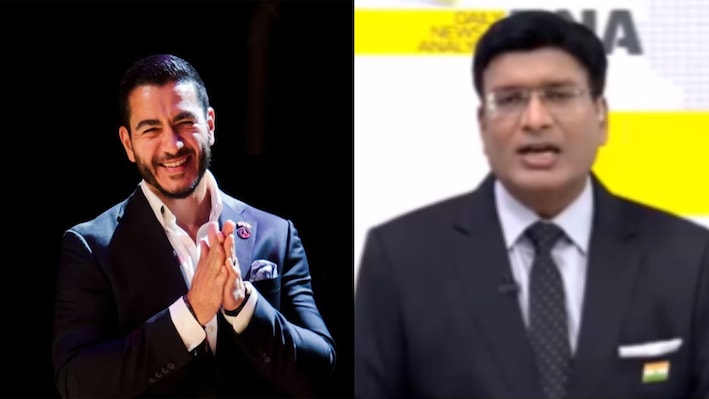
Democratic candidate Abdul El-Sayed has defeated Republican Mike Rogers in Michigan’s US Senate election, overcoming strong opposition from US President Donald Trump. El-Sayed secured roughly 52 per cent of the vote, compared with Rogers’ 46 per cent, according to preliminary results, in a victory that makes him the first Muslim elected to the US Senate.
In today’s DNA episode, Zee News Managing Editor Rahul Sinha decodes how El-Sayed’s victory became a setback for Trump, who had openly campaigned against the Democratic candidate. The episode also examines Trump’s remarks against El-Sayed, the controversy surrounding his position on Israel and Gaza, and how the victories of Muslim-American politicians have added a new dimension to the political debate in the United States.
#DNAमित्रों | यूएस ने अब्दुल को चुना.. ट्रंप को क्यों नकारा? ट्रंप ने 'जिहादी' कहा.. जनता ने जिता दिया 'ईसाई बहुल देश' में 'अब्दुल' की जीत खास है #DNA #DNAWithRahulSinha #DonaldTrump #USAElection @rahulsinhatv https://t.co/oU8iKQ7LUP
— Zee News (@ZeeNews) November 4, 2026
Trump’s criticism of El-Sayed became one of the most controversial aspects of the campaign. During election rallies, the President described the Democratic candidate as a “jihadist” and a “jihadist lunatic,” accused him of being aligned with the Muslim Brotherhood, and claimed he supported terrorists.
Trump also suggested that Congress would need a “special metal detector” before El-Sayed entered the chamber. These remarks brought religious identity into the election campaign and intensified the political confrontation between the two sides.
After securing victory, El-Sayed hit back at Trump, turning the result into a setback for a President who had openly campaigned against him.
Trump was not the only political challenge El-Sayed had to overcome. His campaign also faced an unexpected setback within the Democratic Party when Representative Haley Stevens withdrew her support two days before the election and endorsed Republican candidate Mike Rogers instead.
Stevens, who lost to El-Sayed in the Democratic primary, had earlier supported him before reversing course amid tensions over his position on Israel. Her decision came at a crucial stage of the contest and added pressure on El-Sayed, but it failed to change the outcome.
Beyond his confrontation with Trump, El-Sayed’s position on the Israel-Palestine conflict made him a prominent figure in the election debate. He has repeatedly criticised Israel’s military campaign in Gaza, describing it as genocide, and has called for an end to US military aid and arms sales to Israel.
His position attracted support from voters who oppose Israel’s military campaign and want a change in US policy. Following his victory, supporters raised pro-Palestine slogans, underlining the importance of the issue among sections of his support base.
El-Sayed was not the only Muslim-American politician targeted by Trump during the campaign. The President also repeatedly attacked Democratic Congresswoman Ilhan Omar, including remarks questioning her marriage and American citizenship.
However, Trump’s attacks did not prevent Omar from securing a fifth consecutive term in Minnesota’s 5th Congressional District, where she defeated Republican nominee John Nagel. Her success, alongside El-Sayed’s win in Michigan, has once again brought Muslim-American political representation into focus.
The outcome in Michigan also attracted attention in India, where AIMIM president Asaduddin Owaisi welcomed El-Sayed’s victory. He invoked the result to call on Muslims in Uttar Pradesh to strengthen their political identity and leadership.
In a pointed remark, Owaisi said that “an Abdul” in Uttar Pradesh should no longer “lay out carpets” for political leaders.
Stay informed on all the latest news, real-time breaking news updates, and follow all the important headlines in india news and world news on Zee News English.