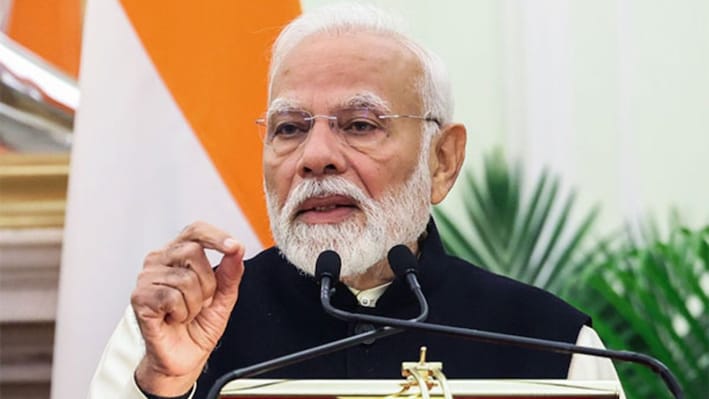

Prime Minister Narendra Modi held a high-level meeting with senior Union ministers and Bharatiya Janata Party leaders at his residence in New Delhi on Sunday, a day before the government introduces the revised Delimitation Bill in the Lok Sabha. Union Home Minister Amit Shah, Defence Minister Rajnath Singh and BJP president Nitin Nabin attended the meeting, even as opposition INDIA bloc leaders prepared to meet DMK chief MK Stalin in Chennai in a bid to rally support against the legislation.
A high-level meeting is underway at the PM's residence ahead of the Delimitation Bill's introduction in the Lok Sabha on Monday, with Union Home Minister Amit Shah, BJP President Nitin Nabin and senior ministers in attendance.
— IANS (@ians_india) November 29, 2026
This meeting comes at a time when the Union Cabinet has approved revised proposals to increase the number of seats in the Lok Sabha and State Legislative Assemblies, as well as to implement reservations for women in these legislative bodies.
On Monday, the government is set to introduce the 'Constitution (132nd Amendment) Bill, 2026' and the 'Delimitation (Second) Bill, 2026' in the Lok Sabha. Union Law Minister Arjun Ram Meghwal is expected to present these bills in the House.
Under the revised proposal, the maximum number of elected members in the Lok Sabha will be increased from 543 to 850. The government has proposed a uniform 50 per cent increase in the number of seats across all states. Furthermore, the proportional representation of states in the Lok Sabha will be maintained until 2051.
Meanwhile, Congress President Mallikarjun Kharge, Sonia Gandhi, Rahul Gandhi, and Trinamool Congress chief Mamata Banerjee were scheduled to meet Stalin in Chennai on Sunday.
Their objective is to persuade the DMK to reconsider its stance on the government's proposals.
The DMK has extended its support to the revised bill after the central government acceded to its demands, specifically, to maintain the 1971 census as the basis for determining the allocation of parliamentary seats among the states, including those for Tamil Nadu.
The NCP (SP), led by Sharad Pawar, has also expressed its support for the bill. Opposition leaders are scheduled to meet with Pawar in Mumbai later on Sunday.
The Congress and several other parties within the INDIA alliance have opposed linking the reservation for women to an increase in the number of parliamentary seats.
They have demanded that the quota be implemented within the existing strength of the Lok Sabha.
Delimitation is the process of redrawing the boundaries of parliamentary and assembly constituencies based on population data.
The distribution of Lok Sabha seats among the states is largely based on the 1971 census. Several southern states have opposed any reallocation of seats based on population, arguing that states that have successfully controlled population growth should not lose their share of parliamentary representation.
In 2023, Parliament passed a constitutional amendment providing for a 33 per cent reservation for women in the Lok Sabha and state legislative assemblies.
The condition for its implementation was linked to future census and delimitation processes.
A previous constitutional amendment bill, introduced by the government in April this year, failed to secure the requisite two-thirds majority in the Lok Sabha.
A special session of Parliament will commence with a sitting of the Lok Sabha on Monday, followed by a sitting of the Rajya Sabha on December 2. The proceedings are scheduled to conclude on December 3.
Stay informed on all the latest news, real-time breaking news updates, and follow all the important headlines in india news and world news on Zee News English.