
• हिन्दीEnglishमराठीবাংলাதமிழ்മലയാളംગુજરાતીతెలుగుಕನ್ನಡଓଡ଼ିଶାZ BharatPHHBusinessWION
  • facebookyoutubetwitterwhatsapp
Zee News English
  • news
  • Live Blog
  • photos
Add Zee Business As A Preferred Source
App
  • Live TV
  • Latest News
  • India
  • World
  • Entertainment
  • Sports
  • Business
  • Lifestyle
  • Astrology
  • Auto
  • Education
  • Technology
  • News
  • /Lifestyle
  • /How managing blood pressure and cholesterol can lower your stroke risk

How managing blood pressure and cholesterol can lower your stroke risk

Experts reveal why heart and brain health share the same blood-vessel risks, and how keeping blood pressure and cholesterol in check helps prevent a stroke.

Written ByAnanya Kaushal
Published: Nov 24, 2026, 14:40 IST|Updated: Nov 24, 2026, 14:42 IST
joinshare
How managing blood pressure and cholesterol can lower your stroke risk

About the Author

Ananya Kaushal

Ananya Kaushal

Ananya Kaushal is a Sub-Editor at Zee News Digital Desk. With 5+ years of experience, she delivers engaging content across entertainment, lifestyle, health, culture, education & more. She has covered major fashion weeks, high-profile celebrity interviews, and key industry events previously. She has interviewed celebs like Khushi Kapoor, Vedang Raina, Sonakshi Sinha, Aditi Rao Hydari, Vicky Kaushal, Rashmika Mandanna, Malaika Arora, Ammy Virk, Sonam Bajwa, and more.She has also reported extensively on elections, conducted in-depth interviews, and managed daily rundowns and overall newsroom operations. Since starting her career in 2020, she has gained experience across both the digital and TV spheres. She can be reached at: Ananya.Kaushal@India.com  
Read More

Trending

  • News
  • Photos
How managing blood pressure and cholesterol can lower your stroke risk

How managing blood pressure and cholesterol can lower your stroke risk

2

Bangladesh rejects Hasina’s December 16 return, rules out her comeback

3

'He was my everything': Hema Malini pays emotional tribute to Dharmendra on his first death anniversary

4

Happy Guru Nanak Jayanti: Rajat Bedi reflects on childhood memories and staying grounded in Bollywood

5

BJP-SAD alliance ahead of 2027 Punjab polls exposes Sukhbir Badal: Congress

logo
  • contact us
  • privacy policy
  • legal
  • investor info
  • advertise with us
© 1998-2026 Indiadotcom Digital Private Limited, All Rights Reserved.

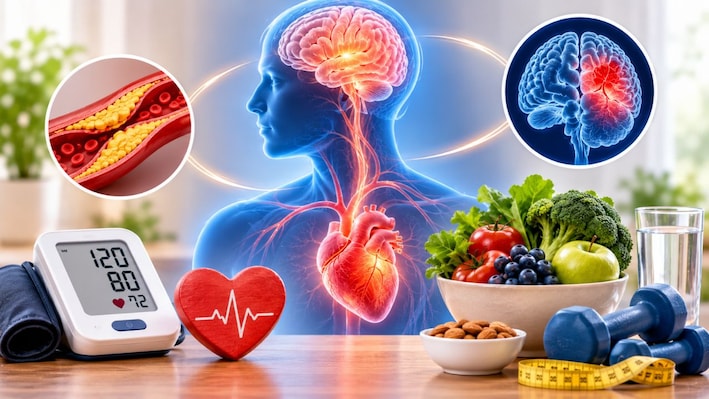
Most people treat heart trouble and strokes as separate health worries, even though they often trace back to the same damaged blood vessels. High blood pressure and high cholesterol can wear down arteries for years without causing a single symptom, quietly raising the odds of a major emergency. Here, a neurologist and a cardiologist explain how the two systems affect each other and what keeping your numbers in check actually involves.

Dr Suresh Babu P, HOD - Neurology, KIMS-Arete Hospital, says, "From a neurological standpoint, one of the biggest concerns is that stroke can strike someone who has felt perfectly well until that point. High blood pressure is a major risk factor because it can damage the brain’s small blood vessels over time, making them more vulnerable to blockage or rupture. High LDL cholesterol contributes in a different way, encouraging plaque to build up in arteries supplying the brain. If a plaque ruptures and a clot forms, blood flow to part of the brain can be cut off. The resulting damage depends on which area is affected and how quickly treatment begins."

Stroke prevention, therefore, needs to start long before there is a warning sign. Dr Suresh reveals, "This is especially important for people with diabetes, a history of smoking, or a family history of stroke at a relatively young age. Blood pressure and cholesterol checks are useful even when there are no symptoms, because waiting to feel unwell can mean missing the opportunity to reduce risk. Sudden facial weakness, loss of strength in an arm or leg, slurred speech or a loss of vision should be treated as an emergency, even if the symptoms disappear within minutes. A transient ischaemic attack can be a warning of a more serious stroke." Managing risk factors consistently and recognising symptoms early can make a meaningful difference to brain health and long-term disability.

Dr Devika G, Cardiologist at HOSMAT Hospital, says, "Heart and brain health are more closely linked than many people realise. Both rely on healthy blood vessels, and problems in these vessels can develop for years without causing symptoms. Persistently high blood pressure damages artery walls, while high LDL cholesterol encourages fatty deposits to build up inside them. As the arteries narrow or become damaged, the chances of a heart attack or stroke rise. The connection also works through certain heart conditions: atrial fibrillation, for example, can allow blood clots to form in the heart and travel to the brain, causing a stroke."

The encouraging part is that many of these risks can be addressed well before a major event occurs. Dr Devika reveals, "Blood pressure and cholesterol targets should be based on an individual's age, medical history and overall cardiovascular risk; there is no single target that suits everyone. Regular exercise, less salt, a balanced diet, avoiding tobacco and taking prescribed medication consistently all contribute to risk reduction. Medication should not be stopped simply because the readings improve, since that improvement may be the result of treatment. Equally, a normal reading on one occasion does not tell the whole story. Prevention works best when blood pressure, cholesterol, blood sugar and other risk factors are reviewed together, rather than treated as separate numbers on a report."

(This article is meant for informational purposes only and must not be considered a substitute for advice provided by qualified medical professionals. Always seek the advice of your doctor for any questions about medical conditions.)

Stay informed on all the latest news, real-time breaking news updates, and follow all the important headlines in india news and world news on Zee News English.

Add Zee News as a Preferred Source
TAGS:
Health News
Health Tips