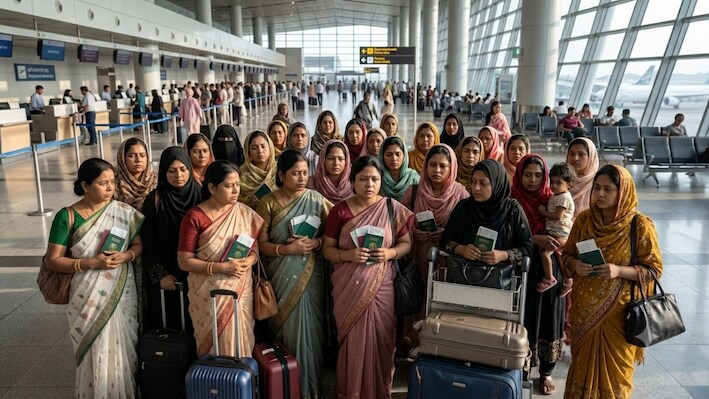
New Delhi: Behind the employment contracts signed in Bangladesh and the jobs taken up in Saudi Arabia are reports of hardship from women who have returned home before completing their contracts. Some have allegedly faced unpaid wages, excessively long working hours, physical abuse and sexual harassment.
Rights groups say that the cases suggest possible weaknesses in enforcing labour protections for migrant domestic workers, despite agreements and regulations meant to protect them.
More than 1,72,000 Bangladeshi women travelled abroad for work between January 2024 and mid-October 2026, according to official data from Bangladesh.
Around 1,20,000 women went to Saudi Arabia, their main overseas work destination. More than 1,500 women had returned to Dhaka since September, including around 1,000 from Saudi Arabia, show data from migrant support organisations.
The death sentences handed down to two Bangladeshi nationals in Saudi Arabia on allegation of indulging in adultery have led to outrage across the country. The case has also brought attention to allegations that Bangladeshi women employed in Saudi households face abuse and struggle to escape difficult working conditions or seek help.
The scale of the problem is difficult to establish because Bangladesh does not maintain a complete record of women who return after experiencing alleged abuse overseas. Shakirul Islam, president of the Migrant Workers Development Programme (OKAP), said the organisation's research into women who returned in July last year found that 90% had left because of physical or psychological abuse.
Independent research has documented similar experiences among women from other countries working in Saudi Arabia. In a report published on July 9, 2026, Amnesty International documented the experiences of 19 Filipino women who had returned from the kingdom, mostly between 2023 and 2026. The women described excessive working hours, degrading treatment, exploitation and sexual abuse. Some said they had worked for up to 21 hours a day, with little opportunity to rest or take a day off.
In a report published on July 9, 2026, Amnesty International documented the experiences of 19 Filipino women who had returned from the kingdom, mostly between 2023 and 2026.
Why domestic workers face risks
Riyadh has introduced several labour reforms under its Vision 2030 programme. Saudi Arabia revised its domestic worker regulations in 2023. The new rules took effect in September 2024. The provisions include limits on working hours, weekly rest, protection against passport confiscation and requirements for written employment contracts.
However, domestic workers fall outside the main Saudi Labour Law and are governed by separate regulations. This distinction is important because women employed in private homes often work without the independent oversight available at conventional workplaces. Their employers control their working conditions and may also influence their freedom of movement and ability to leave the job.
The Amnesty International's report found that some Filipino workers had difficulty leaving abusive employers because of restrictions on movement, passport confiscation and unfamiliarity with local procedures. The organisation said the presence of the kafala sponsorship system left workers dependent on employers for their legal status and ability to change jobs.
The kingdom’s government claims that domestic workers are protected by existing regulations and that complaints of abuse are investigated. It has also cited standard employment contracts, wage protection, insurance schemes and complaint mechanisms as measures aimed at safeguarding workers. Amnesty said that the government did not provide answers to its detailed questions about how these protections were being enforced.
A decade-old deal, few safeguards
Saudi Arabia first received Bangladeshi workers in 1976. Since then, over 3 million people from the country have worked in the kingdom, Bangladesh Sangbad Sangstha reported.
Saudi Arabia is also one of Bangladesh’s largest sources of remittances. Overseas workers’ earnings play an important role in the country’s economy. Following reports of abuse and the early return of many women from the kingdom, the two countries signed an agreement on domestic workers in 2015. The agreement set a monthly salary of 800 Saudi riyals for domestic workers on two-year contracts and provided for recruitment without fees charged to the workers.
Rights organisations have since cited cases in which women allegedly received only part of their wages or were not paid at all. Some returning workers have said they faced abuse after asking employers for their salaries.
Ghulam Masih, a former Bangladeshi ambassador to Saudi Arabia, while talking to BBC, has blamed part of the problem on weaknesses in the agreement and inadequate preparation before departure. He said that recruitment agents brought women from remote villages and sent them overseas without sufficient training in household equipment, working conditions or the language they would encounter.
The Organisation for Economic Co-operation and Development (OECD), in its 2025 report on labour migration in Asia, also documented Bangladesh's rising dependence on the kingdom as a destination for overseas workers. Saudi Arabia accounted for 66% of Bangladeshi labour migration in 2024, while women made up only 6% of the workers sent there through official channels.
Wage protection and access to help
Riyadh has introduced a digital wage protection service for domestic workers through its Musaned recruitment platform. The scheme began applying to new domestic worker contracts in July 2024, with a phased rollout for existing contracts and the stated aim of covering all domestic workers by January 2026. The system is aimed at making salary payments traceable through approved banks and digital wallets.
The government has also introduced insurance for domestic labour contracts. The Saudi Press Agency said in December 2024 that the scheme was meant to protect workers and employers by providing compensation for certain contractual breaches and unforeseen circumstances. At that time, the kingdom had 3.74 million domestic workers, according to the agency.
Reports of alleged abuse have led several South Asian countries to reconsider sending women to the kingdom for domestic work. Nepal lifted its ban on women travelling to several Gulf countries for work in 2022, but it has not reached an agreement with Saudi Arabia to send domestic workers. Sri Lanka has also said it is reluctant to send women to work in Saudi households.
Dhaka faces the challenge of finding out how many women suffer abuse in Saudi Arabia, investigating their complaints and helping those who want to return home. A government official said the authorities were regularly discussing the issue with Saudi officials.
Stay informed on all the latest news, real-time breaking news updates, and follow all the important headlines in india news and world news on Zee News.