She struggled to breathe through delhi’s pollution. Now this class 11 student is helping children protect their lungs. After experiencing wheezing and breathing difficulties herself for years, Diya turned her concern about respiratory health into Project Prana – a student-led initiative bringing lung-health education to children in underserved communities. There are some things we do thousands of times a day without ever thinking about them. Breathing is one of them. For Diya, however, breathing was not always something she could take for granted.
When she moved to Delhi in her early schooling years, where polluted air is an increasingly familiar part of everyday life, Diya experienced episodes of wheezing and struggled with asthma. Newspaper headlines in November screamed about an entire generation of children growing up without well-functioning lungs, due to the pollution. Hospitals wards overflowing with patients. What began as a personal health challenge gradually became something much bigger: an intriguing question.
What happens to children who grow up breathing polluted air but don't know how to protect their lungs? How can textbook knowledge be translated to real world issues? Can children be empowered early enough to take care of their own lungs and prevent lung illness? This curiosity became the starting point for Project Prana, a student-led initiative Diya founded to create awareness about respiratory health and preventive lung care among schoolchildren, particularly those from underserved communities. The name Prana, meaning life force or breath, reflects the project's central idea: every child should understand the importance of the breath they often take for granted.
From personal experience to scientific curiosity
Diya's interest in respiratory health did not stop at her own experience. As a student passionate about biology and chemistry, she began exploring the science behind breathing from the mechanics of ventilation and the role of the diaphragm to oxygen exchange in the alveoli and the effects of particulate pollution on the respiratory system. She began reading scientific literature, connecting with healthcare professionals, policy makers, schools, NGO’s, breathing experts to understand the problem beyond what she had experienced personally.
The more she learned, the more she noticed a gap. Children were often told that pollution was "bad", but few were taught what pollution does inside the lungs, why children may be particularly vulnerable, how to recognise warning signs, or what practical steps they could take to reduce exposure. Diya decided that science needed to leave the textbook and enter the classroom.
Taking lung health to schools
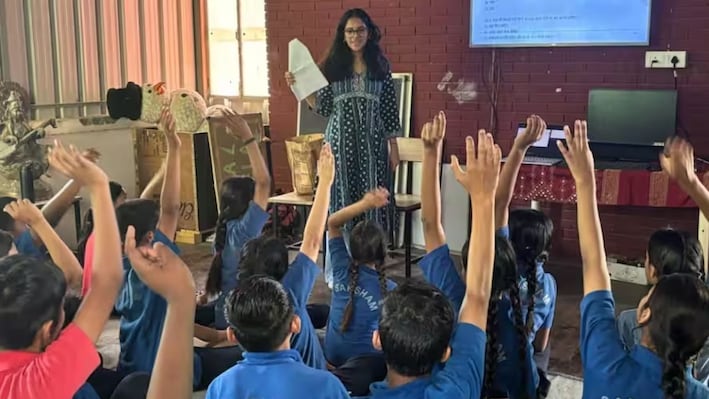
Over the past 22 months, Project Prana has evolved into a structured school-health initiative. Diya has conducted several interactive respiratory-health workshops, including sessions in local languages, designed educational resources for children, and worked towards making lung science accessible to students who may never otherwise encounter it. Instead of relying only on traditional lectures, Project Prana uses innovative hands-on activities, demonstrations, quizzes, games, posters and simple experiments to engage and excite the students.
A child may learn about lung expansion by building a simple balloon model. Another may learn about air pollution through a classroom activity. She also developed a free digital School Resource Kits, containing teacher resources, student activities and educational material that schools can use independently, including multilingual story books, school guides, workbooks, posters etc, that can be accessed by all. During her sessions, she realised that each student in class can be a lung health ambassador in his or her community, thereby maximising the scale and reach. She then developed an APP on Android phones that would enable students teaching neighbours and friends about lung health, ensuring they can check their own lung health at home and get access to high-quality medical care. She is currently working on a sensor-based Device that can make the lung monitoring effective for large communities. The goal is simple: make respiratory-health education easy to understand, easy to teach and free to access. Thereby empowering children to take control of their own lung health.
Beyond awareness
For Diya, Project Prana is not simply an awareness campaign. She has also onboarded senior pulmonologists as mentors and experts with whom she worked closely with. She organized numerous free Pulmonary Function Test (PFT) camps, helping students understand that persistent respiratory symptoms should not simply be ignored. Affected cases were connected to doctors for free consultation.
The project aims to build a bridge between awareness, early recognition and access to appropriate medical care. Diya translates complex medical concepts to easy to understand, child friendly modules. Children love these sessions and engage and participate with full enthusiasm. "Awareness is the first step," Diya believes. "But awareness becomes meaningful only when it changes what we do."
That philosophy has shaped the way Project Prana is being built. The initiative brings together students, teachers, doctors, NGOs, healthcare organizations and other stakeholders, with the aim of creating a model that can be replicated across schools across the country. Today, the project is gaining tremendous traction, with large medical institutions and government backed organizations adopting Project Prana as part of their programs.
Making children part of the solution
One of the most distinctive aspects of Project Prana is its focus on children not merely as beneficiaries, but as participants and changemakers. A student who learns why air pollution matters can take that conversation home. A child who understands the importance of recognizing respiratory symptoms can encourage a sibling or parent to seek appropriate medical attention.
A classroom that learns about clean air can begin asking what can be changed within its own school environment. The impact therefore has the potential to extend beyond the classroom.
Today, Project Prana has impacted over 5000 children. Diya's ambition is to take this model much further reaching over 50,000 students through partnerships with schools, NGOs, foundations and healthcare institutions. She is also exploring digital resources that could allow Project Prana's educational content to reach children beyond the schools where she can personally conduct workshops.
A student's response to a much larger problem
Air pollution is a problem that can sometimes feel too large for an individual to solve. Diya isn't claiming that a school project can solve India's air-quality crisis. Here, Project Prana asks a different question: What can one student do about the part of the problem within her reach? The answer, for Diya, has been empowerment through education. She has taken something deeply personal, the experience of struggling to breathe, and transformed it into a scientific and social initiative. Her journey also reflects an important idea about young people and public health: they do not always have to wait until they become doctors, scientists or policymakers to contribute. Sometimes, they can begin by asking a question. Sometimes, they can begin by sharing what they learn. And at times, they can begin with something as fundamental as understanding breath.
For Diya, that breath has become a mission.
Through Project Prana, she hopes to create a generation of children who don't just know that clean air matters but understand why it matters and what they can do to protect their lungs and become the breath champion in their communities. To ensure the newspaper headlines scream how well our children are doing, and how hospital wards run empty in December!
(This article is meant for informational purposes only and must not be considered a substitute for advice provided by qualified medical professionals. Always seek the advice of a doctor for any lungs-related problems.)
Stay informed on all the latest news, real-time breaking news updates, and follow all the important headlines in india news and world news on Zee News English.