Rahini Bansal first discovered karewa while researching the lives of women in rural North India. This is usually interpreted as levirate marriage, in which a widow is often expected to wed a male relative of her deceased husband. At first it looked like a cultural tradition, but then the harder truth emerged. Even in many cases, the decision was less a matter of free will for women than of economic dependence, social pressure, and the threat of losing access to land, shelter, or family support.
As Rahini started to talk to women’s rights advocates and to research the stories behind the rationale for the practice, she became increasingly intrigued by the connection between financial dependence and personal autonomy. The same pattern appeared in other situations. Widows, victims of domestic violence, and women leaving abusive marriages were often expected to start over with no independent income or reliable institutional support.
Her interest in these questions also extended beyond karewa. In an independent applied economics study on barriers faced by women in STEM, Rahini surveyed 300 professionals and examined how workplace inequality, domestic responsibilities, and financial constraints affect women’s professional advancement. The research identified unpaid domestic labour as a significant obstacle to women attempting to scale careers and ventures. For Rahini, these findings reinforced a central question emerging from her work: what practical conditions allow a woman to make decisions without being economically dependent on another person?
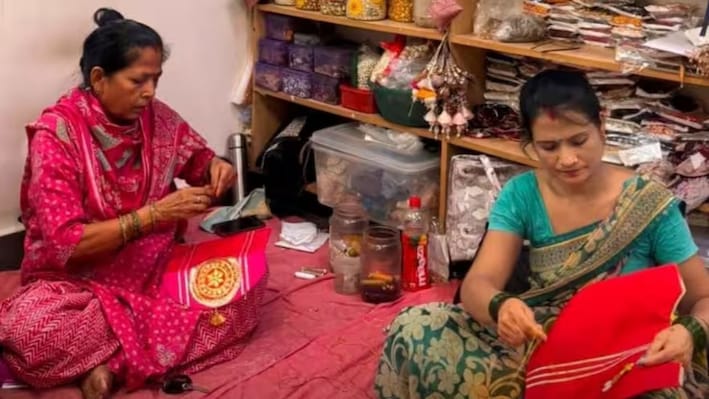
That question led to the creation of Sutradhar, a zero waste textile social enterprise that works with women who have survived domestic abuse or remain financially dependent on others. Through Sutradhar, women receive textile based training and paid opportunities to manufacture products using discarded and surplus fabric. The objective is straightforward: convert existing skills and accessible materials into a dependable source of income.
The enterprise has since expanded its work across three states. Its broader programmes and supply networks have reached more than 1,800 women, while more than 200 women have received direct skill development support. Sutradhar has sold hundreds of textile products and developed survivor led supply chains that allow women to participate not simply as beneficiaries, but as paid contributors to the production process. The enterprise has generated approximately ₹15 lakh in revenue, with about ₹1.5 lakh directed as earnings to women producing its goods. Its work has also helped support the education of more than 120 children.
The environmental component of the model is deliberate, but it is not separate from its economic purpose. By using surplus and discarded fabric, Sutradhar reduces material waste while keeping production costs accessible for small scale manufacturing. The model also connects women with micro vendors, creating a supply chain in which economic participation can continue beyond a single training programme.
Rahini’s understanding of financial independence has also been informed by her work in public policy. During an internship with the Income Tax Department under the Ministry of Finance, she researched wealth frameworks and financial literacy. Her policy work contributed to a draft that was subsequently adopted for regional financial literacy initiatives. The experience gave her another perspective on the problem she had encountered through karewa and Sutradhar: earning an income is important, but the ability to understand, manage, and retain control over that income is equally significant.
Her work as a curriculum lead with Sewa Bharti added a further dimension. There, she designed contextual learning programmes for more than 100 students from underserved communities. The experience strengthened her focus on education as part of long term economic mobility, an idea that now appears in Sutradhar’s support for the schooling of children from participating families.
Rahini has also documented questions of gender, work, and urban livelihoods through her writing. Across two published books, including An Ode To… and Heartbeats of Delhi Streets, she conducted interviews with more than 100 street vendors and survivors while examining feminist and socioeconomic experiences through oral histories. The books have sold more than 310 copies. These conversations gave her access to individual accounts of how income, family structures, informal work, and social expectations shape everyday choices.
Her ongoing research on karewa now examines how cultural narratives can normalize the economic coercion of widows. Combining literary analysis, policy research, and conversations with women’s rights advocates, the project studies how customs presented as forms of protection can also restrict a woman’s autonomy when financial alternatives are absent.
Karewa and Sutradhar may appear to belong to different fields, one academic and the other entrepreneurial. In Rahini’s work the connection between the two defines the direction of her work: understanding why economic dependence limits women’s ability to shape their own lives and building mechanisms that increase the range of choices available to them.
Stay informed on all the latest news, real-time breaking news updates, and follow all the important headlines in india news and world news on Zee News English.